







Question: 2 Neighbors and Degrees Problem 4. Consider a undirected graph G =(V. E) with the following properties: V = 5 and V = {a,b,c,d,e). Vertices
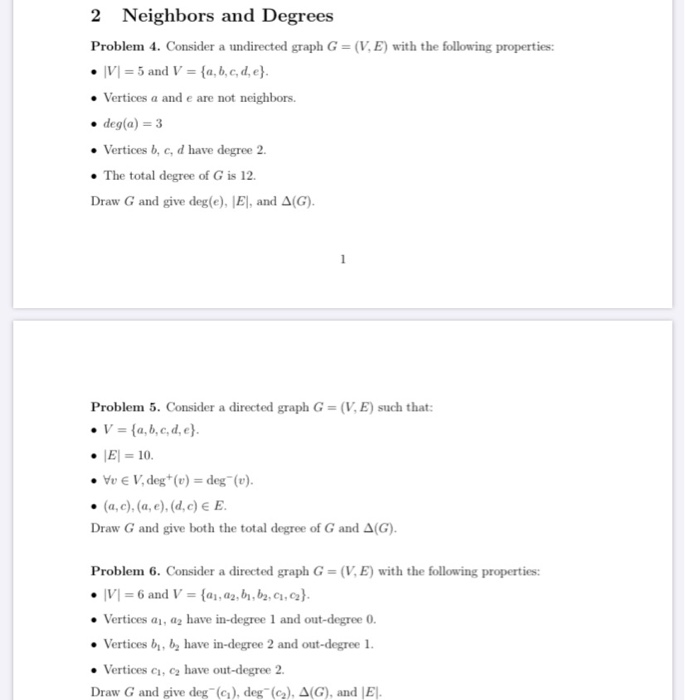
2 Neighbors and Degrees Problem 4. Consider a undirected graph G =(V. E) with the following properties: V = 5 and V = {a,b,c,d,e). Vertices a and e are not neighbors. deg(a) = 3 Vertices b, c, d have degree 2. The total degree of G is 12. Draw G and give deg(e), E, and A(G). Problem 5. Consider a directed graph G = (V. E) such that: . V = {a,b,c,d,e}. . El = 10. Vu e V, degt (v) = deg (u). (a,c),(a,e), (d.c) E E. Draw G and give both the total degree of G and AG). Problem 6. Consider a directed graph G = (V. E) with the following properties: VI = 6 and V = {0,22, b1,b2, 1, 2}. Vertices a, a, have in-degree 1 and out-degree 0. Vertices b, b, have in-degree 2 and out-degree 1. Vertices ci, o, have out-degree 2. Draw G and give deg (c), deg" (c), A(G), and El
Step by Step Solution
There are 3 Steps involved in it

Get step-by-step solutions from verified subject matter experts
 Study Help