







Question: 2. Pooled Testing. Blood testing is a critical method to screen for the presence of disease in a community. The natural way to administer the
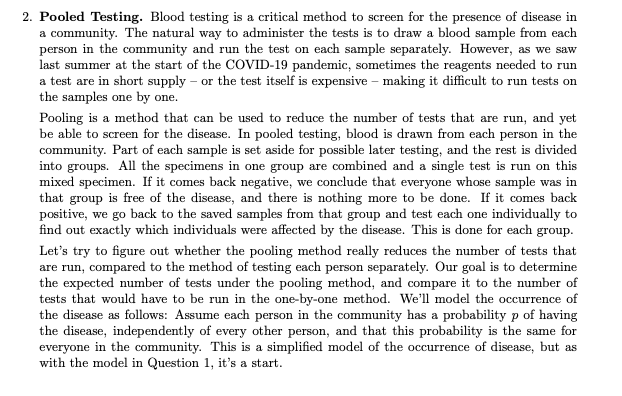
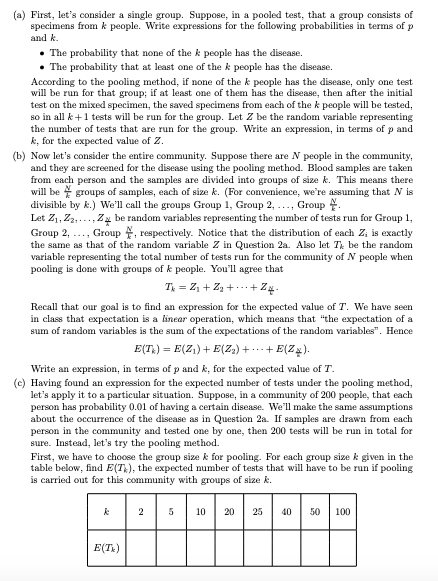
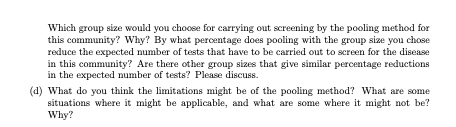
2. Pooled Testing. Blood testing is a critical method to screen for the presence of disease in a community. The natural way to administer the tests is to draw a blood sample from each person in the community and run the test on each sample separately. However, as we saw last summer at the start of the CUVID-IQ pandemic, sometimes the reagents needed to run a test are in short supply or the test itself is expensive making it difcult to run tests on the samples one by one. Pooling is a method that can be used to reduce the number of tests that are run1 and yet be able to screen for the disease. In pooled testing, blood is drawn from each person in the community. Part ofeach sample is set aside for possible later testing, and the rest is divided into groups. All the specimens in one group are combined and a single test is run on this mixed specimen. If it comes back negative, we conclude that everyone whcse sample was in that group is Free of the disease, and there is nothing more to be done. If it com- back positive, we go back to the saved samples from that group and test each one individually to nd out exactly which individuals 1were afFected by the disease. This is done for each group. Let's try to gure out whether the pooling method really reduces the number of tests that are run1 compared tc the method of testing each person separately. ur goal is to determine the expected number of tests under the pooling method, and compare it to the number of tests that would have to be run in the one-biy-one method. We'll model the occurrence of the disease as follows: Assume each person in the community has a probability p of having the disease, independently of every other person, and that this probability is the same for everyone in the community. This is a simplied model of the occurrence of disease, but as with the model in Question 11 it's a start. (a) First, let's consider a single group. Suppose, in a pooled test, that a group consists of specimens from * people. Write expressions for the following probabilities in terms of p and k. . The probability that none of the & people has the disease. . The probability that at least one of the & people has the disease. According to the pooling method, if none of the & people has the disease, only one test will be run for that group; if at least one of them has the disease, then after the initial test on the mixed specimen, the saved specimens from each of the * people will be tested, so in all * + 1 tests will be run for the group. Let Z be the random variable representing the number of tests that are run for the group. Write an expression, in terms of p and k, for the expected value of Z. (b) Now let's consider the entire community. Suppose there are N people in the community, and they are screened for the disease using the pooling method. Blood samples are taken from each person and the samples are divided into groups of size k. This means there will be # groups of samples, each of size k. (For convenience, we're assuming that N is divisible by k.) We'll call the groups Group 1, Group 2, ..., Group . Let 71, Zz,.... Za be random variables representing the number of tests run for Group 1, Group 2, ..., Group +, respectively. Notice that the distribution of each Z, is exactly the same as that of the random variable Z in Question 2a. Also let Th be the random variable representing the total number of tests run for the community of N people when pooling is done with groups of & people. You'll agree that Th = 21+ 2+ ... +24 Recall that our goal is to find an expression for the expected value of T. We have seen in class that expectation is a linear operation, which means that "the expectation of a sum of random variables is the sum of the expectations of the random variables". Hence E(7) = E(21) + E(Z.) + ..-+ E(Z). Write an expression, in terms of p and &, for the expected value of T. (c) Having found an expression for the expected number of tests under the pooling method, let's apply it to a particular situation. Suppose, in a community of 200 people, that each person has probability 0.01 of having a certain disease. We'll make the same assumptions about the occurrence of the disease as in Question 2a. If samples are drawn from each person in the community and tested one by one, then 200 tests will be run in total for sure. Instead, let's try the pooling method. First, we have to choose the group size & for pooling. For each group size & given in the table below, find E(7 ), the expected number of tests that will have to be run if pooling is carried out for this community with groups of size &. 2 5 10 20 25 40 50 100 E(TK )Which group size would you choose for carrying out screening by the pooling method for this community? Why? By what percentage does pooling with the group size you chose reduce the expected number of tests that have to be carried out to screen for the disease in this community? Are there other group sizes that give similar percentage reductions in the expected number of tests? Please discuss. (d) What do you think the limitations might be of the pooling method? What are some situations where it might be applicable, and what are some where it might not be? Why
Step by Step Solution
There are 3 Steps involved in it

Get step-by-step solutions from verified subject matter experts
 Study Help