







Question: 2. What would the doubling time be if the initial investment were $1,000 $10,000? What effect does changing the principal have on the doubling time,
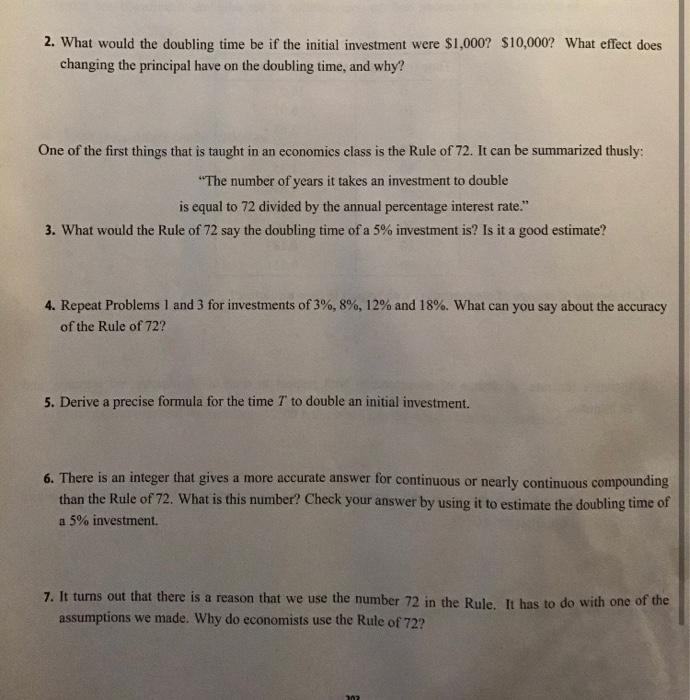
2. What would the doubling time be if the initial investment were $1,000 $10,000? What effect does changing the principal have on the doubling time, and why? One of the first things that is taught in an economies class is the Rule of 72. It can be summarized thusly: "The number of years it takes an investment to double is equal to 72 divided by the annual percentage interest rate." 3. What would the Rule of 72 say the doubling time of a 5% investment is? Is it a good estimate? 4. Repeat Problems 1 and 3 for investments of 3%, 8%, 12% and 18%. What can you say about the accuracy of the Rule of 72? 5. Derive a precise formula for the time I to double an initial investment. 6. There is an integer that gives a more accurate answer for continuous or nearly continuous compounding than the Rule of 72. What is this number? Check your answer by using it to estimate the doubling time of a 5% investment 7. It turns out that there is a reason that we use the number 72 in the Rule. It has to do with one of the assumptions we made. Why do economists use the Rule of 72? 27 2. What would the doubling time be if the initial investment were $1,000 $10,000? What effect does changing the principal have on the doubling time, and why? One of the first things that is taught in an economies class is the Rule of 72. It can be summarized thusly: "The number of years it takes an investment to double is equal to 72 divided by the annual percentage interest rate." 3. What would the Rule of 72 say the doubling time of a 5% investment is? Is it a good estimate? 4. Repeat Problems 1 and 3 for investments of 3%, 8%, 12% and 18%. What can you say about the accuracy of the Rule of 72? 5. Derive a precise formula for the time I to double an initial investment. 6. There is an integer that gives a more accurate answer for continuous or nearly continuous compounding than the Rule of 72. What is this number? Check your answer by using it to estimate the doubling time of a 5% investment 7. It turns out that there is a reason that we use the number 72 in the Rule. It has to do with one of the assumptions we made. Why do economists use the Rule of 72? 27
Step by Step Solution
There are 3 Steps involved in it

Get step-by-step solutions from verified subject matter experts
 Study Help