







Question: 2. Write a SELECT statement that returns two columns: VendorName and PaymentSum, where PaymentSum is the sum of the PaymentTotal column. Group the result set
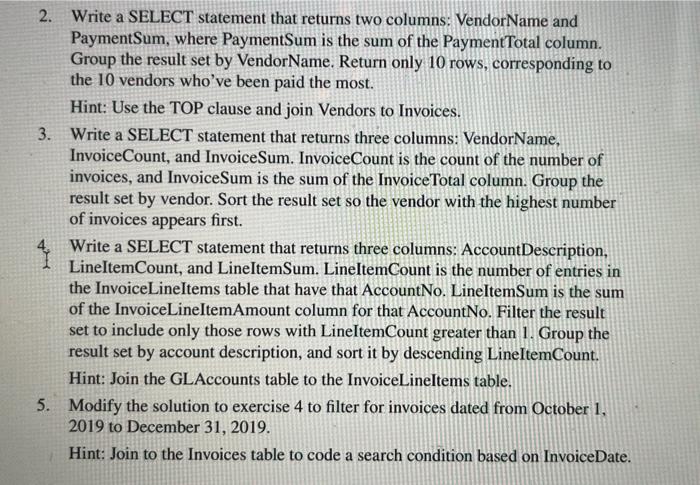
2. Write a SELECT statement that returns two columns: VendorName and PaymentSum, where PaymentSum is the sum of the PaymentTotal column. Group the result set by VendorName. Return only 10 rows, corresponding to the 10 vendors who've been paid the most. Hint: Use the TOP clause and join Vendors to Invoices. 3. Write a SELECT statement that returns three columns: VendorName, InvoiceCount, and InvoiceSum. InvoiceCount is the count of the number of invoices, and InvoiceSum is the sum of the InvoiceTotal column. Group the result set by vendor. Sort the result set so the vendor with the highest number of invoices appears first. 4. Write a SELECT statement that returns three columns: AccountDescription, LineItemCount, and LineItemSum. LineltemCount is the number of entries in the InvoiceLineItems table that have that AccountNo. LineItemSum is the sum of the InvoiceLineItemAmount column for that AccountNo. Filter the result set to include only those rows with LineItemCount greater than 1. Group the result set by account description, and sort it by descending LineItemCount. Hint: Join the GLAccounts table to the InvoiceLineltems table. 5. Modify the solution to exercise 4 to filter for invoices dated from October 1 , 2019 to December 31, 2019. Hint: Join to the Invoices table to code a search condition based on InvoiceDate
Step by Step Solution
There are 3 Steps involved in it

Get step-by-step solutions from verified subject matter experts
 Study Help