







Question: (20 points) In problem 1, imagine that wage is equal to 10. The firms cost function, c(q), is obtained as follows. If q = f
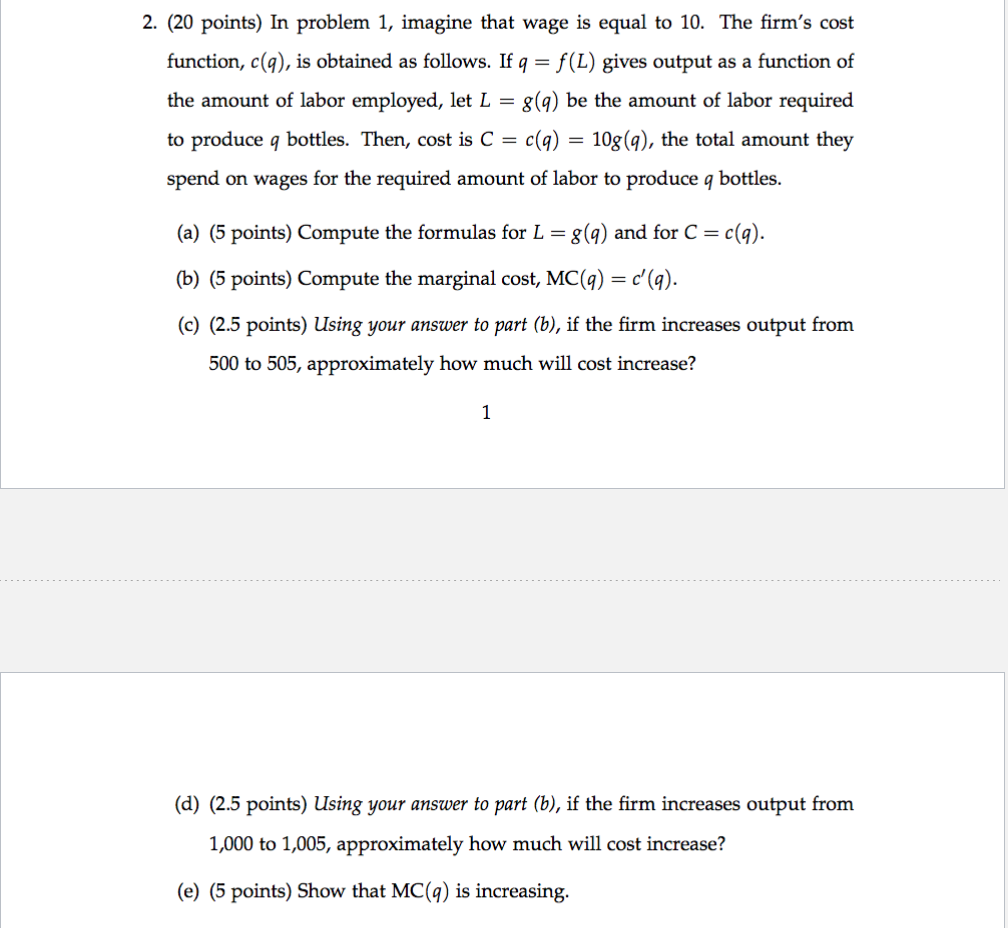
(20 points) In problem 1, imagine that wage is equal to 10. The firms cost function, c(q), is obtained as follows. If q = f (L) gives output as a function of the amount of labor employed, let L = g(q) be the amount of labor required to produce q bottles. Then, cost is C = c(q) = 10g(q), the total amount they spend on wages for the required amount of labor to produce q bottles. (a) (5 points) Compute the formulas for L = g(q) and for C = c(q). (b) (5 points) Compute the marginal cost, MC(q) = c(q). (c) (2.5 points) Using your answer to part (b), if the firm increases output from 500 to 505, approximately how much will cost increase?
(d) (2.5 points) Using your answer to part (b), if the firm increases output from 1,000 to 1,005, approximately how much will cost increase? (e) (5 points) Show that MC(q) is increasing.
2. (20 points) In problem 1, imagine that wage is equal to 10. The firm's cost function, c(9), is obtained as follows. If q = f(L) gives output as a function of the amount of labor employed, let L = 8(9) be the amount of labor required to produce q bottles. Then, cost is C = c(q) = 10g(9), the total amount they spend on wages for the required amount of labor to produce q bottles. = (a) (5 points) Compute the formulas for L = g(9) and for C = c(q). (b) (5 points) Compute the marginal cost, MC(9) c'(9). (c) (2.5 points) Using your answer to part (b), if the firm increases output from 500 to 505, approximately how much will cost increase? 1 (d) (2.5 points) Using your answer to part (b), if the firm increases output from 1,000 to 1,005, approximately how much will cost increase? (e) (5 points) Show that MC(9) is increasing. 2. (20 points) In problem 1, imagine that wage is equal to 10. The firm's cost function, c(9), is obtained as follows. If q = f(L) gives output as a function of the amount of labor employed, let L = 8(9) be the amount of labor required to produce q bottles. Then, cost is C = c(q) = 10g(9), the total amount they spend on wages for the required amount of labor to produce q bottles. = (a) (5 points) Compute the formulas for L = g(9) and for C = c(q). (b) (5 points) Compute the marginal cost, MC(9) c'(9). (c) (2.5 points) Using your answer to part (b), if the firm increases output from 500 to 505, approximately how much will cost increase? 1 (d) (2.5 points) Using your answer to part (b), if the firm increases output from 1,000 to 1,005, approximately how much will cost increase? (e) (5 points) Show that MC(9) is increasing
Step by Step Solution
There are 3 Steps involved in it

Get step-by-step solutions from verified subject matter experts
 Study Help