



Question: Consider now a similar setting as the one from the previous exercise, nut suppose now that there are N1 consumers of type 91 and N2
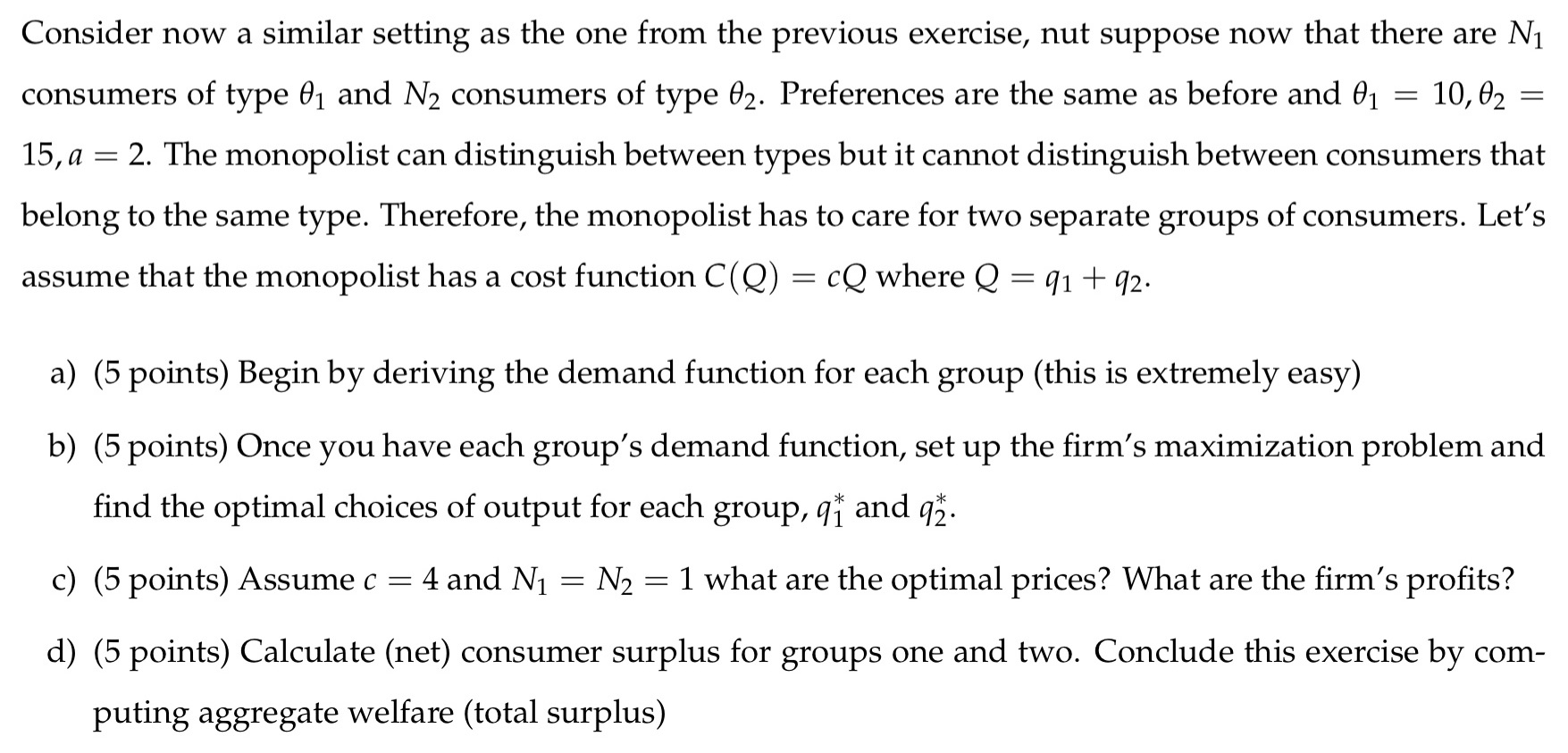
Consider now a similar setting as the one from the previous exercise, nut suppose now that there are N1 consumers of type 91 and N2 consumers of type 92. Preferences are the same as before and 91 = 10, 92 = 15, a = 2. The monopolist can distinguish between types but it cannot distinguish between consumers that belong to the same type. Therefore, the monopolist has to care for two separate groups of consumers. Let's assume that the monopolist has a cost function C (Q) : cQ where Q : 11 + qz. a) (5 points) Begin by deriving the demand function for each group (this is extremely easy) b) (5 points) Once you have each group's demand function, set up the firm's maximization problem and find the optimal choices of output for each group, of; and a]; c) (5 points) Assume C = 4 and N1 = N2 = 1 what are the optimal prices? What are the firm's profits? (1) (5 points) Calculate (net) consumer surplus for groups one and two. Conclude this exercise by com- puting aggregate welfare (total surplus)
Step by Step Solution
There are 3 Steps involved in it

Get step-by-step solutions from verified subject matter experts