







Question: ECON 207 Name: Spring 2024 Section: Lab 9: Derivatives, Implicit Differentiation & Elasticity 1. Compute the first derivatives below. For each equation, write down which
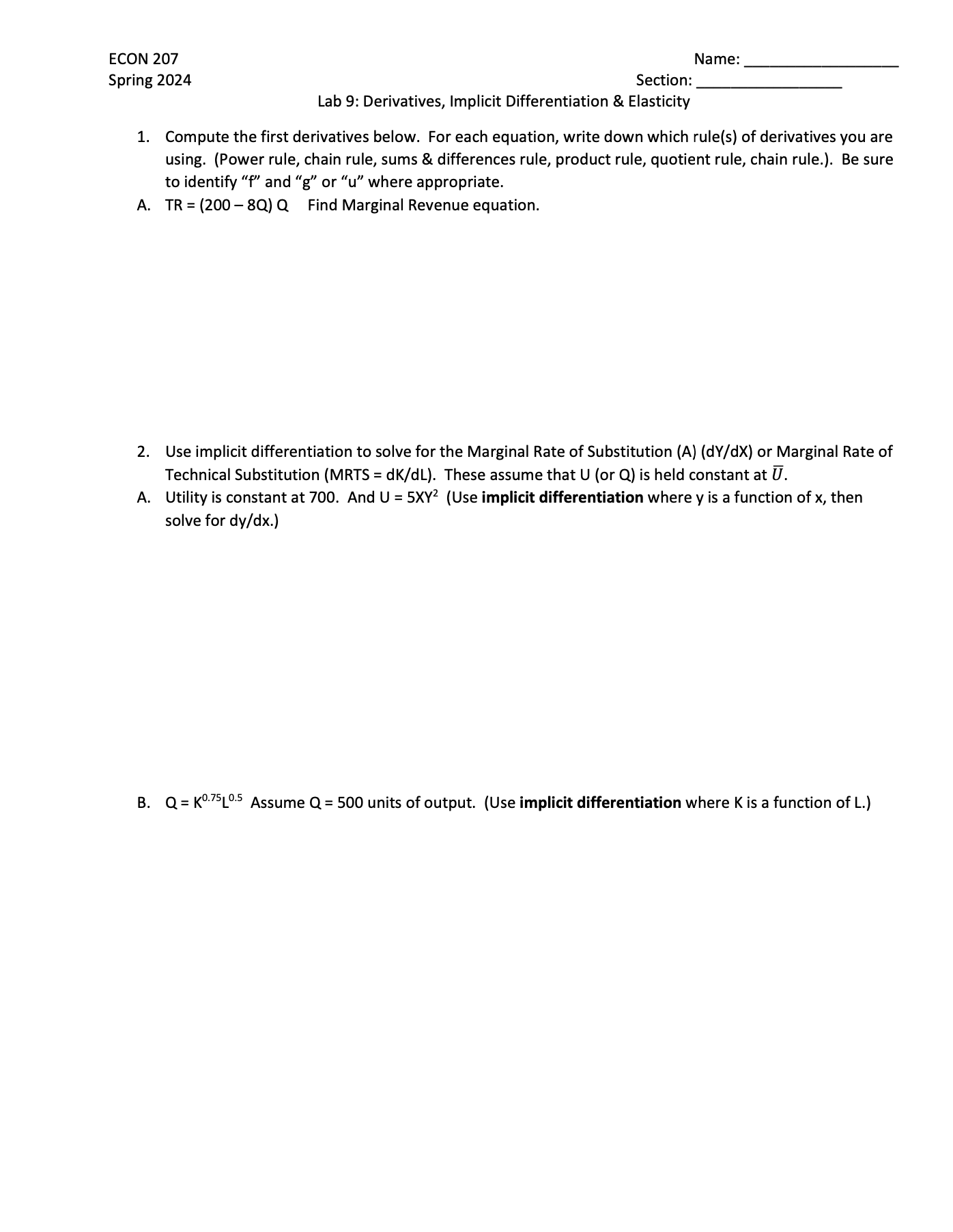
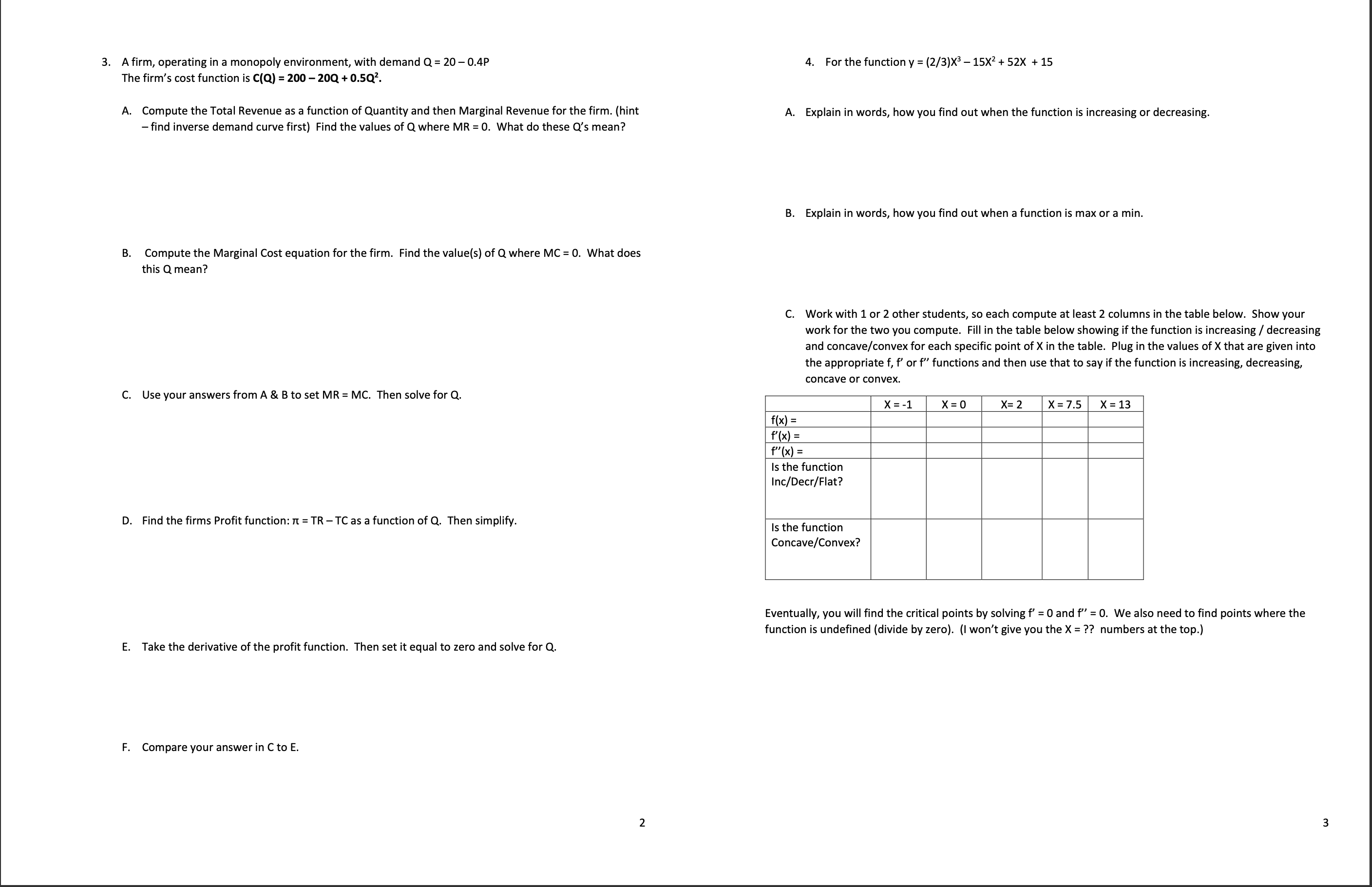
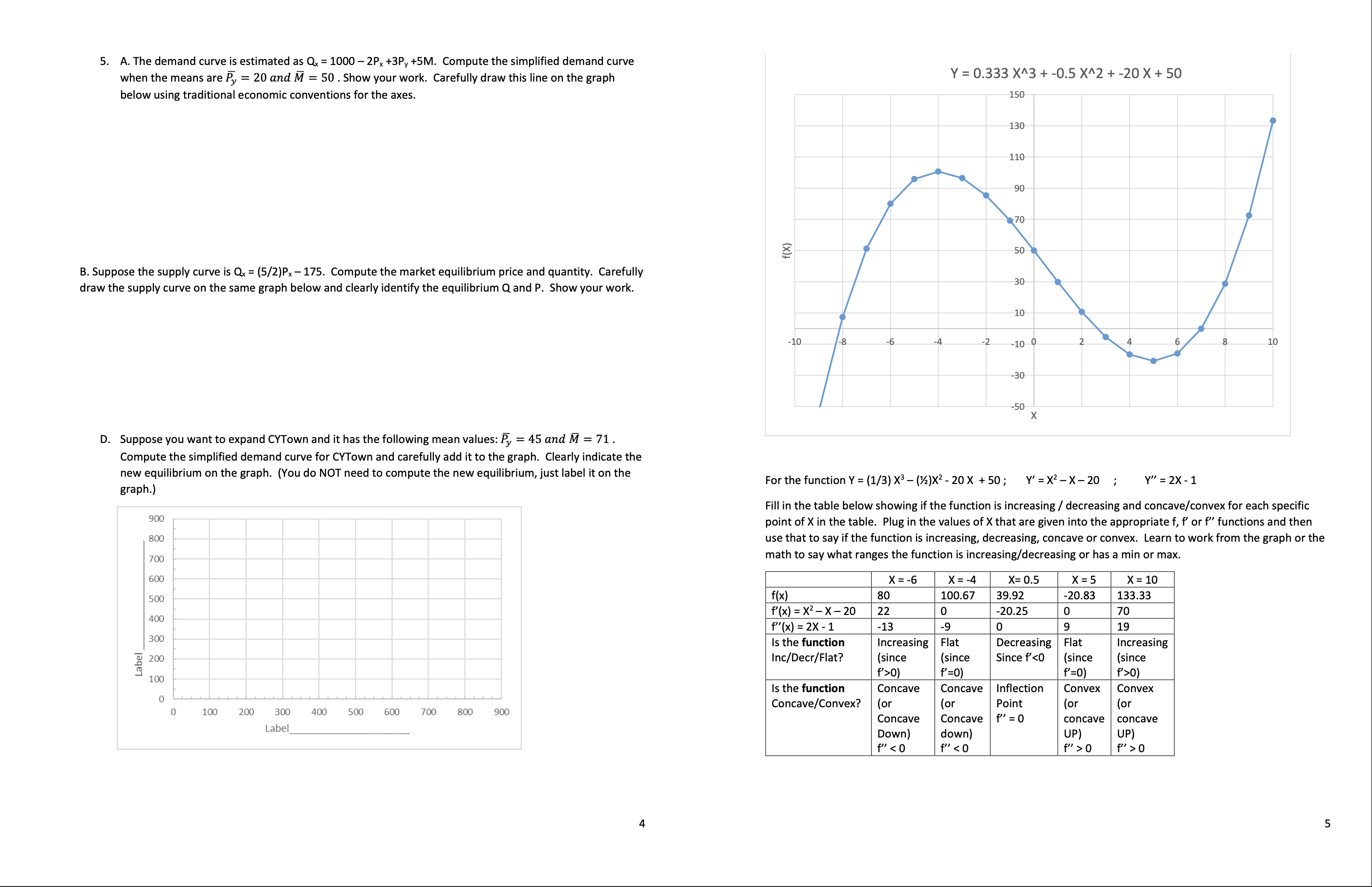
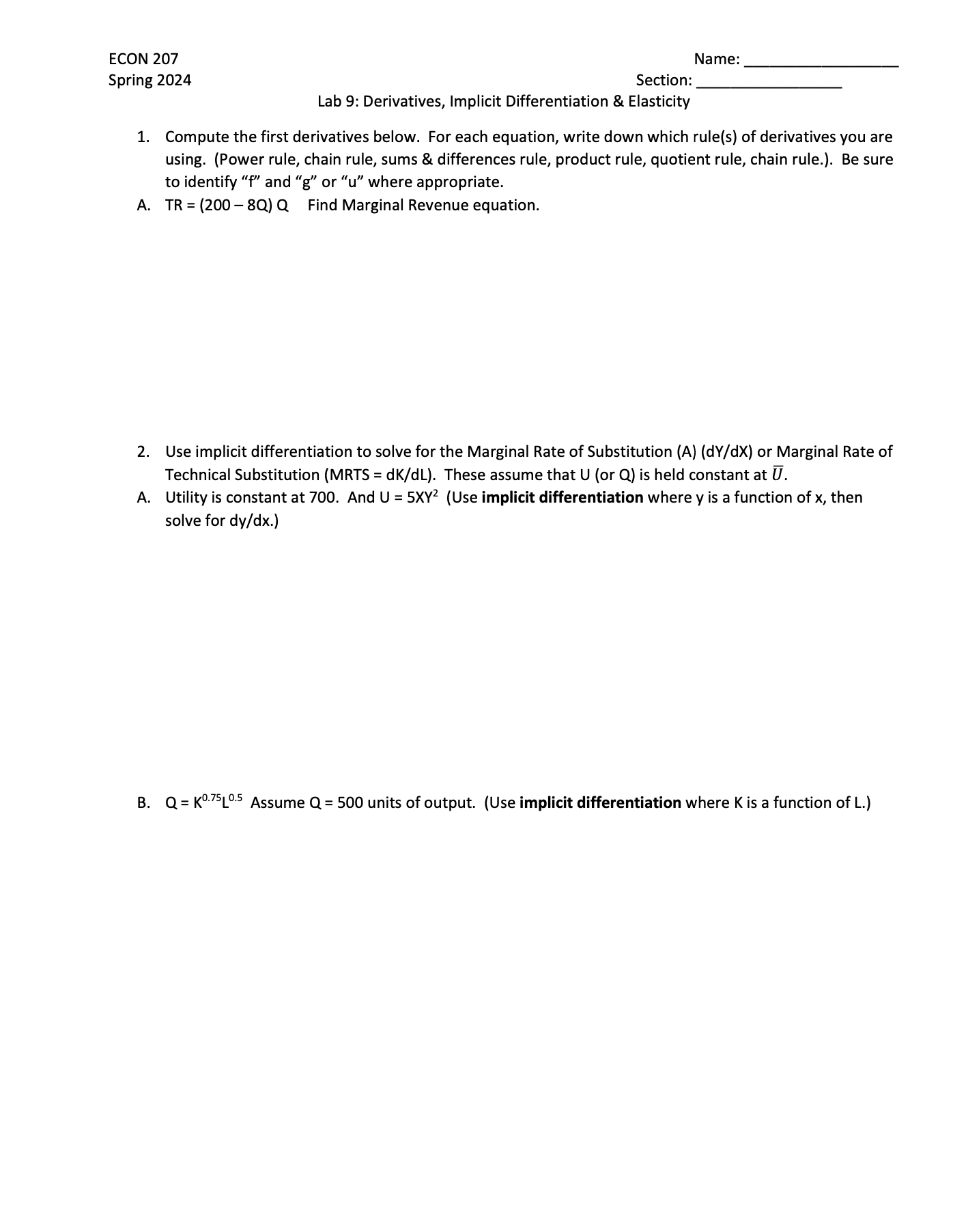
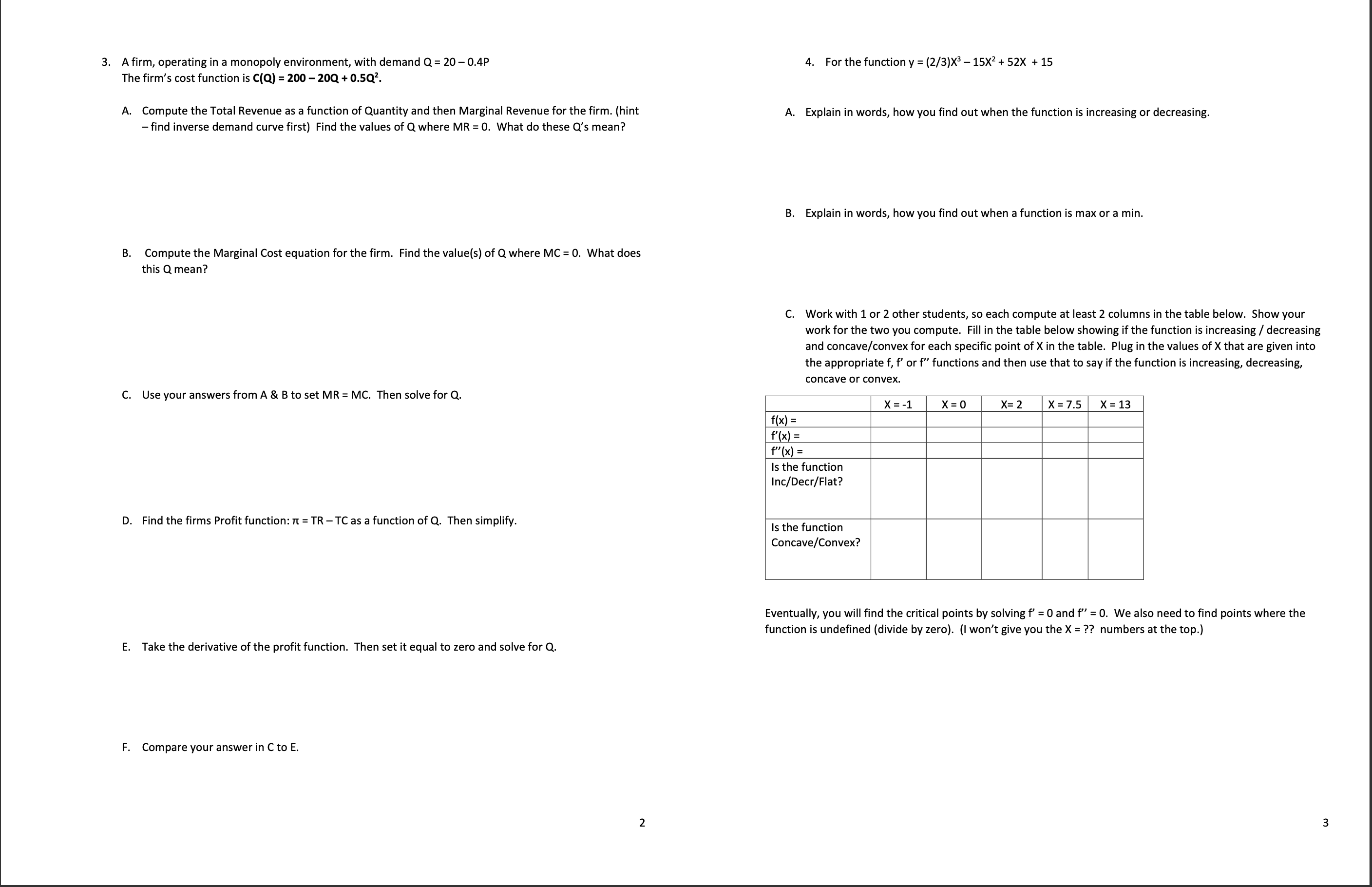
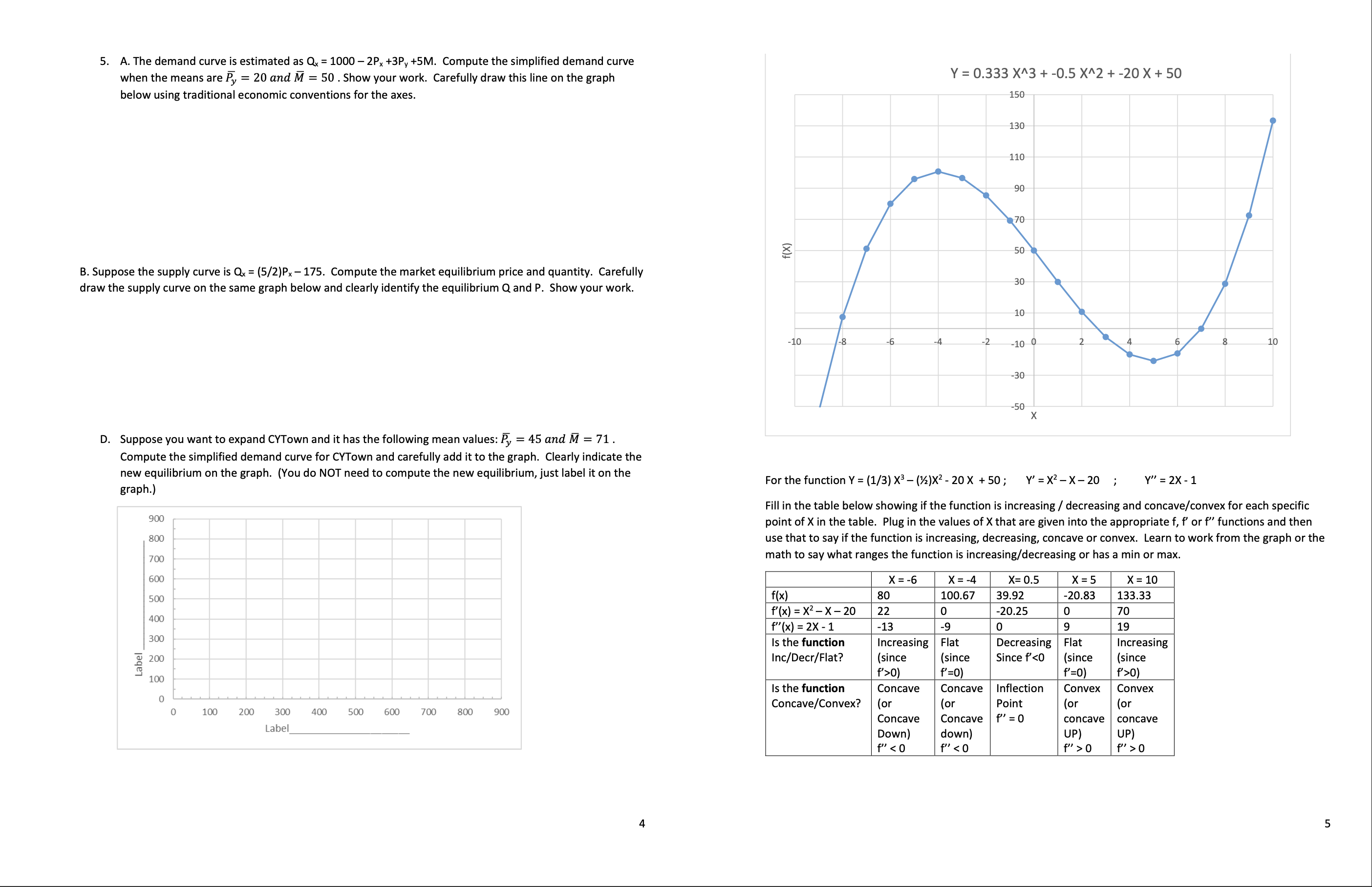
ECON 207 Name: Spring 2024 Section: Lab 9: Derivatives, Implicit Differentiation & Elasticity 1. Compute the first derivatives below. For each equation, write down which rule(s) of derivatives you are using. (Power rule, chain rule, sums & differences rule, product rule, quotient rule, chain rule.). Be sure to identify \"f\" and \"g\" or \"u\" where appropriate. A. TR=(200-8Q)Q Find Marginal Revenue equation. 2. Use implicit differentiation to solve for the Marginal Rate of Substitution (A) (dY/dX) or Marginal Rate of Technical Substitution (MRTS = dK/dL). These assume that U (or Q) is held constant at U. A. Utility is constant at 700. And U = 5XY? (Use implicit differentiation where y is a function of x, then solve for dy/dx.) B. Q=K%"L% Assume Q=500 units of output. (Use implicit differentiation where K is a function of L.) 3. Afirm, operating in a monopoly environment, with demand Q = 20 - 0.4P 4. Forthe functiony = (2/3)X - 15X? + 52X +15 The firm''s cost function is (Q) = 200 - 20Q + 0.5Q2. A. Compute the Total Revenue as a function of Quantity and then Marginal Revenue for the firm. (hint A. Explain in words, how you find out when the function is increasing or decreasing. find inverse demand curve first) Find the values of Q where MR = 0. What do these Q's mean? B. Explain in words, how you find out when a function is max or a min. B. Compute the Marginal Cost equation for the firm. Find the value(s) of Q where MC = 0. What does this Q mean? C. Work with 1 or 2 other students, so each compute at least 2 columns in the table below. Show your work for the two you compute. Fill in the table below showing if the function is increasing / decreasing and concave/convex for each specific point of X in the table. Plug in the values of X that are given into the appropriate f, ' or f functions and then use that to say if the function is increasing, decreasing, concave or convex. C. Use your answers from A & B to set MR = MC. Then solve for Q. X=-1 X=0 X=2 X=75| X=13 flx) = flx)= (x) = Is the function Inc/Decr/Flat? D. Find the firms Profit function: it = TR TC as a function of Q. Then simplify. Is the function Concave/Convex? Eventually, you will find the critical points by solving f' = 0 and f\" = 0. We also need to find points where the function is undefined (divide by zero). (I won't give you the X = ?? numbers at the top.) E. Take the derivative of the profit function. Then set it equal to zero and solve for Q. F. Compare your answer in C to E. 5. A.The demand curve is estimated as Q. = 1000 2P, +3P, +5M. Compute the simplified demand curve when the means are Fy =20 and M = 50 . Show your work. Carefully draw this line on the graph below using traditional economic conventions for the axes. B. Suppose the supply curve is Q.= (5/2)Px175. Compute the market equilibrium price and quantity. Carefully draw the supply curve on the same graph below and clearly identify the equilibrium Q and P. Show your work. D. Suppose you want to expand CYTown and it has the following mean values: Fy =45and M =71. Compute the simplified demand curve for CYTown and carefully add it to the graph. Clearly indicate the new equilibrium on the graph. (You do NOT need to compute the new equilibrium, just label it on the graph.) 900 800 700 600 500 400 300 200 Label 100 Label Y =0.333 XA3 +-0.5X*2+-20 X + 50 150 130 110 f(X) -10 For the function Y = (1/3) X3 = (%)X2-20X +50; Y =X2-X-20 ; Y =2X-1 Fill in the table below showing if the function is increasing / decreasing and concave/convex for each specific point of X in the table. Plug in the values of X that are given into the appropriate f, f or f\" functions and then use that to say if the function is increasing, decreasing, concave or convex. Learn to work from the graph or the math to say what ranges the function is increasing/decreasing or has a min or max. X=-6 X=-4 X=0.5 X=5 X=10 f(x) 80 100.67 | 39.92 -20.83 133.33 f(x)=X2-X-20 |22 0 -20.25 0 70 f(x)=2X-1 -13 -9 0 9 19 Is the function Increasing | Flat Decreasing | Flat Increasing Inc/Decr/Flat? (since (since Since f0) Is the function Concave | Concave | Inflection | Convex | Convex Concave/Convex? | (or (or Point (or (or Concave | Concave | f"=0 concave | concave Down) down) UP) UP) 0 >0
Step by Step Solution
There are 3 Steps involved in it

Get step-by-step solutions from verified subject matter experts
 Study Help