







Question: 21. In a water solution, how do acids differ from bases? a. Acids form salts, bust bases do not. b. Acids turn litmus blue,
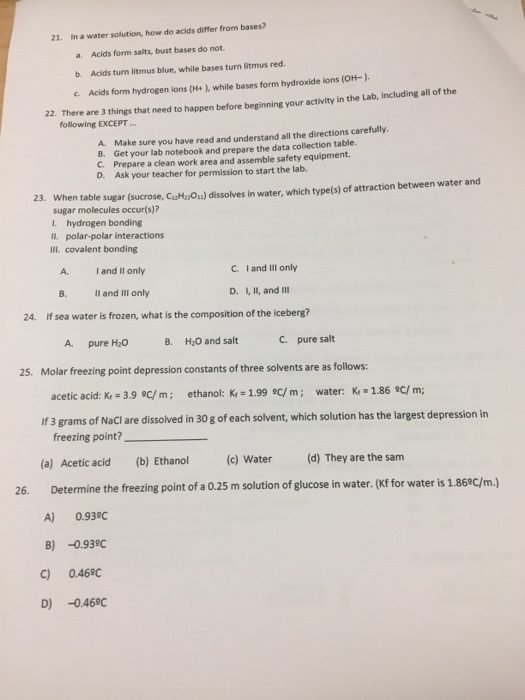
21. In a water solution, how do acids differ from bases? a. Acids form salts, bust bases do not. b. Acids turn litmus blue, while bases turn litmus red. C. Acids form hydrogen lons (H+ ), while bases form hydroxide ions (OH-). 22. There are 3 things that need to happen before beginning your activity in the Lab, including all of the following EXCEPT. A. Make sure you have read and understand all the directions carefully. 8. Get your lab notebook and prepare the data collection table. C. Prepare a clean work area and assemble safety equipment. D. Ask your teacher for permission to start the lab. 23. When table sugar (sucrose, CaHyOu) dissolves in water, which type(s) of attraction between water and sugar molecules occur(s)? 1. hydrogen bonding II. polar-polar interactions II. covalent bonding A. I and Il only C. I and III only Il and III only . D. L II, and IIl 24. If sea water is frozen, what is the composition of the iceberg? A. pure H;0 B. H;0 and salt C. pure salt 25. Molar freezing point depression constants of three solvents are as follows: acetic acid: Ke = 3.9 C/ m; ethanol: K= 1.99 C/ m; water: K= 1.86 C/ m; If 3 grams of NaCl are dissolved in 30 g of each solvent, which solution has the largest depression in freezing point? (a) Acetic acid (b) Ethanol (c) Water (d) They are the sam 26. Determine the freezing point of a 0.25 m solution of glucose in water. (Kf for water is 1.86C/m.) A) 0.93C B) -0.93C C) 0.46C D) -0.46C
Step by Step Solution
3.49 Rating (149 Votes )
There are 3 Steps involved in it
ACCOYding to Arrhenus Stheorey Aid produce HT ion in aqueaus solubi t... View full answer

Get step-by-step solutions from verified subject matter experts
 Study Help