







Question: 21. N For small, slowly falling objects, the assumption made in the text that the drag force is proportional to the velocity is a good
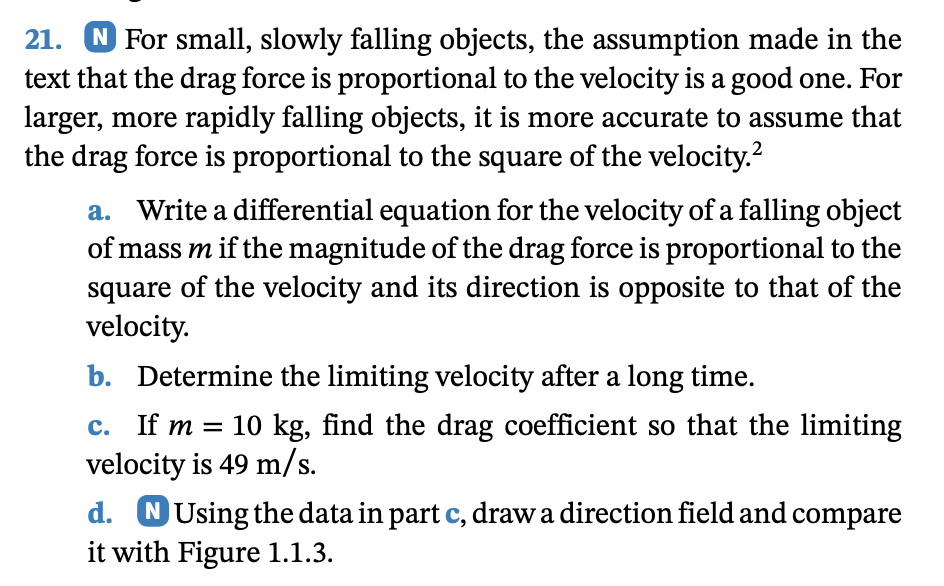
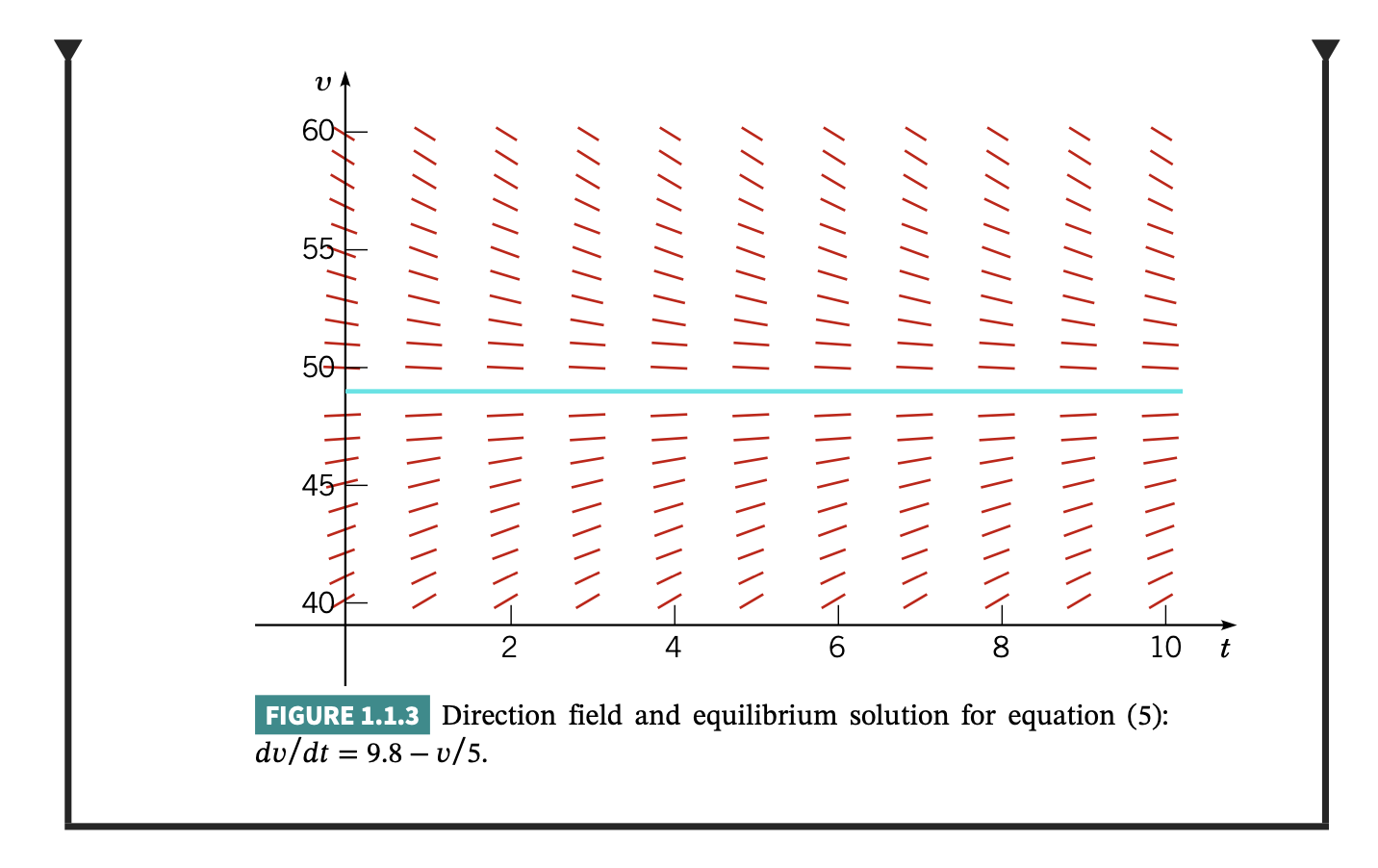
21. N For small, slowly falling objects, the assumption made in the text that the drag force is proportional to the velocity is a good one. For larger, more rapidly falling objects, it is more accurate to assume that the drag force is proportional to the square of the velocity. a. Write a differential equation for the velocity of a falling object of mass m if the magnitude of the drag force is proportional to the square of the velocity and its direction is opposite to that of the velocity. b. Determine the limiting velocity after a long time. c. If m = 10 kg, find the drag coefficient so that the limiting velocity is 49 m/s. d. N Using the data in part c, draw a direction field and compare it with Figure 1.1.3.40 U FIGURE 1.1.3 du/dt = 9.8 - v/5. 11101MAIL 1 1 1 1 1 1 1 1 1 1 1 ~-1III1 111171111 1 1 11110141 1 1 1 1 1 1 1 1 1 1 1 -IIIIII1 11 1 1 1 1 1 1 1 1 1 111101ALL 1 1 1 1 1 1 1 1 1 1 1 Direction field and equilibrium solution for equation (5): 1111III 11 1 1 1 1 1 1 1 1 1 11110101 1 1 1 1 1 1 1 1 1 1 1 111101 11 1 1 1 1 1 1 1 1 1 10
Step by Step Solution
There are 3 Steps involved in it

Get step-by-step solutions from verified subject matter experts
 Study Help