Question: 2-3 paragraphs QUESTION 3 Based on our study of Structuration theory and Canary's 2010 article (Module 7), explain why organizational communication policies need ongoing review
2-3 paragraphs
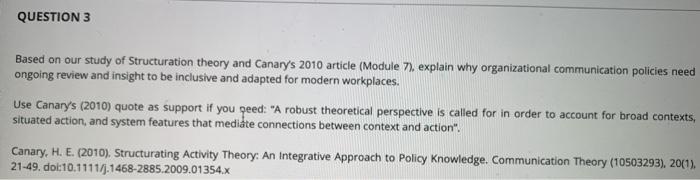
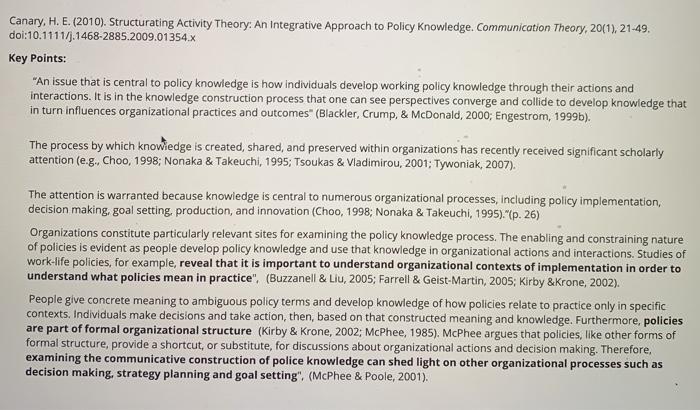
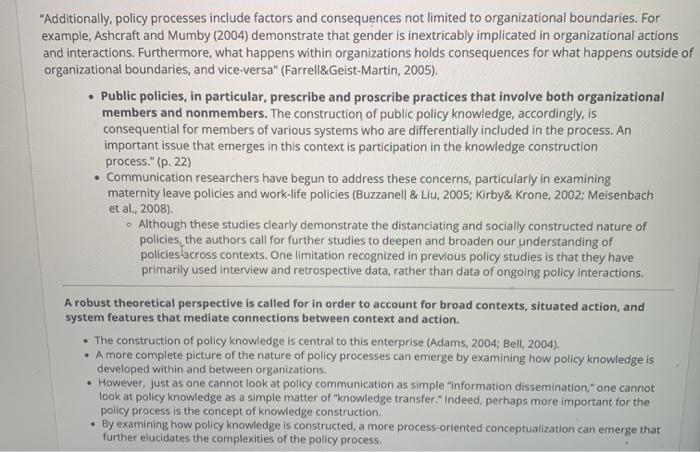
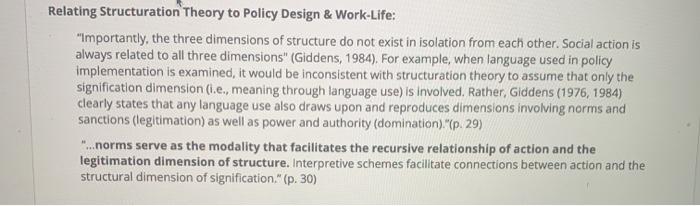
QUESTION 3 Based on our study of Structuration theory and Canary's 2010 article (Module 7), explain why organizational communication policies need ongoing review and insight to be inclusive and adapted for modern workplaces. Use Canary's (2010) quote as support if you geed: "A robust theoretical perspective is called for in order to account for broad contexts, situated action, and system features that mediate connections between context and action". Canary, H. E. (2010). Structurating Activity Theory: An Integrative Approach to Policy Knowledge. Communication Theory (10503293), 20(1). 21-49. doi:10.1111/j.1468-2885.2009.01354.x Canary, H. E. (2010). Structurating Activity Theory: An Integrative Approach to Policy Knowledge. Communication Theory, 20(1), 21-49. doi:10.1111/j.1468-2885.2009.01354.x Key Points: "An issue that is central to policy knowledge is how individuals develop working policy knowledge through their actions and interactions. It is in the knowledge construction process that one can see perspectives converge and collide to develop knowledge that in turn influences organizational practices and outcomes" (Blackler, Crump, & McDonald, 2000; Engestrom, 1999b). The process by which knowledge is created, shared, and preserved within organizations has recently received significant scholarly attention (e. g. Choo, 1998; Nonaka & Takeuchi, 1995; Tsoukas & Vladimirou, 2001; Tywoniak, 2007). The attention is warranted because knowledge is central to numerous organizational processes, including policy implementation, decision making, goal setting, production, and innovation (Choo, 1998; Nonaka & Takeuchi, 1995)."(p. 26) Organizations constitute particularly relevant sites for examining the policy knowledge process. The enabling and constraining nature of policies is evident as people develop policy knowledge and use that knowledge in organizational actions and interactions. Studies of work-life policies, for example, reveal that it is important to understand organizational contexts of implementation in order to understand what policies mean in practice". (Buzzanell & Liu, 2005; Farrell & Geist-Martin, 2005; Kirby & Krone, 2002). People give concrete meaning to ambiguous policy terms and develop knowledge of how policies relate to practice only in specific contexts. Individuals make decisions and take action, then, based on that constructed meaning and knowledge. Furthermore, policies are part of formal organizational structure (Kirby & Krone, 2002; McPhee, 1985). McPhee argues that policies, like other forms of formal structure, provide a shortcut, or substitute, for discussions about organizational actions and decision making. Therefore, examining the communicative construction of police knowledge can shed light on other organizational processes such as decision making, strategy planning and goal setting". (McPhee & Poole, 2001). "Additionally, policy processes include factors and consequences not limited to organizational boundaries. For example, Ashcraft and Mumby (2004) demonstrate that gender is inextricably implicated in organizational actions and interactions. Furthermore, what happens within organizations holds consequences for what happens outside of organizational boundaries, and vice-versa" (Farrell&Geist-Martin, 2005). Public policies, in particular, prescribe and proscribe practices that involve both organizational members and nonmembers. The construction of public policy knowledge, accordingly, is consequential for members of various systems who are differentially included in the process. An important issue that emerges in this context is participation in the knowledge construction process." (p. 22) Communication researchers have begun to address these concerns, particularly in examining maternity leave policies and work-life policies (Buzzanell & Liu, 2005; Kirby& Krone, 2002: Meisenbach et al., 2008). Although these studies clearly demonstrate the distanciating and socially constructed nature of policies, the authors call for further studies to deepen and broaden our understanding of policies across contexts. One limitation recognized in previous policy studies is that they have primarily used interview and retrospective data, rather than data of ongoing policy interactions. A robust theoretical perspective is called for in order to account for broad contexts, situated action, and system features that mediate connections between context and action. The construction of policy knowledge is central to this enterprise (Adams, 2004: Bell, 2004). . A more complete picture of the nature of policy processes can emerge by examining how policy knowledge is developed within and between organizations, . However, just as one cannot look at policy communication as simple "information dissemination," one cannot look at policy knowledge as a simple matter of "knowledge transfer. Indeed, perhaps more important for the policy process is the concept of knowledge construction By examining how policy knowledge is constructed, a more process-oriented conceptualization can emerge that further elucidates the complexities of the policy process. Relating Structuration Theory to Policy Design & Work-Life: "Importantly, the three dimensions of structure do not exist in isolation from each other. Social action is always related to all three dimensions" (Giddens, 1984). For example, when language used in policy implementation is examined, it would be inconsistent with structuration theory to assume that only the signification dimension (.e., meaning through language use) is involved. Rather, Giddens (1976, 1984) clearly states that any language use also draws upon and reproduces dimensions involving norms and sanctions (legitimation) as well as power and authority (domination)."(p. 29) "...norms serve as the modality that facilitates the recursive relationship of action and the legitimation dimension of structure. Interpretive schemes facilitate connections between action and the structural dimension of signification." (p. 30)









 Study Help