



Question: 27. Fluoride is sometimes found in high concentrations in ground and surface waters. Fluoride, in low concentrations, is often added to drinking water to minimize
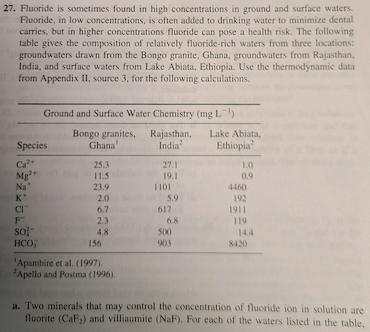
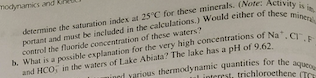
27. Fluoride is sometimes found in high concentrations in ground and surface waters. Fluoride, in low concentrations, is often added to drinking water to minimize dental carries, but in higher concentrations fluoride can pose a health risk. The following a table gives the composition of relatively fluoride-rich waters from three locations: groundwaters drawn from the Bongo granite, Ghana, groundwaters from Rajasthan. India, and surface waters from Lake Abiata, Ethiopia. Use the thermodynamic data from Appendix II, source 3. for the following calculations Ground and Surface Water Chemistry (mg L-)) Bongo granites, Rajasthan, Lake Abiata Species Ghana India Ethiopia Ca 25.3 27.1 10 Mp? 11.5 19.1 0.9 Na 23.9 1101 4460 K 2.0 5.9 192 CI 6.7 617 1911 F 23 6.8 119 SO 4.8 500 HCO, 156 903 8420 Apambire et al. (1997) Apello and Postma (1996). a. Two minerals that may control the concentration of fluoride ion in solution are fluorite (CaF,) and villaumite (NaF). For each of the waters listed in the table, modynamics and determine the saturation index at 25 C for these minerals. (Note: Activity is portant and must be included in the calculations) Would either of these mi control the Nuoride concentration of these waters! and HCO, in the waters of Lake Abiata? The lake has a pH of 9.62. in Yarious thermodynamic quantities for the age 5. What is a possible explanation for the very high concentrations of NCR interest, trichloroethene To
Step by Step Solution
There are 3 Steps involved in it

Get step-by-step solutions from verified subject matter experts