



Question: 28.3 (1) Let us consider a more general version of the voluntary public goods game described in the previous question. This game has N players,
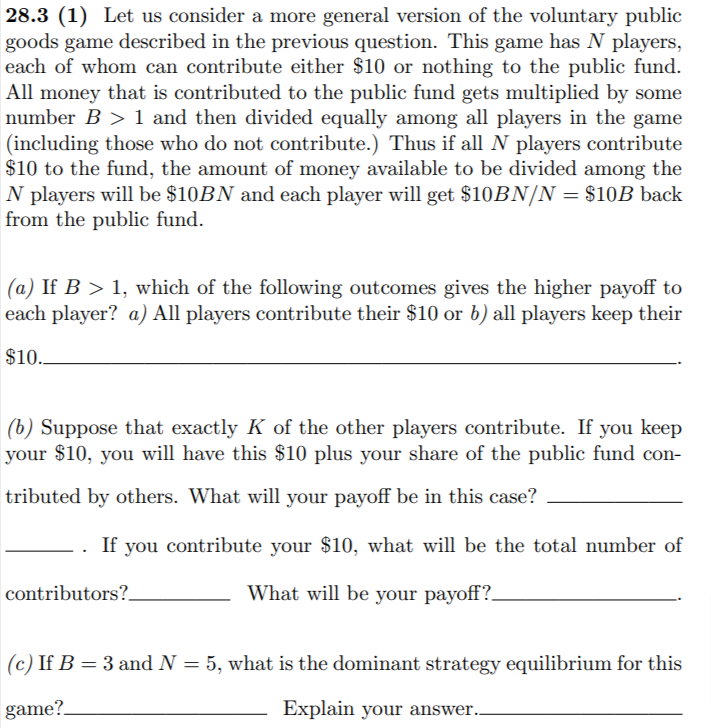
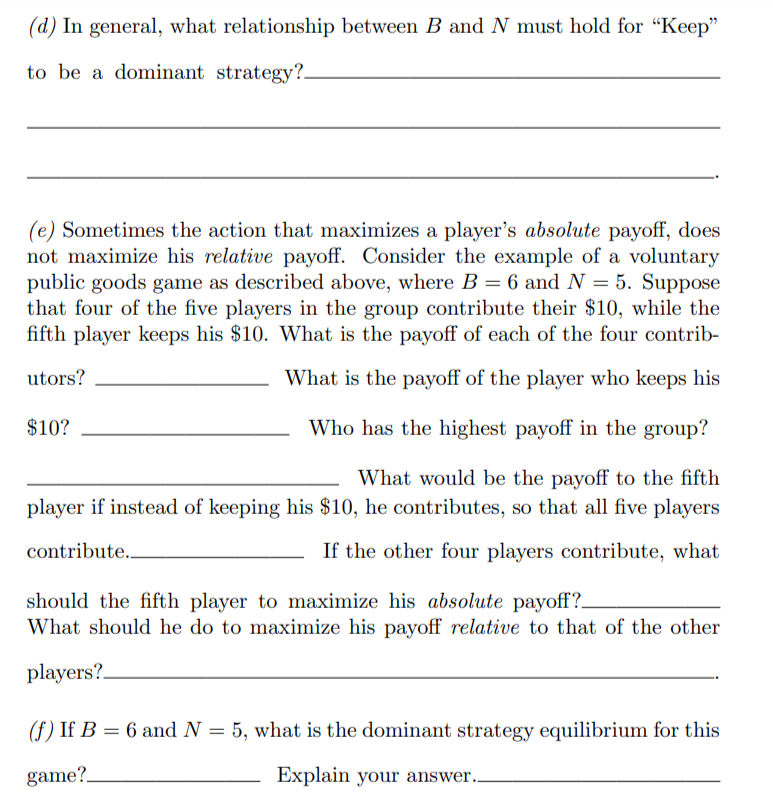
28.3 (1) Let us consider a more general version of the voluntary public goods game described in the previous question. This game has N players, each of whom can contribute either $10 or nothing to the public fund. All money that is contributed to the public fund gets multiplied by some number B >1 and then divided equally among all players in the game (including those who do not contribute.) Thus if all N players contribute $10 to the fund, the amount of money available to be divided among the N players will be $10BN and each player will get $10BN/N = $10B back from the public fund. (a) If B > 1, which of the following outcomes gives the higher payoff to each player? a) All players contribute their $10 or b) all players keep their $10.. (6) Suppose that exactly K of the other players contribute. If you keep your $10, you will have this $10 plus your share of the public fund con- tributed by others. What will your payoff be in this case? If you contribute your $10, what will be the total number of contributors? What will be your payoff? (c) If B = 3 and N = 5, what is the dominant strategy equilibrium for this = game? Explain your answer. (d) In general, what relationship between B and N must hold for Keep" to be a dominant strategy? (e) Sometimes the action that maximizes a player's absolute payoff, does not maximize his relative payoff. Consider the example of a voluntary public goods game as described above, where B = 6 and N = 5. Suppose that four of the five players in the group contribute their $10, while the fifth player keeps his $10. What is the payoff of each of the four contrib- utors? What is the payoff of the player who keeps his $10? Who has the highest payoff in the group? What would be the payoff to the fifth player if instead of keeping his $10, he contributes, so that all five players contribute. If the other four players contribute, what should the fifth player to maximize his absolute payoff? What should he do to maximize his payoff relative to that of the other players? (f) If B = 6 and N = 5, what is the dominant strategy equilibrium for this game? Explain your answer.- 28.3 (1) Let us consider a more general version of the voluntary public goods game described in the previous question. This game has N players, each of whom can contribute either $10 or nothing to the public fund. All money that is contributed to the public fund gets multiplied by some number B >1 and then divided equally among all players in the game (including those who do not contribute.) Thus if all N players contribute $10 to the fund, the amount of money available to be divided among the N players will be $10BN and each player will get $10BN/N = $10B back from the public fund. (a) If B > 1, which of the following outcomes gives the higher payoff to each player? a) All players contribute their $10 or b) all players keep their $10.. (6) Suppose that exactly K of the other players contribute. If you keep your $10, you will have this $10 plus your share of the public fund con- tributed by others. What will your payoff be in this case? If you contribute your $10, what will be the total number of contributors? What will be your payoff? (c) If B = 3 and N = 5, what is the dominant strategy equilibrium for this = game? Explain your answer. (d) In general, what relationship between B and N must hold for Keep" to be a dominant strategy? (e) Sometimes the action that maximizes a player's absolute payoff, does not maximize his relative payoff. Consider the example of a voluntary public goods game as described above, where B = 6 and N = 5. Suppose that four of the five players in the group contribute their $10, while the fifth player keeps his $10. What is the payoff of each of the four contrib- utors? What is the payoff of the player who keeps his $10? Who has the highest payoff in the group? What would be the payoff to the fifth player if instead of keeping his $10, he contributes, so that all five players contribute. If the other four players contribute, what should the fifth player to maximize his absolute payoff? What should he do to maximize his payoff relative to that of the other players? (f) If B = 6 and N = 5, what is the dominant strategy equilibrium for this game? Explain your
Step by Step Solution
There are 3 Steps involved in it

Get step-by-step solutions from verified subject matter experts