



Question: 29.3 (1) Let us consider a more general version of the voluntary public goods game described in the previous question. This game has NV players,
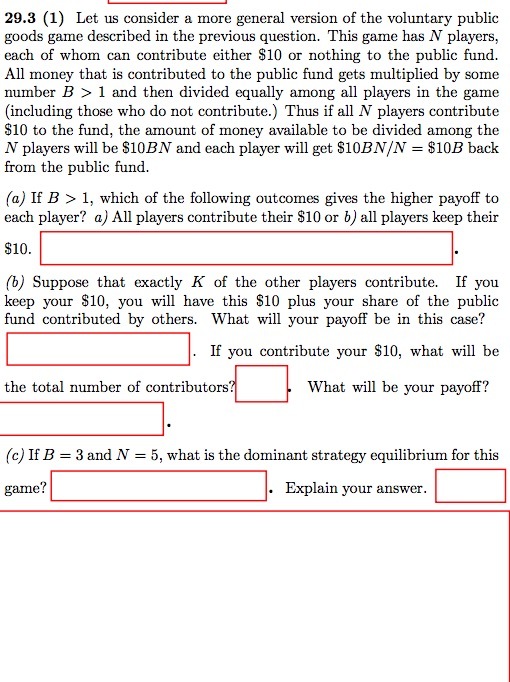
29.3 (1) Let us consider a more general version of the voluntary public goods game described in the previous question. This game has NV players, each of whom can contribute either $10 or nothing to the public fund. All money that is contributed to the public fund gets multiplied by some number B > 1 and then divided equally among all players in the game (including those who do not contribute.) Thus if all N players contribute $10 to the fund, the amount of money available to be divided among the N players will be $10BN and each player will get $10BN/N = $10B back from the public fund. (a) If B > 1, which of the following outcomes gives the higher payoff to each player? a) All players contribute their $10 or b) all players keep their $10. (b) Suppose that exactly K of the other players contribute. If you keep your $10, you will have this $10 plus your share of the public fund contributed by others. What will your payoff be in this case? If you contribute your $10, what will be the total number of contributors? What will be your payoff? (c) If B = 3 and N = 5, what is the dominant strategy equilibrium for this game? Explain your
Step by Step Solution
There are 3 Steps involved in it

Get step-by-step solutions from verified subject matter experts