Question: 2.Internal Analysis PART A - List 10-12 processes in the Wal-Mart USA operation's value chain and number to indicate sequence where process number 2b implies
2.Internal Analysis
PART A - List 10-12 processes in the Wal-Mart USA operation's value chain and number to indicate sequence where process number 2b implies that it occurs after 1, before 3, and at the same time as 2a.
PART B - Which process in your value chain in PART A provides the strongest competitive advantage? Why?
PART C - With regards to Wal-Mart's joint venture in India, how will two of the joint venture value chain's most critical processes be different from the processes in your PART A value chain above?
PART D - In India, what is Wal-Mart's strategic issue?
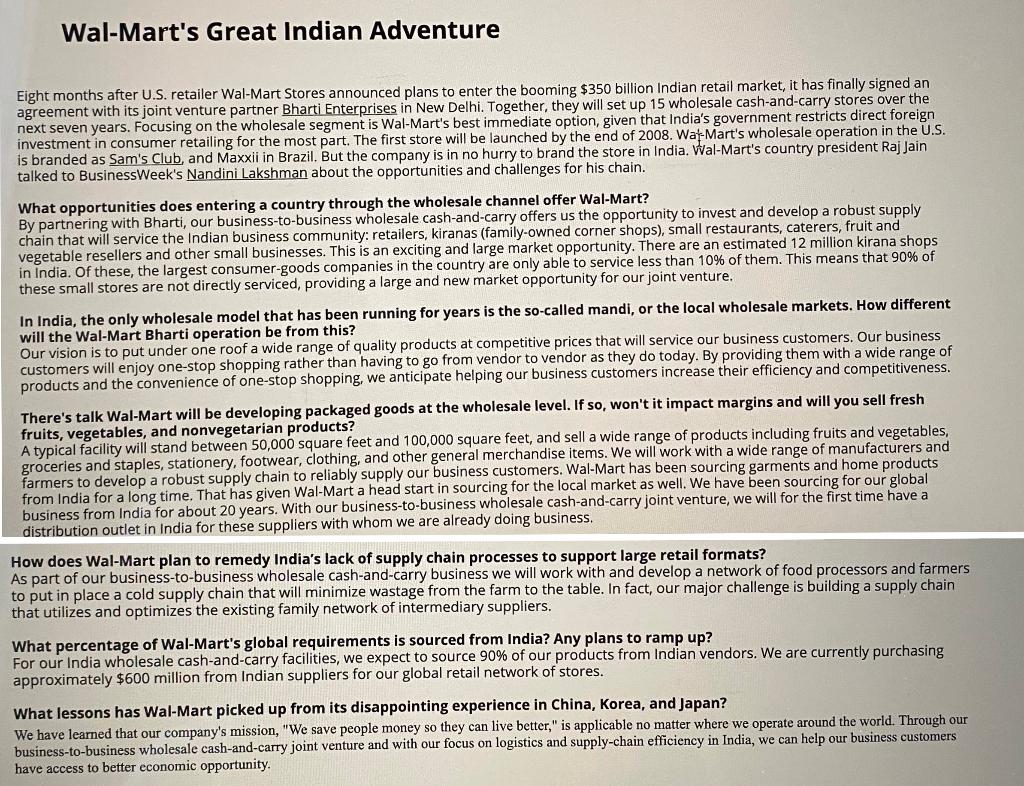
Wal-Mart's Great Indian Adventure Eight months after U.S. retailer Wal-Mart Stores announced plans to enter the booming $350 billion Indian retail market, it has finally signed an agreement with its joint venture partner Bharti Enterprises in New Delhi. Together, they will set up 15 wholesale cash-and-carry stores over the next seven years. Focusing on the wholesale segment is Wal-Mart's best immediate option, given that India's government restricts direct foreign investment in consumer retailing for the most part. The first store will be launched by the end of 2008. Wat-Mart's wholesale operation in the U.S. is branded as Sam's Club and Maxxii in Brazil. But the company is in no hurry to brand the store in India. Wal-Mart's country president Raj Jain talked to BusinessWeek's Nandini Lakshman about the opportunities and challenges for his chain. What opportunities does entering a country through the wholesale channel offer Wal-Mart? By partnering with Bharti, our business-to-business wholesale cash-and-carry offers us the opportunity to invest and develop a robust supply chain that will service the Indian business community: retailers, kiranas (family-owned corner shops), small restaurants, caterers, fruit and vegetable resellers and other small businesses. This is an exciting and large market opportunity. There are an estimated 12 million kirana shops in India. Of these, the largest consumer-goods companies in the country are only able to service less than 10% of them. This means that 90% of these small stores are not directly serviced, providing a large and new market opportunity for our joint venture. In India, the only wholesale model that has been running for years is the so-called mandi, or the local wholesale markets. How different will the Wal-Mart Bharti operation be from this? Our vision is to put under one roof a wide range of quality products at competitive prices that will service our business customers. Our business customers will enjoy one-stop shopping rather than having to go from vendor to vendor as they do today. By providing them with a wide range of products and the convenience of one-stop shopping, we anticipate helping our business customers increase their efficiency and competitiveness. There's talk Wal-Mart will be developing packaged goods at the wholesale level. If so, won't it impact margins and will you sell fresh fruits, vegetables, and nonvegetarian products? A typical facility will stand between 50,000 square feet and 100,000 square feet, and sell a wide range of products including fruits and vegetables, groceries and staples, stationery, footwear, clothing, and other general merchandise items. We will work with a wide range of manufacturers and farmers to develop a robust supply chain to reliably supply our business customers. Wal-Mart has been sourcing garments and home products from India for a long time. That has given Wal-Mart a head start in sourcing for the local market as well. We have been sourcing for our global business from India for about 20 years. With our business-to-business wholesale cash-and-carry joint venture, we will for the first time have a distribution outlet in India for these suppliers with whom we are already doing business. How does Wal-Mart plan to remedy India's lack of supply chain processes to support large retail formats? As part of our business-to-business wholesale cash-and-carry business we will work with and develop a network of food processors and farmers to put in place a cold supply chain that will minimize wastage from the farm to the table. In fact, our major challenge is building a supply chain that utilizes and optimizes the existing family network of intermediary suppliers. What percentage of Wal-Mart's global requirements is sourced from India? Any plans to ramp up? For our India wholesale cash-and-carry facilities, we expect to source 90% of our products from Indian vendors. We are currently purchasing approximately $600 million from Indian suppliers for our global retail network of stores. What lessons has Wal-Mart picked up from its disappointing experience in China, Korea, and Japan? We have learned that our company's mission, "We save people money so they can live better," is applicable no matter where we operate around the world. Through our business-to-business wholesale cash-and-carry joint venture and with our focus on logistics and supply-chain efficiency in India, we can help our business customers have access to better economic opportunity









 Study Help