







Question: Part A - List 10-12 processes in Ashley's value chain and number to indicate sequence where process number 2b implies that it occurs after 1,
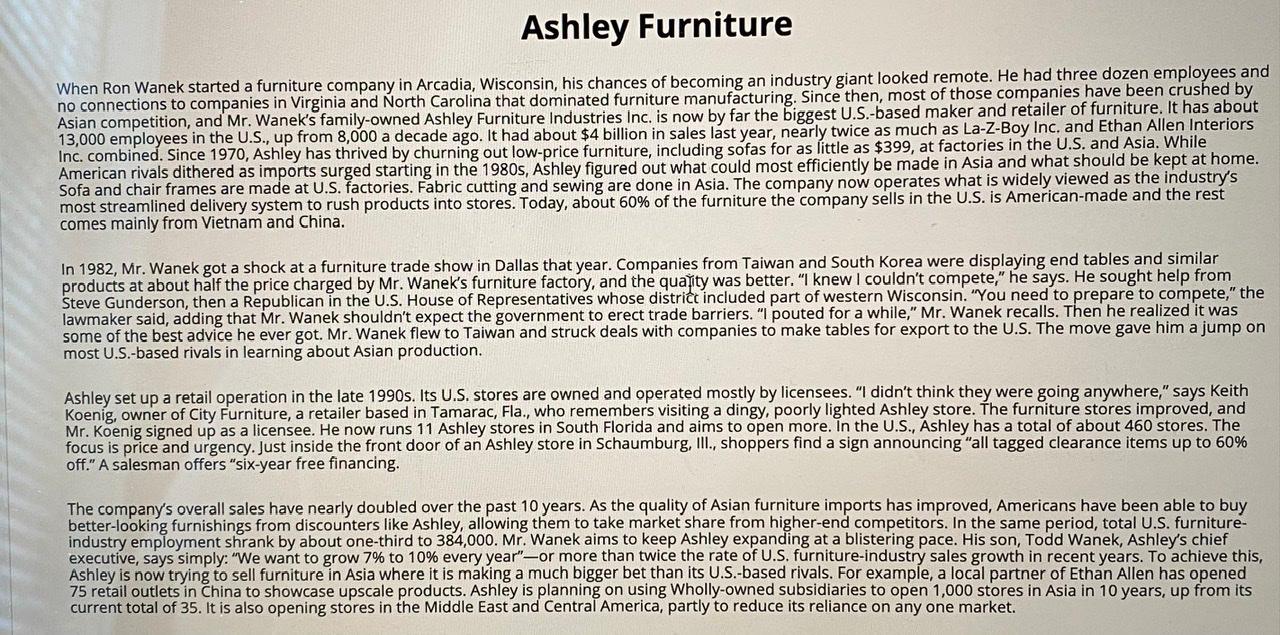
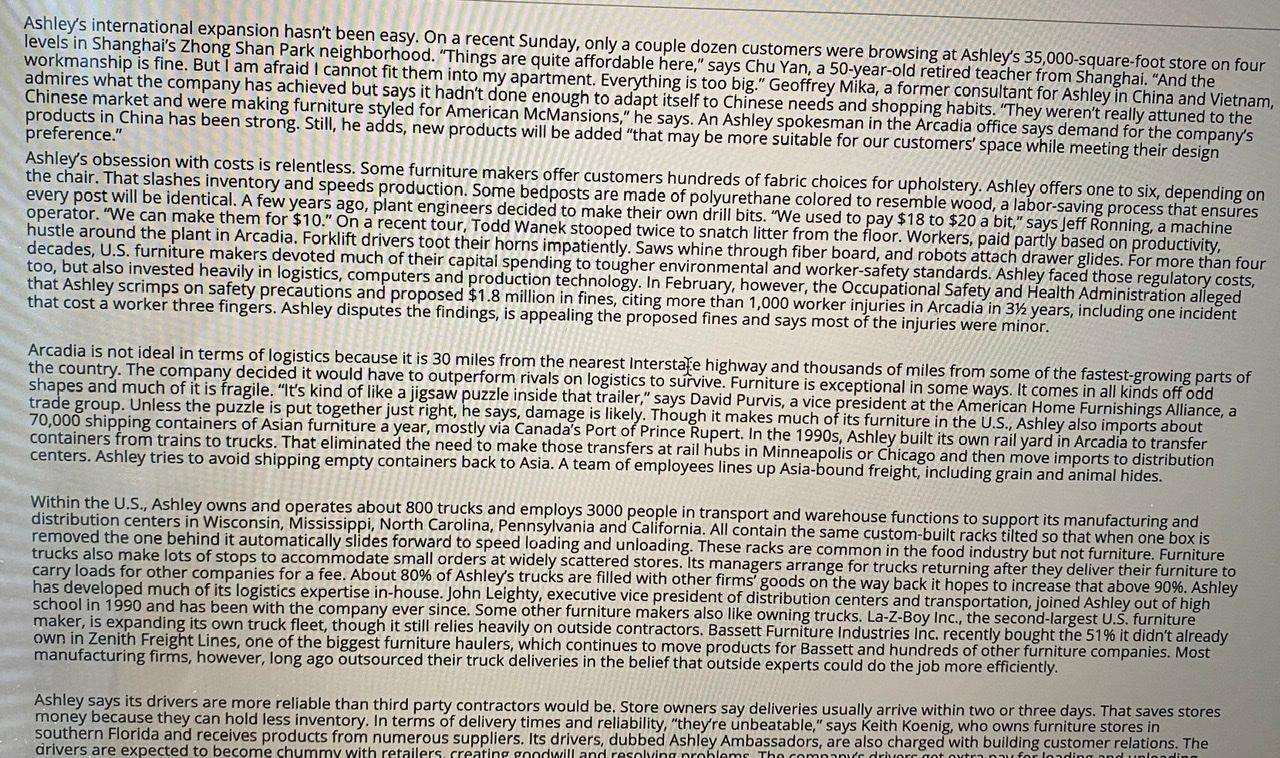
Part A - List 10-12 processes in Ashley's value chain and number to indicate sequence where process number 2b implies that it occurs after 1, before 3, and at the same time as 2a.
Part B - What is Ashley's Business-Level Strategy? Why? Part C - Which three processes from your value chain best support Ashley's business level strategy? How? Part D - How does the value chain fit the external Environment? Describe how a particular link in your value chain is a response to a particular aspect of the external Environment
Part E- Which value chain process comes closest to a sustainable competitive advantage? What type of competitive advantage is it? Justify
Ashley Furniture When Ron Wanek started a furniture company in Arcadia, Wisconsin, his chances of becoming an industry giant looked remote. He had three dozen employees and no connections to companies in Virginia and North Carolina that dominated furniture manufacturing. Since then, most of those companies have been crushed by Asian competition, and Mr. Wanek's family-owned Ashley Furniture Industries Inc. is now by far the biggest U.S.-based maker and retailer of furniture. It has about 13,000 employees in the U.S., up from 8,000 a decade ago. It had about $4 billion in sales last year, nearly twice as much as La-z-Boy Inc. and Ethan Allen Interiors Inc. combined. Since 1970, Ashley has thrived by churning out low-price furniture, including sofas for as little as $399, at factories in the U.S. and Asia. While American rivals dithered as imports surged starting in the 1980s, Ashley figured out what could most efficiently be made in Asia and what should be kept at home. Sofa and chair frames are made at U.S. factories. Fabric cutting and sewing are done in Asia. The company now operates what is widely viewed as the industry's most streamlined delivery system to rush products into stores. Today, about 60% of the furniture the company sells in the U.S. is American-made and the rest comes mainly from Vietnam and China. In 1982, Mr. Wanek got a shock at a furniture trade show in Dallas that year. Companies from Taiwan and South Korea were displaying end tables and similar products at about half the price charged by Mr. Wanek's furniture factory, and the quafity was better. "I knew I couldn't compete," he says. He sought help from Steve Gunderson, then a Republican in the U.S. House of Representatives whose district included part of western Wisconsin. "You need to prepare to compete," the lawmaker said, adding that Mr. Wanek shouldn't expect the government to erect trade barriers. "I pouted for a while," Mr. Wanek recalls. Then he realized it was some of the best advice he ever got. Mr. Wanek flew to Taiwan and struck deals with companies to make tables for export to the U.S. The move gave him a jump on most U.S.-based rivals in learning about Asian production. Ashley set up a retail operation in the late 1990s. Its U.S. stores are owned and operated mostly by licensees. "I didn't think they were going anywhere," says Keith Koenig, owner of City Furniture, a retailer based in Tamarac, Fla., who remembers visiting a dingy, poorly lighted Ashley store. The furniture stores improved, and Mr. Koenig signed up as a licensee. He now runs 11 Ashley stores in South Florida and aims to open more. In the U.S., Ashley has a total of about 460 stores. The focus is price and urgency. Just inside the front door of an Ashley store in Schaumburg, III., shoppers find a sign announcing "all tagged clearance items up to 60% off." A salesman offers "six-year free financing. The company's overall sales have nearly doubled over the past 10 years. As the quality of Asian furniture imports has improved, Americans have been able to buy better-looking furnishings from discounters like Ashley, allowing them to take market share from higher-end competitors. In the same period, total U.S. furniture- industry employment shrank by about one-third to 384,000. Mr. Wanek aims to keep Ashley expanding at a blistering pace. His son, Todd Wanek, Ashley's chief executive, says simply: "We want to grow 7% to 10% every year"or more than twice the rate of U.S. furniture-industry sales growth in recent years. To achieve this, Ashley is now trying to sell furniture in Asia where it is making a much bigger bet than its U.S.-based rivals. For example, a local partner of Ethan Allen has opened 75 retail outlets in China to showcase upscale products. Ashley is planning on using Wholly-owned subsidiaries to open 1,000 stores in Asia in 10 years, up from its current total of 35. It is also opening stores in the Middle East and Central America, partly to reduce its reliance on any one market. Ashley's international expansion hasn't been easy. On a recent Sunday, only a couple dozen customers were browsing at Ashley's 35,000-square-foot store on four levels in Shanghai's Zhong Shan Park neighborhood. "Things are quite affordable here," says Chu Yan, a 50-year-old retired teacher from Shanghai. "And the workmanship is fine. But I am afraid I cannot fit them into my apartment. Everything is too big." Geoffrey Mika, a former consultant for Ashley in China and Vietnam, admires what the company has achieved but says it hadn't done enough to adapt itself to Chinese needs and shopping habits. "They weren't really attuned to the Chinese market and were making furniture styled for American McMansions," he says. An Ashley spokesman the Arcadia office says demand for the company's products in China has been strong. Still, he adds, new products will be added that may be more suitable for our customers' space while meeting their design preference." Ashley's obsession with costs is relentless. Some furniture makers offer customers hundreds of fabric choices for upholstery. Ashley offers one to six, depending on the chair. That slashes inventory and speeds production. Some bedposts are made of polyurethane colored to resemble wood, a labor-saving process that ensures every post will be identical. A few years ago, plant engineers decided to make their own drill bits. 'We used to pay $18 to $20 a bit," says Jeff Ronning, a machine operator. "We can make them for $10." On a recent tour, Todd Wanek stooped twice to snatch litter from the floor. Workers, paid partly based on productivity, hustle around the plant in Arcadia. Forklift drivers toot their horns impatiently. Saws whine through fiber board, and robots attach drawer glides. For more than four decades, U.S. furniture makers devoted much of their capital spending to tougher environmental and worker-safety standards. Ashley faced those regulatory costs, too, but also invested heavily in logistics, computers and production technology. In February, however, the Occupational Safety and Health Administration alleged that Ashley scrimps on safety precautions and proposed $1.8 million in fines, citing more than 1,000 worker injuries in Arcadia in 32 years, including one incident that cost a worker three fingers. Ashley disputes the findings, is appealing the proposed fines and says most of the injuries were minor. Arcadia is not ideal in terms of logistics because it is 30 miles from the nearest Interstate highway and thousands of miles from some of the fastest-growing parts of the country. The company decided it would have to outperform rivals on logistics to survive. Furniture is exceptional in some ways. It comes in all kinds off odd shapes and much of it is fragile. "It's kind of like a jigsaw puzzle inside that trailer," says David Purvis, a vice president at the American Home Furnishings Alliance, a trade group. Unless the puzzle is put together just right, he says, damage is likely. Though it makes much of its furniture in the U.S., Ashley also imports about 70,000 shipping containers of Asian furniture a year, mostly via Canada's Port of Prince Rupert. In the 1990s, Ashley built its own rail yard in Arcadia to transfer containers from trains to trucks. That eliminated the need to make those transfers at rail hubs in Minneapolis or Chicago and then move imports to distribution centers. Ashley tries to avoid shipping empty containers back to Asia. A team of employees lines up Asia-bound freight, including grain and animal hides. Within the U.S., Ashley owns and operates about 800 trucks and employs 3000 people in transport and warehouse functions to support its manufacturing and distribution centers in Wisconsin, Mississippi, North Carolina, Pennsylvania and California. All contain the same custom-built racks tilted so that when one box is removed the one behind it automatically slides forward to speed loading and unloading. These racks are common in the food industry but not furniture. Furniture trucks also make lots of stops to accommodate small orders at widely scattered stores. Its managers arrange for trucks returning after they deliver their furniture to carry loads for other companies for a fee. About 80% of Ashley's trucks are filled with other firms' goods on the way back it hopes to increase that above 90%. Ashley has developed much of its logistics expertise in-house. John Leighty, executive vice president of distribution centers and transportation, joined Ashley out of high school in 1990 and has been with the company ever since. Some other furniture makers also like owning trucks. La-z-Boy Inc., the second-largest U.S. furniture maker, is expanding its own truck fleet, though it still relies heavily on outside contractors. Bassett Furniture Industries Inc. recently bought the 51% it didn't already own in Zenith Freight Lines, one of the biggest furniture haulers, which continues to move products for Bassett and hundreds of other furniture companies. Most manufacturing firms, however, long ago outsourced their truck deliveries in the belief that outside experts could do the job more efficiently. Ashley says its drivers are more reliable than third party contractors would be. Store owners say deliveries usually arrive within two or three days. That saves stores money because they can hold less inventory. In terms of delivery times and reliability, "they're unbeatable," says Keith Koenig, who owns furniture stores in southern Florida and receives products from numerous suppliers. Its drivers, dubbed Ashley Ambassadors, are also charged with building customer relations. The drivers are expected to become chummy with retailers, creating poodwill and resolving problems The command driver at nytnou for loading and unloadina Ashley Furniture When Ron Wanek started a furniture company in Arcadia, Wisconsin, his chances of becoming an industry giant looked remote. He had three dozen employees and no connections to companies in Virginia and North Carolina that dominated furniture manufacturing. Since then, most of those companies have been crushed by Asian competition, and Mr. Wanek's family-owned Ashley Furniture Industries Inc. is now by far the biggest U.S.-based maker and retailer of furniture. It has about 13,000 employees in the U.S., up from 8,000 a decade ago. It had about $4 billion in sales last year, nearly twice as much as La-z-Boy Inc. and Ethan Allen Interiors Inc. combined. Since 1970, Ashley has thrived by churning out low-price furniture, including sofas for as little as $399, at factories in the U.S. and Asia. While American rivals dithered as imports surged starting in the 1980s, Ashley figured out what could most efficiently be made in Asia and what should be kept at home. Sofa and chair frames are made at U.S. factories. Fabric cutting and sewing are done in Asia. The company now operates what is widely viewed as the industry's most streamlined delivery system to rush products into stores. Today, about 60% of the furniture the company sells in the U.S. is American-made and the rest comes mainly from Vietnam and China. In 1982, Mr. Wanek got a shock at a furniture trade show in Dallas that year. Companies from Taiwan and South Korea were displaying end tables and similar products at about half the price charged by Mr. Wanek's furniture factory, and the quafity was better. "I knew I couldn't compete," he says. He sought help from Steve Gunderson, then a Republican in the U.S. House of Representatives whose district included part of western Wisconsin. "You need to prepare to compete," the lawmaker said, adding that Mr. Wanek shouldn't expect the government to erect trade barriers. "I pouted for a while," Mr. Wanek recalls. Then he realized it was some of the best advice he ever got. Mr. Wanek flew to Taiwan and struck deals with companies to make tables for export to the U.S. The move gave him a jump on most U.S.-based rivals in learning about Asian production. Ashley set up a retail operation in the late 1990s. Its U.S. stores are owned and operated mostly by licensees. "I didn't think they were going anywhere," says Keith Koenig, owner of City Furniture, a retailer based in Tamarac, Fla., who remembers visiting a dingy, poorly lighted Ashley store. The furniture stores improved, and Mr. Koenig signed up as a licensee. He now runs 11 Ashley stores in South Florida and aims to open more. In the U.S., Ashley has a total of about 460 stores. The focus is price and urgency. Just inside the front door of an Ashley store in Schaumburg, III., shoppers find a sign announcing "all tagged clearance items up to 60% off." A salesman offers "six-year free financing. The company's overall sales have nearly doubled over the past 10 years. As the quality of Asian furniture imports has improved, Americans have been able to buy better-looking furnishings from discounters like Ashley, allowing them to take market share from higher-end competitors. In the same period, total U.S. furniture- industry employment shrank by about one-third to 384,000. Mr. Wanek aims to keep Ashley expanding at a blistering pace. His son, Todd Wanek, Ashley's chief executive, says simply: "We want to grow 7% to 10% every year"or more than twice the rate of U.S. furniture-industry sales growth in recent years. To achieve this, Ashley is now trying to sell furniture in Asia where it is making a much bigger bet than its U.S.-based rivals. For example, a local partner of Ethan Allen has opened 75 retail outlets in China to showcase upscale products. Ashley is planning on using Wholly-owned subsidiaries to open 1,000 stores in Asia in 10 years, up from its current total of 35. It is also opening stores in the Middle East and Central America, partly to reduce its reliance on any one market. Ashley's international expansion hasn't been easy. On a recent Sunday, only a couple dozen customers were browsing at Ashley's 35,000-square-foot store on four levels in Shanghai's Zhong Shan Park neighborhood. "Things are quite affordable here," says Chu Yan, a 50-year-old retired teacher from Shanghai. "And the workmanship is fine. But I am afraid I cannot fit them into my apartment. Everything is too big." Geoffrey Mika, a former consultant for Ashley in China and Vietnam, admires what the company has achieved but says it hadn't done enough to adapt itself to Chinese needs and shopping habits. "They weren't really attuned to the Chinese market and were making furniture styled for American McMansions," he says. An Ashley spokesman the Arcadia office says demand for the company's products in China has been strong. Still, he adds, new products will be added that may be more suitable for our customers' space while meeting their design preference." Ashley's obsession with costs is relentless. Some furniture makers offer customers hundreds of fabric choices for upholstery. Ashley offers one to six, depending on the chair. That slashes inventory and speeds production. Some bedposts are made of polyurethane colored to resemble wood, a labor-saving process that ensures every post will be identical. A few years ago, plant engineers decided to make their own drill bits. 'We used to pay $18 to $20 a bit," says Jeff Ronning, a machine operator. "We can make them for $10." On a recent tour, Todd Wanek stooped twice to snatch litter from the floor. Workers, paid partly based on productivity, hustle around the plant in Arcadia. Forklift drivers toot their horns impatiently. Saws whine through fiber board, and robots attach drawer glides. For more than four decades, U.S. furniture makers devoted much of their capital spending to tougher environmental and worker-safety standards. Ashley faced those regulatory costs, too, but also invested heavily in logistics, computers and production technology. In February, however, the Occupational Safety and Health Administration alleged that Ashley scrimps on safety precautions and proposed $1.8 million in fines, citing more than 1,000 worker injuries in Arcadia in 32 years, including one incident that cost a worker three fingers. Ashley disputes the findings, is appealing the proposed fines and says most of the injuries were minor. Arcadia is not ideal in terms of logistics because it is 30 miles from the nearest Interstate highway and thousands of miles from some of the fastest-growing parts of the country. The company decided it would have to outperform rivals on logistics to survive. Furniture is exceptional in some ways. It comes in all kinds off odd shapes and much of it is fragile. "It's kind of like a jigsaw puzzle inside that trailer," says David Purvis, a vice president at the American Home Furnishings Alliance, a trade group. Unless the puzzle is put together just right, he says, damage is likely. Though it makes much of its furniture in the U.S., Ashley also imports about 70,000 shipping containers of Asian furniture a year, mostly via Canada's Port of Prince Rupert. In the 1990s, Ashley built its own rail yard in Arcadia to transfer containers from trains to trucks. That eliminated the need to make those transfers at rail hubs in Minneapolis or Chicago and then move imports to distribution centers. Ashley tries to avoid shipping empty containers back to Asia. A team of employees lines up Asia-bound freight, including grain and animal hides. Within the U.S., Ashley owns and operates about 800 trucks and employs 3000 people in transport and warehouse functions to support its manufacturing and distribution centers in Wisconsin, Mississippi, North Carolina, Pennsylvania and California. All contain the same custom-built racks tilted so that when one box is removed the one behind it automatically slides forward to speed loading and unloading. These racks are common in the food industry but not furniture. Furniture trucks also make lots of stops to accommodate small orders at widely scattered stores. Its managers arrange for trucks returning after they deliver their furniture to carry loads for other companies for a fee. About 80% of Ashley's trucks are filled with other firms' goods on the way back it hopes to increase that above 90%. Ashley has developed much of its logistics expertise in-house. John Leighty, executive vice president of distribution centers and transportation, joined Ashley out of high school in 1990 and has been with the company ever since. Some other furniture makers also like owning trucks. La-z-Boy Inc., the second-largest U.S. furniture maker, is expanding its own truck fleet, though it still relies heavily on outside contractors. Bassett Furniture Industries Inc. recently bought the 51% it didn't already own in Zenith Freight Lines, one of the biggest furniture haulers, which continues to move products for Bassett and hundreds of other furniture companies. Most manufacturing firms, however, long ago outsourced their truck deliveries in the belief that outside experts could do the job more efficiently. Ashley says its drivers are more reliable than third party contractors would be. Store owners say deliveries usually arrive within two or three days. That saves stores money because they can hold less inventory. In terms of delivery times and reliability, "they're unbeatable," says Keith Koenig, who owns furniture stores in southern Florida and receives products from numerous suppliers. Its drivers, dubbed Ashley Ambassadors, are also charged with building customer relations. The drivers are expected to become chummy with retailers, creating poodwill and resolving problems The command driver at nytnou for loading and unloadinaStep by Step Solution
There are 3 Steps involved in it

Get step-by-step solutions from verified subject matter experts
 Study Help