







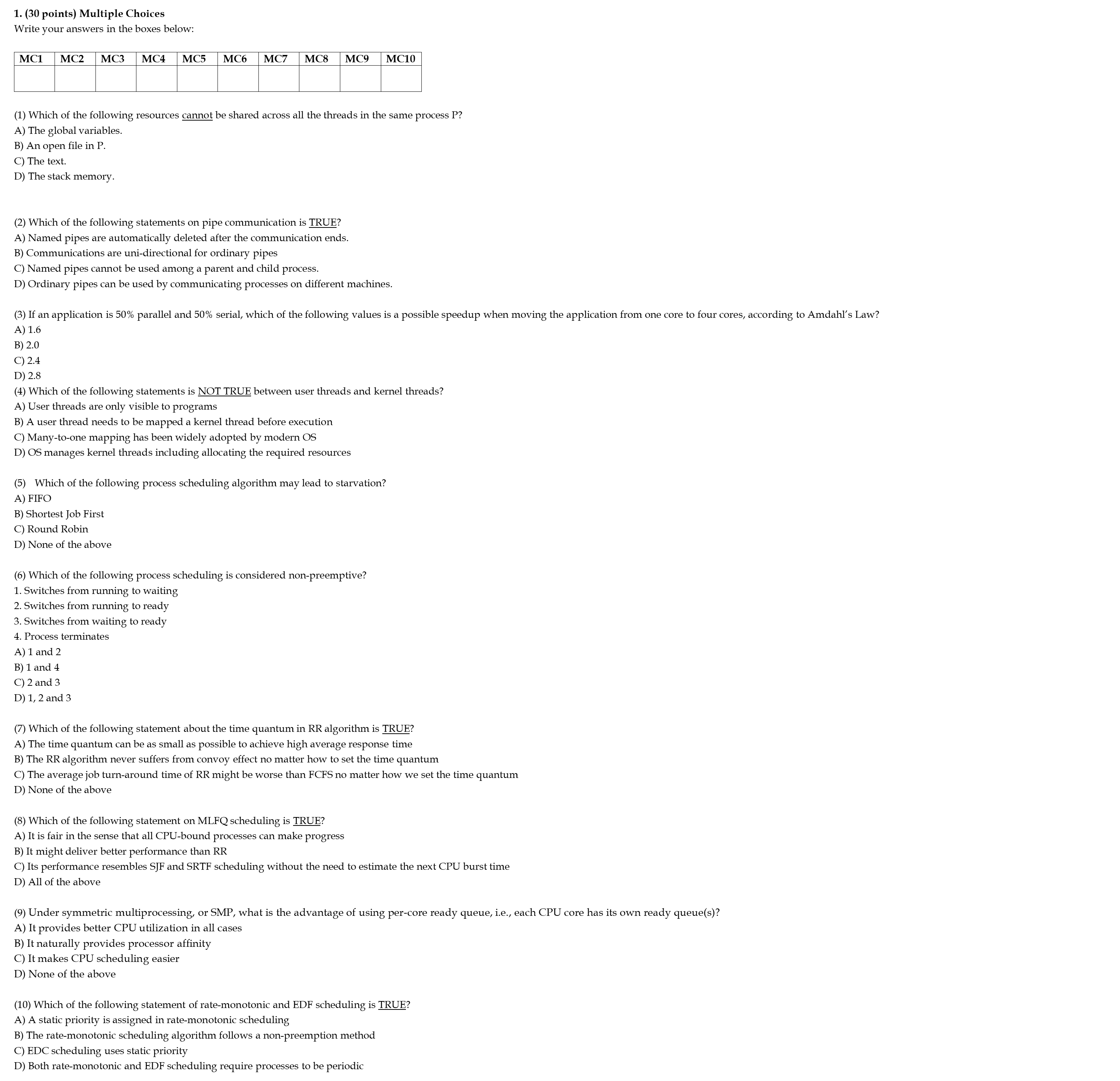
Question: ( 3 0 points ) Multiple Choices Write your answers in the boxes below: ( 1 ) Which of the following resources cannot be shared
points Multiple Choices
Write your answers in the boxes below:
Which of the following resources cannot be shared across all the threads in the same process P
A The global variables.
B An open file in
C The text.
D The stack memory.
Which of the following statements on pipe communication is TRUE?
A Named pipes are automatically deleted after the communication ends.
B Communications are unidirectional for ordinary pipes
C Named pipes cannot be used among a parent and child process.
D Ordinary pipes can be used by communicating processes on different machines.
If an application is parallel and serial, which of the following values is a possible speedup when moving the application from one core to four cores, according to Amdahl's Law?
A
B
C
D
Which of the following statements is NOT TRUE between user threads and kernel threads?
A User threads are only visible to programs
B A user thread needs to be mapped a kernel thread before execution
C Manytoone mapping has been widely adopted by modern OS
D OS manages kernel threads including allocating the required resources
Which of the following process scheduling algorithm may lead to starvation?
A FIFO
B Shortest Job First
C Round Robin
D None of the above
Which of the following process scheduling is considered nonpreemptive?
Switches from running to waiting
Switches from running to ready
Switches from waiting to ready
Process terminates
A and
B and
C and
D and
Which of the following statement about the time quantum in RR algorithm is TRUE?
A The time quantum can be as small as possible to achieve high average response time
B The RR algorithm never suffers from convoy effect no matter how to set the time quantum
C The average job turnaround time of RR might be worse than FCFS no matter how we set the time quantum
D None of the above
Which of the following statement on MLFQ scheduling is TRUE?
A It is fair in the sense that all CPUbound processes can make progress
B It might deliver better performance than
C Its performance resembles SJF and SRTF scheduling without the need to estimate the next CPU burst time
D All of the above
Under symmetric multiprocessing, or SMP what is the advantage of using percore ready queue, ie each CPU core has its own ready queues
A It provides better CPU utilization in all cases
B It naturally provides processor affinity
C It makes CPU scheduling easier
D None of the above
Which of the following statement of ratemonotonic and EDF scheduling is TRUE?
A A static priority is assigned in ratemonotonic scheduling
B The ratemonotonic scheduling algorithm follows a nonpreemption method
C EDC scheduling uses static priority
D Both ratemonotonic and EDF scheduling require processes to be periodic
Step by Step Solution
There are 3 Steps involved in it
1 Expert Approved Answer
Step: 1 Unlock

Question Has Been Solved by an Expert!
Get step-by-step solutions from verified subject matter experts
Step: 2 Unlock
Step: 3 Unlock
 Study Help