







Question: ( 3 ) ( 5 0 p . ) Autocatalytic reaction in an isothermal batch reactor ( Nobel Prize research ) The overall reaction A
p Autocatalytic reaction in an isothermal batch reactor Nobel Prize research
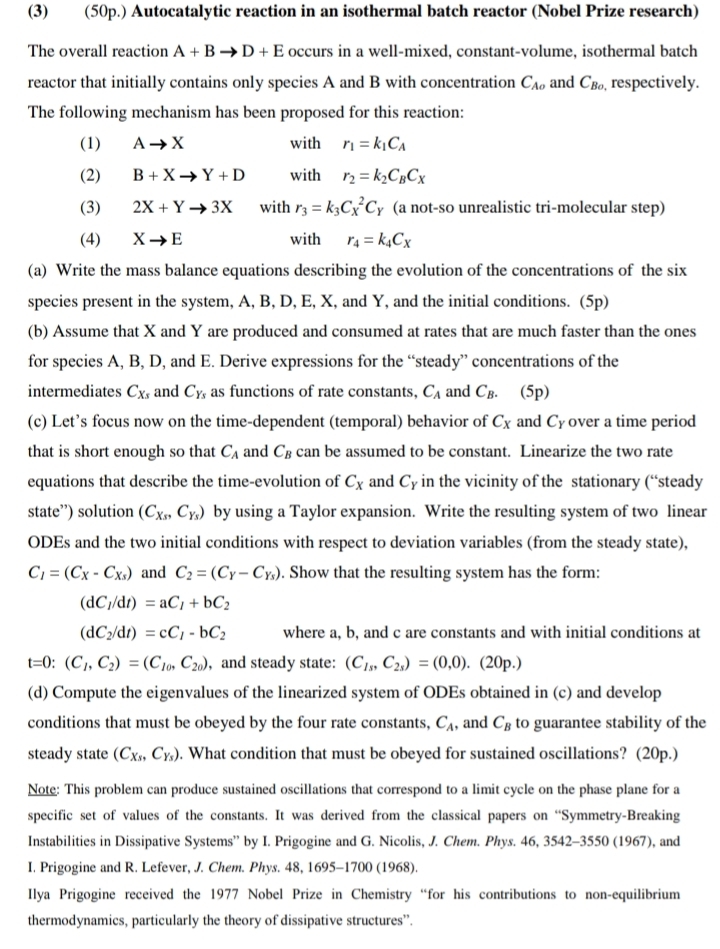
The overall reaction occurs in a wellmixed, constantvolume, isothermal batch reactor that initially contains only species A and with concentration and respectively. The following mechanism has been proposed for this reaction:
with
with
with a notso unrealistic trimolecular step
with
a Write the mass balance equations describing the evolution of the concentrations of the six species present in the system, A B D E X and Y and the initial conditions. p
b Assume that and are produced and consumed at rates that are much faster than the ones for species A B D and E Derive expressions for the "steady" concentrations of the intermediates and as functions of rate constants, and
c Let's focus now on the timedependent temporal behavior of and over a time period that is short enough so that and can be assumed to be constant. Linearize the two rate equations that describe the timeevolution of and in the vicinity of the stationary steady state" solution : by using a Taylor expansion. Write the resulting system of two linear ODEs and the two initial conditions with respect to deviation variables from the steady state and Show that the resulting system has the form:
where and are constants and with initial conditions at : and steady state:
d Compute the eigenvalues of the linearized system of ODEs obtained in c and develop conditions that must be obeyed by the four rate constants, and to guarantee stability of the steady state What condition that must be obeyed for sustained oscillations? p
Note: This problem can produce sustained oscillations that correspond to a limit cycle on the phase plane for a specific set of values of the constants. It was derived from the classical papers on "SymmetryBreaking Instabilities in Dissipative Systems" by I. Prigogine and G Nicolis, J Chem. Phys and I. Prigogine and R Lefever, J Chem. Phys
Ilya Prigogine received the Nobel Prize in Chemistry "for his contributions to nonequilibrium thermodynamics, particularly the theory of dissipative structures".
Step by Step Solution
There are 3 Steps involved in it
1 Expert Approved Answer
Step: 1 Unlock

Question Has Been Solved by an Expert!
Get step-by-step solutions from verified subject matter experts
Step: 2 Unlock
Step: 3 Unlock
 Study Help