



Question: 3. A regular expression is said to be top-plus if it is of the form (Q1 + a2 + ... +an) for some n> 1,
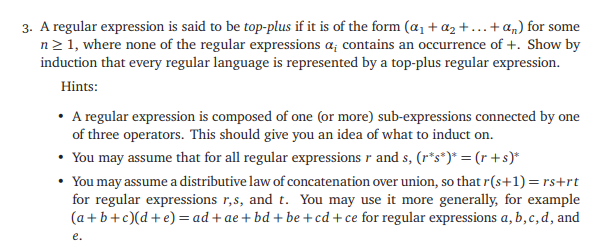
3. A regular expression is said to be top-plus if it is of the form (Q1 + a2 + ... +an) for some n> 1, where none of the regular expressions a contains an occurrence of +. Show by induction that every regular language is represented by a top-plus regular expression. Hints: A regular expression is composed of one or more) sub-expressions connected by one of three operators. This should give you an idea of what to induct on. You may assume that for all regular expressions r and s, (r*s*)* =(r +s)* You may assume a distributive law of concatenation over union, so that r(s+1)=rs+rt for regular expressions r,s, and t. You may use it more generally, for example (a+b+c)(d+e)= ad + ae+bd+be+cd + ce for regular expressions a, b,c,d, and e
Step by Step Solution
There are 3 Steps involved in it

Get step-by-step solutions from verified subject matter experts