







Question: 3.) Assume that the Integral Method is applied to this problem. A third-order polynomial is used for the velocity profile and the temperature profile.
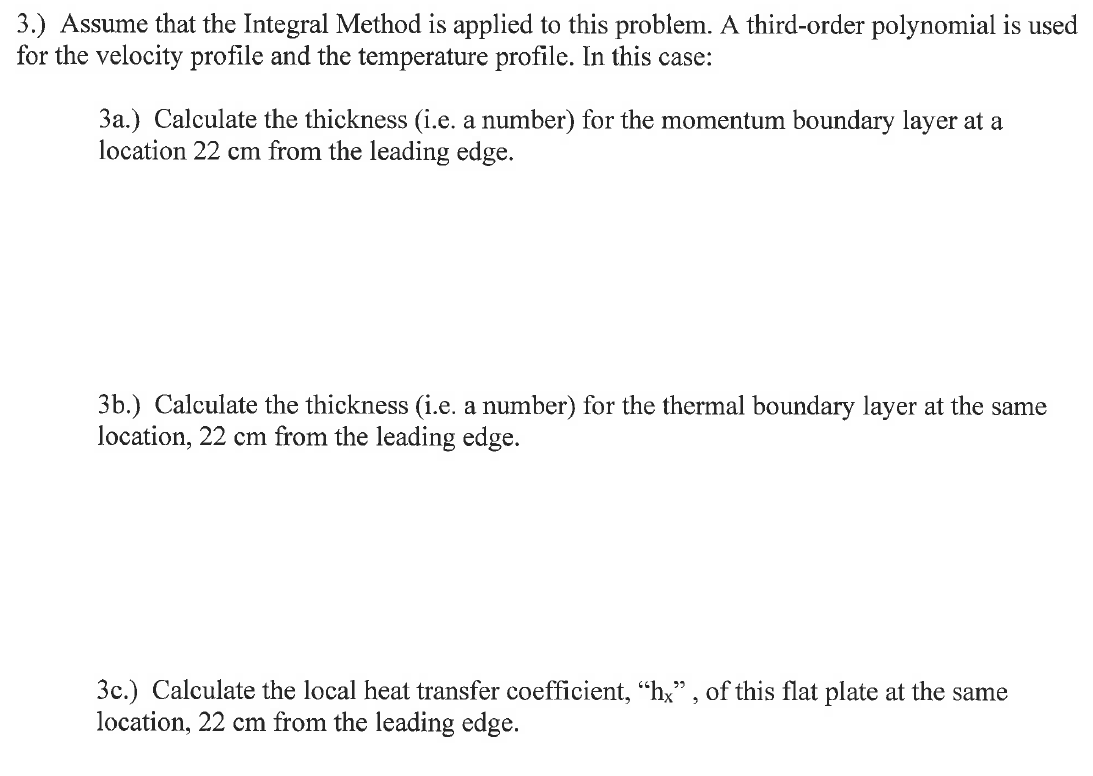
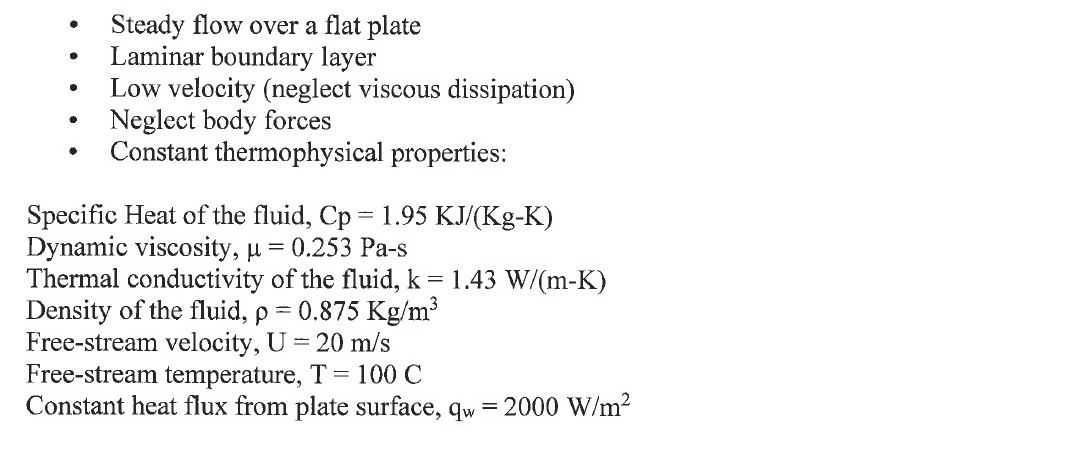
3.) Assume that the Integral Method is applied to this problem. A third-order polynomial is used for the velocity profile and the temperature profile. In this case: 3a.) Calculate the thickness (i.e. a number) for the momentum boundary layer at a location 22 cm from the leading edge. 3b.) Calculate the thickness (i.e. a number) for the thermal boundary layer at the same location, 22 cm from the leading edge. 3c.) Calculate the local heat transfer coefficient, "hx", of this flat plate at the same location, 22 cm from the leading edge. Steady flow over a flat plate Laminar boundary layer Low velocity (neglect viscous dissipation) Neglect body forces Constant thermophysical properties: Specific Heat of the fluid, Cp = 1.95 KJ/(Kg-K) Dynamic viscosity, = 0.253 Pa-s Thermal conductivity of the fluid, k = 1.43 W/(m-K) Density of the fluid, p = 0.875 Kg/m Free-stream velocity, U = 20 m/s Free-stream temperature, T = 100 C Constant heat flux from plate surface, qw = 2000 W/m
Step by Step Solution
There are 3 Steps involved in it

Get step-by-step solutions from verified subject matter experts
 Study Help