







Question: 3. ) Autism spectrum disorder has a frequency in the US of about 0.0091. The probability that a child is a boy is 0.51. If
3. ) Autism spectrum disorder has a frequency in the US of about 0.0091. The probability that a child is a boy is 0.51. If autism spectrum disorder and sex are independent, what is the probability that a randomly selected child will be a girl with autism spectrum disorder (in 4 decimal places)4. ) Each year about 3.5 million people in the US get measles, of these about 500 die. Given this, the probability of dying is?( 4 decimal places)5. ) Each year about 3.5 million people in the US get measles, of these about 500 die. If 100 people get measles, what is the probability that they all survive? 6. ) Assume that the probability that any child born in the population will be a boy is 0.51 and the probability that it will be a girl is 0.49. If a family has six children, what is the probability that they will have 3 boys and 3 girls? 7. ) About 10% of the human population is left handed. If that rate is correct and a class of 50 represented a random sample of the population as a whole, what is the probability that 6 or fewer students in the class would be left handed?
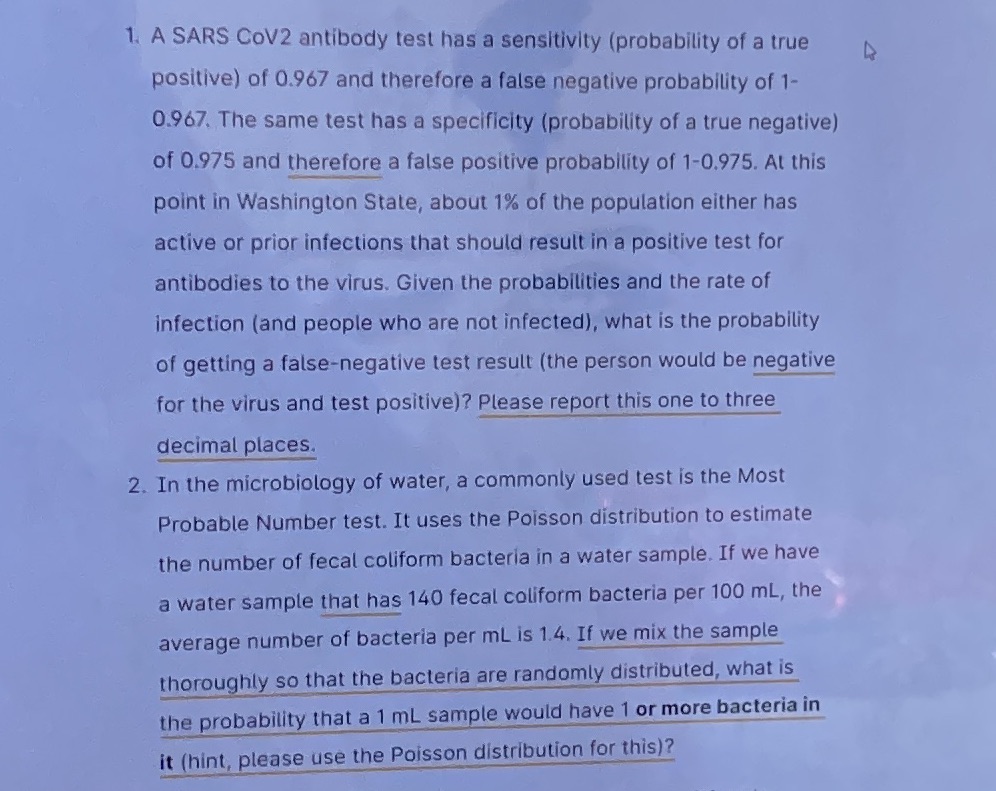
1. A SARS CoV2 antibody test has a sensitivity (probability of a true positive) of 0.967 and therefore a false negative probability of 1- 0.967. The same test has a specificity (probability of a true negative) of 0.975 and therefore a false positive probability of 1-0.975. At this point in Washington State, about 1% of the population either has active or prior infections that should result in a positive test for antibodies to the virus. Given the probabilities and the rate of infection (and people who are not infected), what is the probability of getting a false-negative test result (the person would be negative for the virus and test positive)? Please report this one to three decimal places. 2. In the microbiology of water, a commonly used test is the Most Probable Number test. It uses the Poisson distribution to estimate the number of fecal coliform bacteria in a water sample. If we have a water sample that has 140 fecal coliform bacteria per 100 mL, the average number of bacteria per mL is 1.4. If we mix the sample thoroughly so that the bacteria are randomly distributed, what is the probability that a 1 ml sample would have 1 or more bacteria in it (hint, please use the Poisson distribution for this)
Step by Step Solution
There are 3 Steps involved in it

Get step-by-step solutions from verified subject matter experts
 Study Help