







Question: 3. Detecting cracks You're a mechanical engineer working at a manufacturing center. There is an important piece of machinery, which has developed a crack
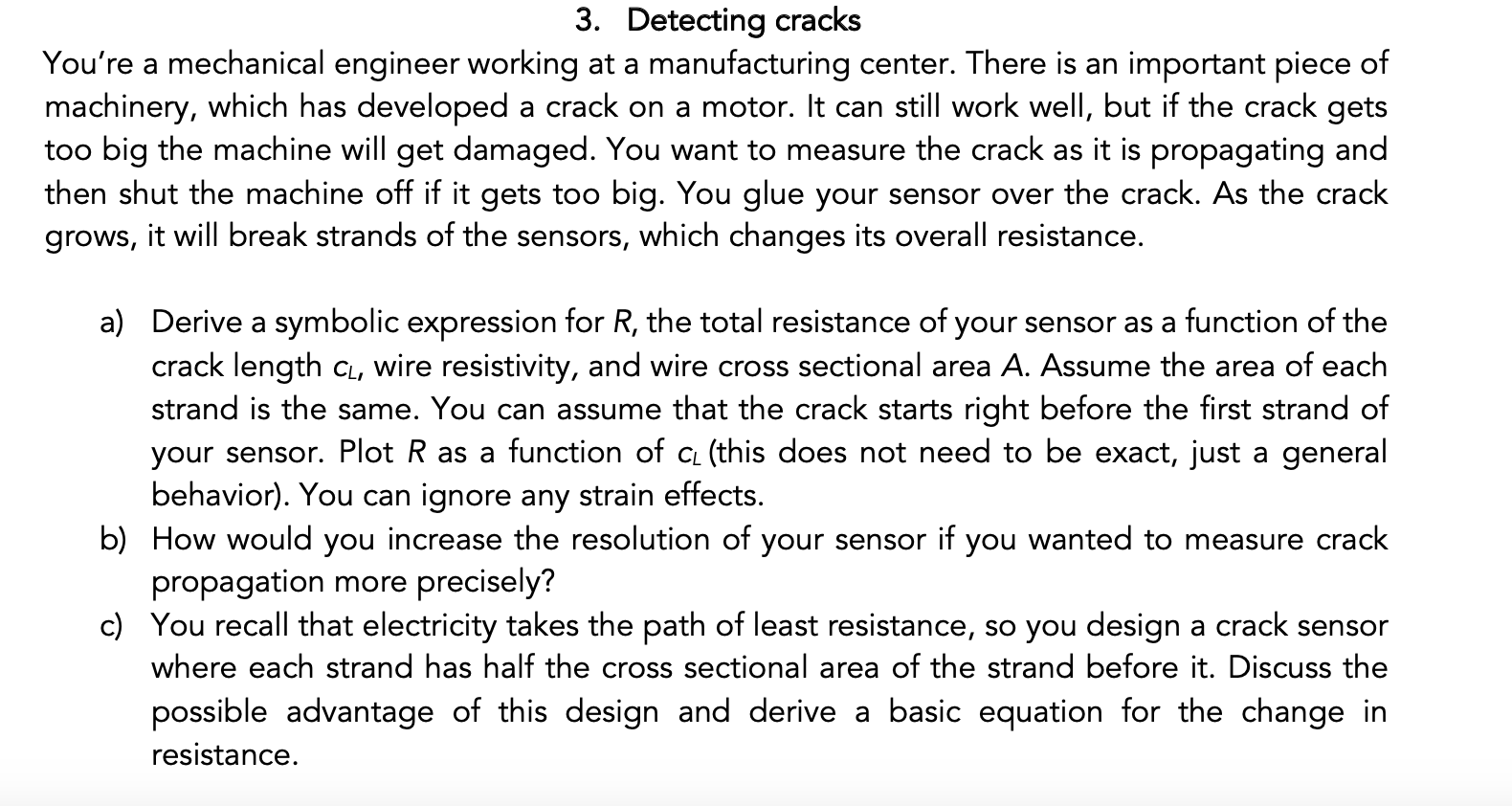
3. Detecting cracks You're a mechanical engineer working at a manufacturing center. There is an important piece of machinery, which has developed a crack on a motor. It can still work well, but if the crack gets too big the machine will get damaged. You want to measure the crack as it is propagating and then shut the machine off if it gets too big. You glue your sensor over the crack. As the crack grows, it will break strands of the sensors, which changes its overall resistance. a) Derive a symbolic expression for R, the total resistance of your sensor as a function of the crack length CL, wire resistivity, and wire cross sectional area A. Assume the area of each strand is the same. You can assume that the crack starts right before the first strand of your sensor. Plot R as a function of c (this does not need to be exact, just a general behavior). You can ignore any strain effects. b) How would you increase the resolution of your sensor if you wanted to measure crack propagation more precisely? c) You recall that electricity takes the path of least resistance, so you design a crack sensor where each strand has half the cross sectional area of the strand before it. Discuss the possible advantage of this design and derive a basic equation for the change in resistance.
Step by Step Solution
There are 3 Steps involved in it

Get step-by-step solutions from verified subject matter experts
 Study Help