







Question: . 3. Evaluate and explain Cirque du Soleil's efficiency, effectiveness, and value in your own words. 9-403-006 REY: OCTOBER 15, 2002 THOMAS DELONG VINEETA VIJAYARAGHAVAN
 .
.
3. Evaluate and explain Cirque du Soleil's efficiency, effectiveness, and value in your own words.
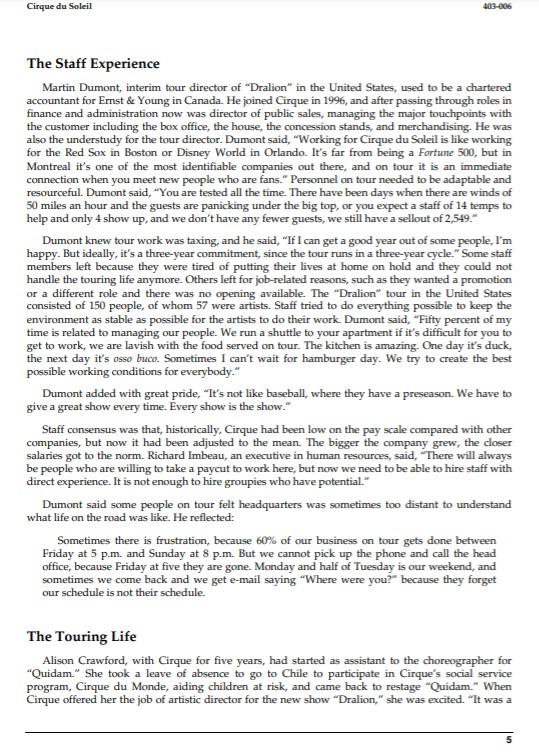
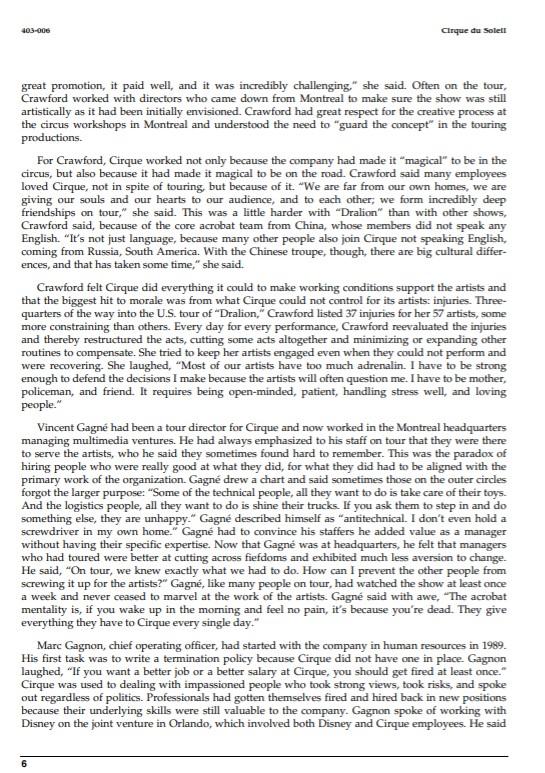
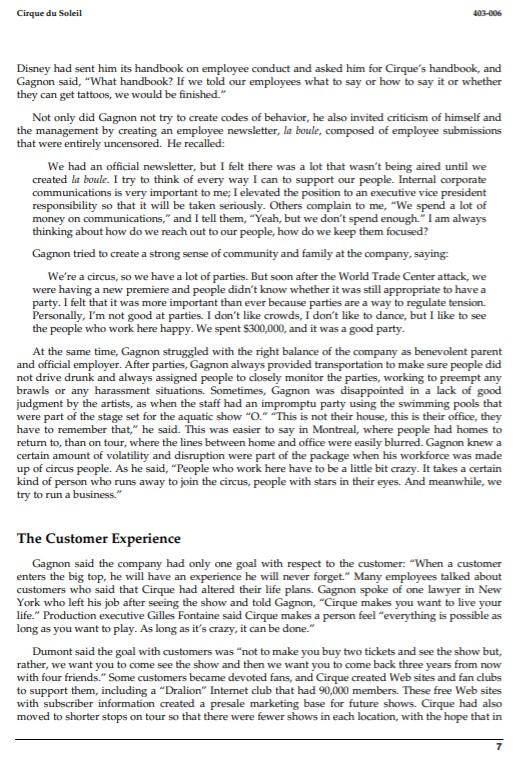
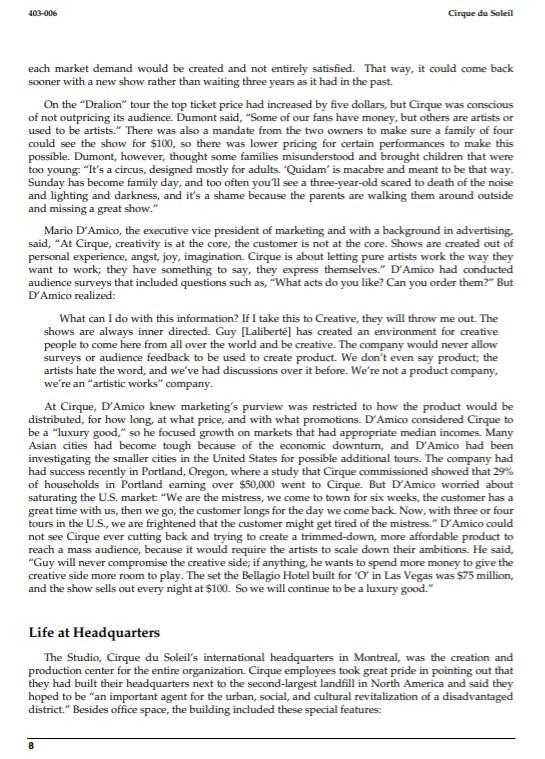
9-403-006 REY: OCTOBER 15, 2002 THOMAS DELONG VINEETA VIJAYARAGHAVAN Cirque du Soleil Murielle Cantin dragged her suitcases through the lobby of the hotel. It was one of the nicer hotels in Rio, but she missed her own bed, her own home back in Montreal, Canada. As casting director for Cirque du Soleil, Cantin was on the road for weeks, even months at a time, trying to find the best talent from the far reaches of the globe. Some of her artistic advisors were urging her to add Peru to this trip because they had scouted out some promising performers. Cantin considered whether she should make a detour to Peru. Had she seen enough artists already? Even if there were good possi- bilities in Peru, was she fresh anymore to evaluate them? Could she trust someone else to go and evaluate them in her stead? Cirque used to need 50 new artists every two years. Now it needed 100 artists every year. How would it handle the growth and keep the shows and the staff fresh? How would it keep the magic? Cantin wondered whether the touring performers felt as weary on the road as she felt now. History Cirque du Soleil was formed in 1984 by a troupe of street performers known as "Le Club des Talons Hauts" (The High-Heels Club), which had earlier founded the first street performers' festival in a small town outside Quebec City. Some members of the original group were still active at Cirque du Soleil, including Guy Lalibert, then a musician and firebreather, now president and chief executive officer. In 1984, 73 people worked for Cirque du Soleil. At the end of 2001, the organization had over 2,100 employees worldwide, including over 500 artists. Initially, Cirque du Soleil toured only one show at a time. From 1984 to 1989, Cirque played to an average of 270,000 people a year. In 2001, nearly 6 million people saw a Cirque du Soleil show. In 2002, there would be eight Cirque productions running on four continents. For most of Cirque's existence, it was owned and managed equally by two men, Lalibert and Daniel Gautier. Lalibert had responsibility for most of the creative production of the company, and Gautier managed most of the business, especially external partnerships and financing. In 1998, when Lalibert bought out Gautier's half, Carundian Business Magazine valued the company at $800 million Managing a company full of creative people was not always smooth. In 1987 and in 1988, there had been "artists' rebellions" where many of the performers disputed whether management was doing what was best for them and consistent with the original spirit of the group. In the mid-1990s, Cirque had tried decentralizing management into three regional divisions, one in North America, one in Europe, and one in Asia, to better support its shows traveling around the world. But this model 403-006 Cirque du Soleil had not worked, and eventually all management was centered at the Montreal headquarters. Some of the concerns about "going corporate" were tempered by the artists' trust in the charismatic and highly creative Lalibert. Lalibert wanted to grow aggressively, but he also eschewed becoming too corporate, especially having to answer to outside investors, who might help with his goal of growth but would constrain his freedom and his ability to treat his employees and invest in them as he chose. He had declared in a "60 Minutes" broadcast, "I will never go public." The Product Cirque was first and foremost a circus without animals. Cirque combined street performers, clowns, acrobats, and gymnasts to present feats and create theater and dance dramas. The music of Cirque was in a Latin-sounding language designed to transcend cultural boundaries. Even when Cirque started out with its first small-scale shows in Canada, it was mindful of globalization, both in staffing and content, eventually, it achieved globalization in audience too, leaving Canada for the first time in 1987. Cirque secured a loan of 1.5 million Canadian dollars from the Canadian government to buy equipment needed to go on tour. Lalibert took his troupe to the Los Angeles Festival to perform "We Reinvent the Circus." They would be given top billing but would be paid no fees, just a share of the box office. One Cirque executive recalled, "We gambled everything when we went to California. If we failed to bring in an audience, we were going to have to leave everything there in LA., because we didn't have the money even to pack the show up and transport it back" Cirque sold out its run in the festival and went on to tour other American cities. By 1990 it could support its first European production, and in 1992 Cirque performed in Asia for the first time. Richard Oberacker, currently conductor for the North American tour of "Dralion," said, "Cirque really became Cirque when they crossed the border and went to Los Angeles. They learned how to present the mystique, the branding, the cross-cultural message." In 1999 Cirque's multimedia division, Cirque du Soleil Images, released its first feature film, Alegra," based on the show of the same name, and its first television special, Cirque du Soleil Presents Quidam." In 2000, Cirque du Soleil created an IMAX large-format film production, "Journey of Man," distributed by Sony Pictures Classics. Cirque du Soleil continued to diversify its commercial activities including projects in publishing and merchandising. In December 1998, Cirque opened its first store right in its new permanent theater on the property of Walt Disney World Resort in Florida. The company was beginning to develop a concept for entertainment complexes, which it described as "presenting a unique blend of creation and the performing arts, of architecture and the arts in general." Facilities in each complex would include a permanent theater for a Cirque du Soleil production. The opening of the first complex, which Cirque said would serve as a laboratory," was planned for Montreal in 2003-2004. The Artists' Experience Artists had very different views of their experience at Cirque depending on their point of comparison. The conductor Oberacker had come from Broadway, and to him the Girque product was less astonishing given his previous exposure to highly creative costuming, lighting, and dance. Said Oberacker, "Cirque is partly about putting it all together. We're impressed because someone's balancing on a beam for six minutes, but they've been doing that in Chinese acrobatics for millions of years. But we add the lighting, the costumes, and it's new for our audiences. Oberacker had not always sounded so blas. He first became interested in becoming involved in Cirque when he saw 2 Cirque du Soleil 403-006 "Mystre" performed in Las Vegas, and he said it was so powerful he wept. "Cirque is like incredibly well-crafted film, it is powerful and moving. But if you are in the industry, you know the craft, you see how the machine works," he said. Oberacker had been part of the union that served musicians and actors on Broadway, so Cirque took some getting used to. He recalled: I almost jumped from a 10-story building when they told me my starting salary two and a half years ago, it was so low. But they told me, build the blocks, put in your time, the rewards will be there. We do 10 shows a week, which is two more than any Broadway house, and it's sometimes a strain. We are paid per show, not per week, so we are unemployed for a fourth of the year. The Broadway union required employers to provide a per-diem stipend for food and housing, whereas Cirque provided the food and housing directly. Oberacker said the 12 hours of rehearsal he put in every week without remuneration would never have been allowed in a Broadway theater. Oberacker knew his ambitions as a composer would be best served by leaving Cirque within a few years, but for now Oberacker loved the central role he had in the performance every night and the headiness of total mutual interdependence between himself and the artists. I thought I was going to wave a stick and conduct. Instead, every night I feel the responsibility for the emotional impact of the show right here," he said, pointing to his shoulders Gonzalo Munoz had come to Cirque from the world of clowning. He had grown up in Colombia and studied theater in Colombia and then in France before joining the famous clowning and mime school in Paris, Le Coq. He went to New York and participated in a small troupe with other mimes, sometimes on a stage, sometimes on the street comer, and always I am dreaming of being in a circus," Munoz said. He heard about Cirque du Soleil and went to see "Quidam." Munoz did not actually like the role of clowns in the show, but he had great respect for one of the clown artists, and it was in order to work with him that he accepted a job with Cirque. The professional clown reflected, clowns here are great in skill and in personality. We are all learning together, we are falling in love with each other's work. And then we have the experience of sharing our stage with amazing trapeze artists and acrobats. I have only been here six months, and maybe I will get jaded later on, but right now, I am dancing in a garden of flowers." Munoz added, "I had always fought to stay in this field and be with people I loved to work with, but I didn't always make it economically." He estimated that working at Cirque provided a 300% pay raise over his previous work. He also valued the noneconomic benefits that Cirque provided, such as language training onsite in six languages to help the artists communicate with the other employees from all over the world. He stated: Cirque works hard to keep artists happy. There is a great master clown in New York that some of us wanted to work with, and we asked Montreal and they sent someone to see his work and they said yes, we could have classes. So he was hired and came and taught us, and it was wonderful. Now we clowns who have been trained in so many different places and techniques share a new common expertise as well. The Challenge Cantin, casting director for Cirque, said it was a constant challenge to find the right artists. "We are trying to find in a desert the pearl that will fit the perfect ring" she said. When casting a new production, Cantin often traveled to more than 20 countries to meet with local artists and hold 403-006 Cirque du Soleil auditions. At the same time that Cantin tried to select artists to fit into the currently conceived productions, she also looked for their potential contributions to future productions at Cirque "Cirque helps artists to grow, and artists help Cirque to grow," she said. "Creativity is a sculpture; we take good material, and then we compose with it. The environment we integrate the artists into is not a fixed environment, it lives." Many Cirque artists had been gymnasts or acrobats. Cirque offered them their first experience outside the rigid training of their chosen discipline. Cantin said, We are offering them a new life, it's like opening a red door for every one of them. Behind it are some fantasies they may never have been exposed to. They have to learn to perform in a very dialectic way, we teach them to expand, to blow up, to be in touch with who they are." Cirque challenged artists to learn to move flexibly between artistic forms, mixing Brazilian dance with classical ballet with mime. Traditionally trained artists learned, often for the first time, to perform in an intensely multicultural background. Cantin said, "The artist has to trust someone to catch them in a dance routine. This can't happen if the artist is prejudiced against Arab people or Japanese people." Cantin tried to evaluate what the artist's needs were in coming to Cirque and how much support that would require. Some artists were integrating an established solo act and were autonomous, while others were joining for a career and needed much more artistic guidance. When hiring artists from different countries, Cantin took into consideration what their nonartistic needs were. The casting director highlighted the impact of Cirque on the lives of the artists We have cast children who live on the streets of Brazil, and we changed their lives. Children who have parents are better off when we use them in an act with their parents, there is never a problem then, but otherwise, it can be too hard on them to go through some of their growing up here. We have cast people from certain African villages, and we have to be very conscious of not isolating them. If we find a single person with talent in that village that year, we don't bring him because it is too difficult for him. We only bring him if we find a few people who are equally talented that he can be supported by and who can support him. The dangerous responsibility for me is knowing that he might beg us to bring him. He wants the economic and artistic opportunity so desperately and says he doesn't care, he can manage, but I have to trust what I have leamed in the past. We thrive on what these new artists bring us. but we also have to help them grow. We are seen in many places as a merchant of dreams, and we can be. But to come and work here, there is more than the magic of the show. Behind the scenes, there is a lot of sweat. During auditions, Cantin tried to measure two key dimensions besides pure talent: "Can they continue to develop?" and "Can they be generous in the show?" She said, "You have to be humble when you are casting, sometimes one can get too specialized, too pretentious. When I went on my first trip to China, I had to clear my head of prejudgement and try to understand where they came from, and think what can our artists share with them, what can we contribute?" Bernard Petiot had coached gymnasts and Olympic teams for Canada before he joined Cirque du Soleil. He created general four-month programs to train 40 athletes at a time, who were then chosen for a given show and had more specialized training in the acts for that show. "I make sure the whole environment is there to support the learner," he said. There were 475 acrobats with Cirque, and it expected to surpass 500 in the coming year, with turnover around 15%. When a new show was being created, Petiot worked closely with the artistic directors. He explained, "The directors say this is what the show is like, and we try to create a plan for the acrobatics, and we try a number of different things, knowing that what we are giving as an answer may not be retained and we will try again. I thought I knew what brainstorming meant before I came here, but I had no idea." Cirque du Soleil 403-006 213.20 The Staff Experience Martin Dumont, interim tour director of "Dralion" in the United States, used to be a chartered accountant for Ernst & Young in Canada. He joined Cirque in 1996, and after passing through roles in finance and administration now was director of public sales, managing the major touchpoints with the customer including the box office, the house, the concession stands, and merchandising. He was also the understudy for the tour director. Dumont said, "Working for Cirque du Soleil is like working for the Red Sox in Boston or Disney World in Orlando. It's far from being a Fortune 500, but in Montreal it's one of the most identifiable companies out there, and on tour it is an immediate connection when you meet new people who are fans." Personnel on tour needed to be adaptable and resourceful. Dumont said, "You are tested all the time. There have been days when there are winds of 50 miles an hour and the guests are panicking under the big top, or you expect a staff of 14 temps to help and only 4 show up, and we don't have any fewer guests, we still have a sellout of 2,549." Dumont knew tour work was taxing, and he said, "If I can get a good year out of some people, I'm happy. But ideally, it's a three-year commitment, since the tour runs in a three-year cycle." Some staff members left because they were tired of putting their lives at home on hold and they could not handle the touring life anymore. Others left for job-related reasons, such as they wanted a promotion or a different role and there was no opening available. The "Dralion" tour in the United States consisted of 150 people, of whom 57 were artists. Staff tried to do everything possible to keep the environment as stable as possible for the artists to do their work. Dumont said, "Fifty percent of my time is related to managing our people. We run a shuttle to your apartment if it's difficult for you to get to work, we are lavish with the food served on tour. The kitchen is amazing. One day it's duck, the next day it's asso buco. Sometimes I can't wait for hamburger day. We try to create the best possible working conditions for everybody." Dumont added with great pride, "It's not like baseball, where they have a preseason. We have to give a great show every time. Every show is the show." Staff consensus was that, historically, Cirque had been low on the pay scale compared with other companies, but now it had been adjusted to the mean The bigger the company grew, the closer salaries got to the norm. Richard Imbeau, an executive in human resources, said, "There will always be people who are willing to take a paycut to work here, but now we need to be able to hire staff with direct experience. It is not enough to hire groupies who have potential." Dumont said some people on tour felt headquarters was sometimes too distant to understand what life on the road was like. He reflected: Sometimes there is frustration, because 60% of our business on tour gets done between Friday at 5 p.m. and Sunday at 8 p.m. But we cannot pick up the phone and call the head office, because Friday at five they are gone. Monday and half of Tuesday is our weekend, and sometimes we come back and we get e-mail saying "Where were you?" because they forget our schedule is not their schedule. The Touring Life Alison Crawford, with Cirque for five years, had started as assistant to the choreographer for "Quidam." She took a leave of absence to go to Chile to participate in Cirque's social service program, Cirque du Monde, aiding children at risk, and came back to restage "Quidam." When Cirque offered her the job of artistic director for the new show "Dralion," she was excited. "It was a 5 403-000 Cirque du Soleil great promotion, it paid well, and it was incredibly challenging," she said. Often on the tour, Crawford worked with directors who came down from Montreal to make sure the show was still artistically as it had been initially envisioned. Crawford had great respect for the creative process at the circus workshops in Montreal and understood the need to "guard the concept in the touring productions. For Crawford, Cirque worked not only because the company had made it "magical" to be in the circus, but also because it had made it magical to be on the road. Crawford said many employees loved Cirque, not in spite of touring but because of it. "We are far from our own homes, we are giving our souls and our hearts to our audience, and to each other, we form incredibly deep friendships on tour," she said. This was a little harder with "Dralion" than with other shows, Crawford said, because of the core acrobat team from China, whose members did not speak any English. "It's not just language, because many other people also join Cirque not speaking English, coming from Russia, South America. With the Chinese troupe, though, there are big cultural differ- ences, and that has taken some time," she said. Crawford felt Cirque did everything it could to make working conditions support the artists and that the biggest hit to morale was from what Cirque could not control for its artists: injuries. Three- quarters of the way into the U.S. tour of "Dralion," Crawford listed 37 injuries for her 57 artists, some more constraining than others. Every day for every performance, Crawford reevaluated the injuries and thereby restructured the acts, cutting some acts altogether and minimizing or expanding other routines to compensate. She tried to keep her artists engaged even when they could not perform and were recovering. She laughed, Most of our artists have too much adrenalin. I have to be strong enough to defend the decisions I make because the artists will often question me. I have to be mother, policeman, and friend. It requires being open-minded, patient, handling stress well, and loving people." Vincent Gagn had been a tour director for Cirque and now worked in the Montreal headquarters managing multimedia ventures. He had always emphasized to his staff on tour that they were there to serve the artists, who he said they sometimes found hard to remember. This was the paradox of hiring people who were really good at what they did, for what they did had to be aligned with the primary work of the organization. Gagn drew a chart and said sometimes those on the outer circles forgot the larger purpose: "Some of the technical people, all they want to do is take care of their toys. And the logistics people, all they want to do is shine their trucks If you ask them to step in and do something else, they are unhappy" Gagn described himself as "antitechnical. I don't even hold a screwdriver in my own home." Gagn had to convince his staffers he added value as a manager without having their specific expertise. Now that Gagn was at headquarters, he felt that managers who had toured were better at cutting across fiefdoms and exhibited much less aversion to change. He said, On tour, we knew exactly what we had to do. How can I prevent the other people from screwing it up for the artists?" Gagn, like many people on tour, had watched the show at least once a week and never ceased to marvel at the work of the artists. Gagn said with awe, "The acrobat mentality is, if you wake up in the morning and feel no pain, it's because you're dead. They give everything they have to Cirque every single day." Marc Gagnon, chief operating officer, had started with the company in human resources in 1989. His first task was to write a termination policy because Cirque did not have one in place. Gagnon laughed, "If you want a better job or a better salary at Cirque, you should get fired at least once." Cirque was used to dealing with impassioned people who took strong views, took risks, and spoke out regardless of politics. Professionals had gotten themselves fired and hired back in new positions because their underlying skills were still valuable to the company. Gagnon spoke of working with Disney on the joint venture in Orlando, which involved both Disney and Cirque employees. He said Cirque du Soleil 403-006 Disney had sent him its handbook on employee conduct and asked him for Cirque's handbook, and Gagnon said, "What handbook? If we told our employees what to say or how to say it or whether they can get tattoos, we would be finished." Not only did Gagnon not try to create codes of behavior, he also invited criticism of himself and the management by creating an employee newsletter, la boule, composed of employee submissions that were entirely uncensored. He recalled: We had an official newsletter, but I felt there was a lot that wasn't being aired until we created la boule. I try to think of every way I can to support our people. Internal corporate communications is very important to me; I elevated the position to an executive vice president responsibility so that it will be taken seriously. Others complain to me, "We spend a lot of money on communications," and I tell them, "Yeah, but we don't spend enough" I am always thinking about how do we reach out to our people, how do we keep them focused? Gagnon tried to create a strong sense of community and family at the company, saying We're a circus, so we have a lot of parties. But soon after the World Trade Center attack, we were having a new premiere and people didn't know whether it was still appropriate to have a party. I felt that it was more important than ever because parties are a way to regulate tension Personally, I'm not good at parties. I don't like crowds, I don't like to dance, but I like to see the people who work here happy. We spent $300,000, and it was a good party. At the same time, Gagnon struggled with the right balance of the company as benevolent parent and official employer. After parties, Gagnon always provided transportation to make sure people did not drive drunk and always assigned people to closely monitor the parties, working to preempt any brawls or any harassment situations. Sometimes, Gagnon was disappointed in a lack of good judgment by the artists, as when the staff had an impromptu party using the swimming pools that were part of the stage set for the aquatic show "0." "This is not their house, this is their office, they have to remember that," he said. This was easier to say in Montreal, where people had homes to return to, than on tour, where the lines between home and office were easily blurred. Gagnon knew a certain amount of volatility and disruption were part of the package when his workforce was made up of circus people. As he said, "People who work here have to be a little bit crazy. It takes a certain kind of person who runs away to join the circus, people with stars in their eyes. And meanwhile, we try to run a business." The Customer Experience Gagnon said the company had only one goal with respect to the customer: "When a customer enters the big top, he will have an experience he will never forget. Many employees talked about customers who said that Cirque had altered their life plans. Gagnon spoke of one lawyer in New York who left his job after seeing the show and told Gagnon, "Cirque makes you want to live your life." Production executive Gilles Fontaine said Cirque makes a person feel everything is possible as long as you want to play. As long as it's crazy, it can be done." Dumont said the goal with customers was not to make you buy two tickets and see the show but, rather, we want you to come see the show and then we want you to come back three years from now with four friends." Some customers became devoted fans, and Cirque created Web sites and fan clubs to support them, including a "Dralion" Internet club that had 90,000 members. These free Web sites with subscriber information created a presale marketing base for future shows. Cirque had also moved to shorter stops on tour so that there were fewer shows in each location, with the hope that in 7 403-006 Cirque du Soleil each market demand would be created and not entirely satisfied. That way, it could come back sooner with a new show rather than waiting three years as it had in the past On the Dralion" tour the top ticket price had increased by five dollars, but Cirque was conscious of not outpricing its audience. Dumont said, "Some of our fans have money, but others are artists or used to be artists." There was also a mandate from the two owners to make sure a family of four could see the show for $100, so there was lower pricing for certain performances to make this possible. Dumont, however, thought some families misunderstood and brought children that were too young "It's a circus, designed mostly for adults. "Quidam' is macabre and meant to be that way. Sunday has become family day, and too often you'll see a three-year-old scared to death of the noise and lighting and darkness, and it's a shame because the parents are walking them around outside and missing a great show." Mario D'Amico, the executive vice president of marketing and with a background in advertising said, "At Cirque, creativity is at the core, the customer is not at the core. Shows are created out of personal experience, angst , joy, imagination. Cirque is about letting pure artists work the way they want to work; they have something to say, they express themselves." D'Amico had conducted audience surveys that included questions such as, "What acts do you like? Can you order them?" But D'Amico realized: What can I do with this information? If I take this to Creative, they will throw me out. The shows are always inner directed. Guy [Lalibert] has created an environment for creative people to come here from all over the world and be creative. The company would never allow surveys or audience feedback to be used to create product. We don't even say product, the artists hate the word, and we've had discussions over it before. We're not a product company, we're an artistic works" company. At Cirque, D'Amico knew marketing's purview was restricted to how the product would be distributed, for how long, at what price, and with what promotions. D'Amico considered Cirque to be a "luxury good," so he focused growth on markets that had appropriate median incomes. Many Asian cities had become tough because of the economic downtum, and D'Amico had been investigating the smaller cities in the United States for possible additional tours. The company had had success recently in Portland, Oregon, where a study that Cirque commissioned showed that 29% of households in Portland eaming over $50,000 went to Cirque. But D'Amico worried about saturating the U.S. market "We are the mistress, we come to town for six weeks, the customer has a great time with us, then we go, the customer longs for the day we come back. Now, with three or four tours in the U.S., we are frightened that the customer might get tired of the mistress." D'Amico could not see Cirque ever cutting back and trying to create a trimmed-down, more affordable product to reach a mass audience, because it would require the artists to scale down their ambitions. He said, "Guy will never compromise the creative side, if anything, he wants to spend more money to give the creative side more room to play. The set the Bellagio Hotel built for 'O in Las Vegas was $75 million, and the show sells out every night at $100. So we will continue to be a luxury good." Life at Headquarters The Studio, Cirque du Soleil's international headquarters in Montreal, was the creation and production center for the entire organization Cirque employees took great pride in pointing out that they had built their headquarters next to the second-largest landfill in North America and said they hoped to be "an important agent for the urban, social, and cultural revitalization of a disadvantaged district." Besides office space, the building included these special features. 8 Cirque du Soleil 403-006 a 75-foot-high training room covering 15,250 square feet, equipped with a trampoline-like grid made of 23 miles of braided metal cable stretched 60 feet above the floor. The technicians used the grid to hang acrobatic and technical equipment in complete safety. a training room covering 8,400 square feet, containing a pit filled with 25,000 Styrofoam cubes (rather than the conventional safety net) and a "fast track" (a trampoline at least 32 feet in length). ad dance studio covering 3,860 square feet a cafeteria run by a food services director who was once chef to a Canadian prime minister. an outdoor site for a big top seating 3,000 people that could be set up for Cirque's Montreal performances. an outdoor terrace to house recreational activities for the public such as musical brunches, circus workshops, and open-house events. a vegetable garden whose harvest went to prepare meals at the cafeteria, with any surplus given to staff and local residents. The Studio was designed so that offices lined the building's central axis, surrounded by training studios in order to foster visual contact between personnel. As one Cirque employee described it, "The administrative staff thus keep in touch with the artistic progress of shows, while the artists see firsthand the support they receive from the employees." Completed in 1997, The Studio was expected to meet Cirque du Soleil's needs for 10 years but had already been enlarged three times. Headquarters tried to stay tied in to the touring shows, what Fontaine described as "staying in contact with the source." Without ever having seen a show, when he was approached by Cirque he demurred, saying, "It's nice, but not for me." After Cirque sent him to see "Saltimbanco" in Germany, he said, "Okay, that's what I want to do." Said Fontaine, "The show drives us, it's not only for the patrons, it's for the employees." But many people at headquarters had never seen a show. Cirque had sent busloads of employees to New York when a show was on tour there, but of the 200 people who worked in costumes, fewer than half had seen a show. Often when someone on tour told Fontaine they were thinking of quitting, Fontaine would tell them, "Go see the show tonightif it's not enough, it may be time to go." Stephane, an IT professional, said, "The closer you are to creating the ultimate show onstage, the more you feel the magic." The company tried to find ways to tie everyone in to the end product. All employees on hand were invited to help raise the big top at the start of a new show, which was a big celebratory event. Employees had also been involved in taping a "thank you for an award ceremony so that it was not only management that was represented. Employees were given jackets that were prized possessions, and employees often monitored the escalating price of the jackets that had been auctioned off on eBay. There was instant connection when employees saw others wearing jackets in downtown Montreal or in the cities they were touring. Imbeau said, "When we decided to close our set department and outsource the building of sets, we were very saddened to tell the employees that they would be laid off. At the meeting, some people asked, "Do I still get to keep my jacket? Even if it was coming to an end, they were proud of their time with Cirque." Some employees worked at Cirque because they were leaming and practicing their craft with the best in their field. Gaeten, who worked in props, said, "If I can build a prop in 20 hours and it's okay, but I tell them I can spend another 20 hours to make it great, they always say spend the extra time 403-006 Cirque du Soleil Everyone here cares about quality." Frederique in costumes agreed: "I had a boss at my old job who said, 'Stop making things nice.' Here everybody notices every last detail; your work is recognized." Employees kept in mind what Lalibert had once said: "The reason why I'm not going public is! want to be able to make decisions that don't make business sense." He did not want to answer to investors or shareholders, and though some employees joked this was because he was a megalomaniac, most were glad Lalibert ran the company and kept it private. "If it had been the other way around, if Guy had sold his shares to Daniel, we would have lost our soul," said Imbeau Danielle Pouliot, in strategy and planning, said, "Eighty percent of business strategy at this company is Guy's vision. It might change completely from one day to the next." Though Pouliot was aware of this, she tried to have managers create six-month plans so people could set out and follow priorities. She said, "At the Cirque people don't really like to be managed. They don't like to be monitored. But they are asking, Where are we going?" And they are asking for the tools of corporate life strategy, mission, plan, and process." Problems and Plans Some employees said they felt that Cirque was not that original when compared to other offerings in Europe and that they expected the shows to continue to make most of their money in North America. Asian tours had also been less successful. In 1997, Gautier and Gagnon had tried decentralization, having three separate headquarters and profit centersin North America, Europe, and Asiato develop the markets. But there were difficulties. The company was asking Asia to meet the same break-even capacity numbers of 70% as the United States, but Asia was only at 65% capacity on average, while the United States was often at 90%. Currency rates also threatened the profits in Asia, as well as the fact that, because world tours began in North America and ended in Asia, employees had gotten more senior and more costly. When Asia tried to negotiate to pay them less to manage its costs, there was widespread dissatisfaction. Recentralization in Montreal resolved the issues on the staff and compensation front but lessened the managerial urgency to develop the overseas markets. In the North American market, saturation was an impending concern, with a touring production usually delivering 375 shows in one year to a capacity audience of 2,500 per show at an average ticket price of $55. One executive said, "We have to plan the right priorities for the next five years. We have to stop making sudden turns and trying to absorb tidal waves." Planning needed to take these organizational issues into account: Diversification into other types of products, that is complex cirques, spas, and so on. Gagnon said, "Diversification is a problem for our sense of belonging. When show people see the show they have created and it moves them, they cry. No one in the hotel business cries." Lalibert was investing the organization's time, money, and resources in a sector new to Cirque, the construction of entertainment complexes. Pouliot said, "I know we can do something very crazy, but will it be viable, a good source of revenue? I hope someone knows." More business people joining the company's upper ranks. The executive forum was starting to have a business flavor. Pouliot commented, "We have to find the right mix, we must not kill the soul of Cirque, and yet we are a big business, we make a lot of money, so we have to make good decisions and we have to protect the assets." 10 Cirque du Soleil 103-006 More competition. One rival, Cirque Oz, in Australia, tried to prevent Cirque du Soleil from getting permits. Gagnon commented, "The irony was that after Cirque du Soleil left, Oz made more money on their next tour. We are still building the market, and it's better if we don't all see each other as the enemy." High ticket prices were removing a lot of possible audience members and making some employees concerned that Cirque was only for the privileged. Could Girque create something for those other than the rich? Some Cirque performers wanted to create a "Cirque Lite," which would have fewer artists and be less expensive to produce. Cirque had to reinvent the circus every so often; even if it still worked for customers, it would get old for the artists. It had to keep them excited about the work Cantin stopped by the Brazilian hotel's travel services desk to book a plane ticket to Peru. She had decided she would make the extra stop, since she really needed a few key positions filled in the new show, "Varekai," that Cirque was planning to launch in April 2002 But she worried that Cirque was growing too fast for its own good. There was the chance of wearing out its welcome in the North American market of running low on original talent, and of doing something less than Cirque quality in its creation of entertainment complexes. There were so many moving pieces. Cantin sometimes wondered if there was a strategy in place at all, but perhaps Cirque did not need a strategy other than to focus on its artists. That approach had certainly served Cirque well in the past. 11Step by Step Solution
There are 3 Steps involved in it
1 Expert Approved Answer
Step: 1 Unlock

Question Has Been Solved by an Expert!
Get step-by-step solutions from verified subject matter experts
Step: 2 Unlock
Step: 3 Unlock
 Study Help