







Question: 3 Evolutionary game theory 10+20+10+10+15+10* points Consider a 2 player, 3 strategy game with the following payoff matrix -b with b > 0 3 i)
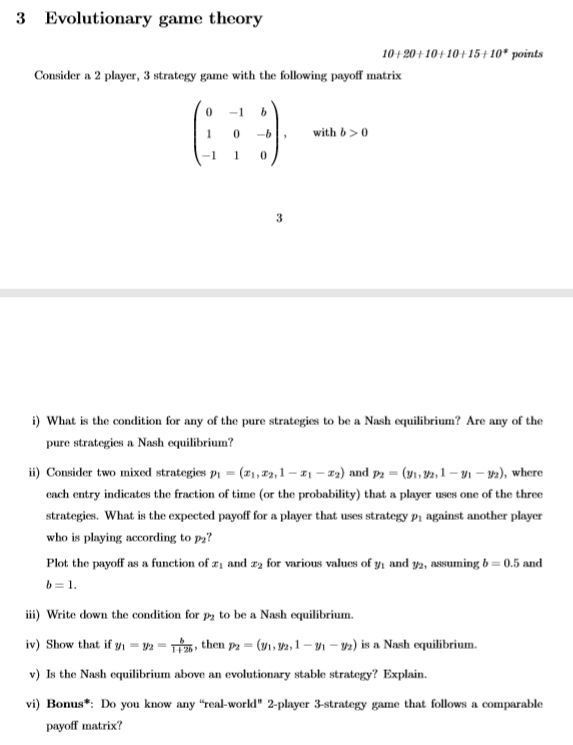
3 Evolutionary game theory 10+20+10+10+15+10* points Consider a 2 player, 3 strategy game with the following payoff matrix -b with b > 0 3 i) What is the condition for any of the pure strategies to be a Nash equilibrium? Are any of the pure strategies a Nash equilibrium? ii) Consider two mixed strategies p1 = (21, 22, 1 -21 - 22) and pa = (1/1, 1/2, 1 - 3/1 - 9/2), where each entry indicates the fraction of time (or the probability) that a player uses one of the three strategies. What is the expected payoff for a player that uses strategy p, against another player who is playing according to pa? Plot the payoff as a function of z, and zo for various values of y and yo, assuming b = 0.5 and b= 1. iii) Write down the condition for pa to be a Nash equilibrium. iv) Show that if #1 = 1/2 = 1725, then pa = (11, 1/2, 1 -3/1 - 1/2) is a Nash equilibrium. v) Is the Nash equilibrium above an evolutionary stable strategy? Explain. vi) Bonus*: Do you know any "real-world" 2-player 3-strategy game that follows a comparable payoff matrix
Step by Step Solution
There are 3 Steps involved in it

Get step-by-step solutions from verified subject matter experts
 Study Help