



Question: (3) Fermi Gas: Quantum physics allows us to understand easily an otherwise mystifying aspect of nature: molecules, atoms, nuclei and nucleons are essentially empty
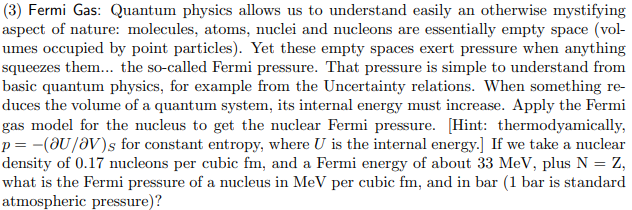
(3) Fermi Gas: Quantum physics allows us to understand easily an otherwise mystifying aspect of nature: molecules, atoms, nuclei and nucleons are essentially empty space (vol- umes occupied by point particles). Yet these empty spaces exert pressure when anything squeezes them... the so-called Fermi pressure. That pressure is simple to understand from basic quantum physics, for example from the Uncertainty relations. When something re- duces the volume of a quantum system, its internal energy must increase. Apply the Fermi gas model for the nucleus to get the nuclear Fermi pressure. [Hint: thermodyamically, p = -(/V)s for constant entropy, where U is the internal energy.] If we take a nuclear density of 0.17 nucleons per cubic fm, and a Fermi energy of about 33 MeV, plus N = Z, what is the Fermi pressure of a nucleus in MeV per cubic fm, and in bar (1 bar is standard atmospheric pressure)?
Step by Step Solution
There are 3 Steps involved in it

Get step-by-step solutions from verified subject matter experts