







Question: 3. Here we consider uarious solids of revolution whose axis is the diagonal line y = :13. The goal is to adapt the pile of
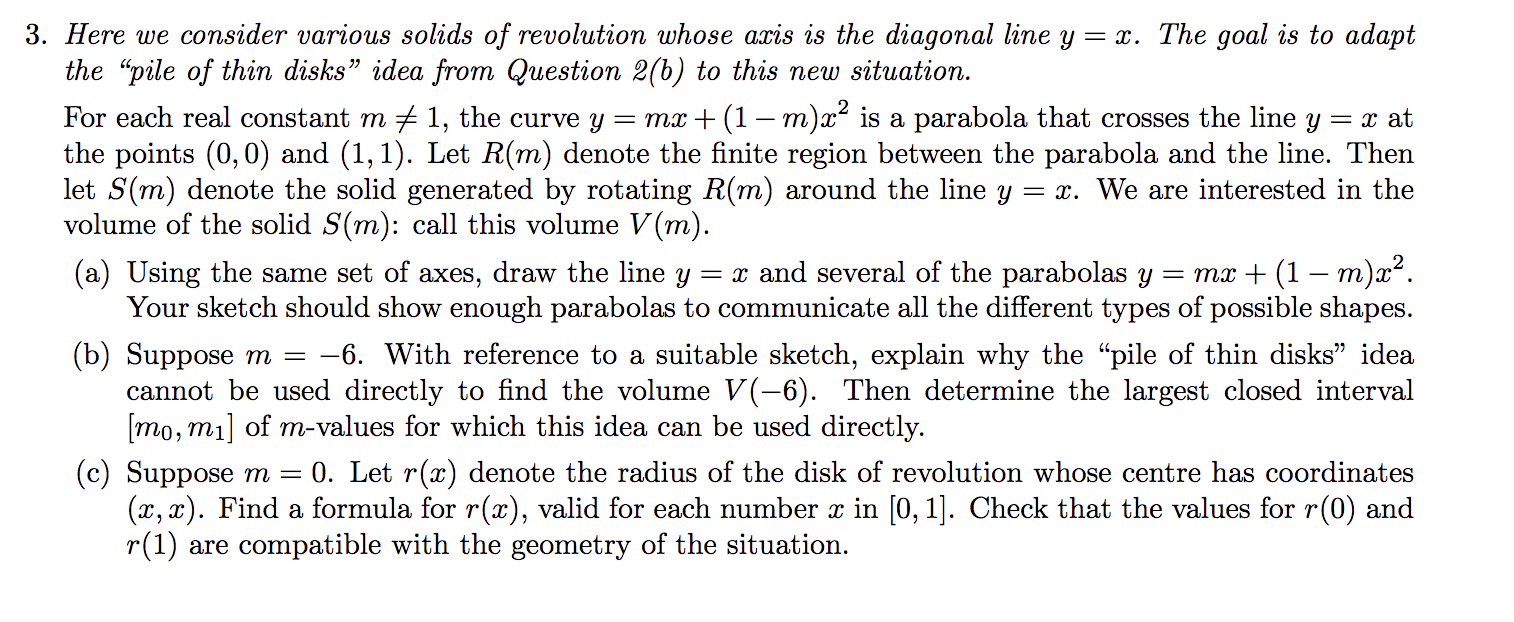
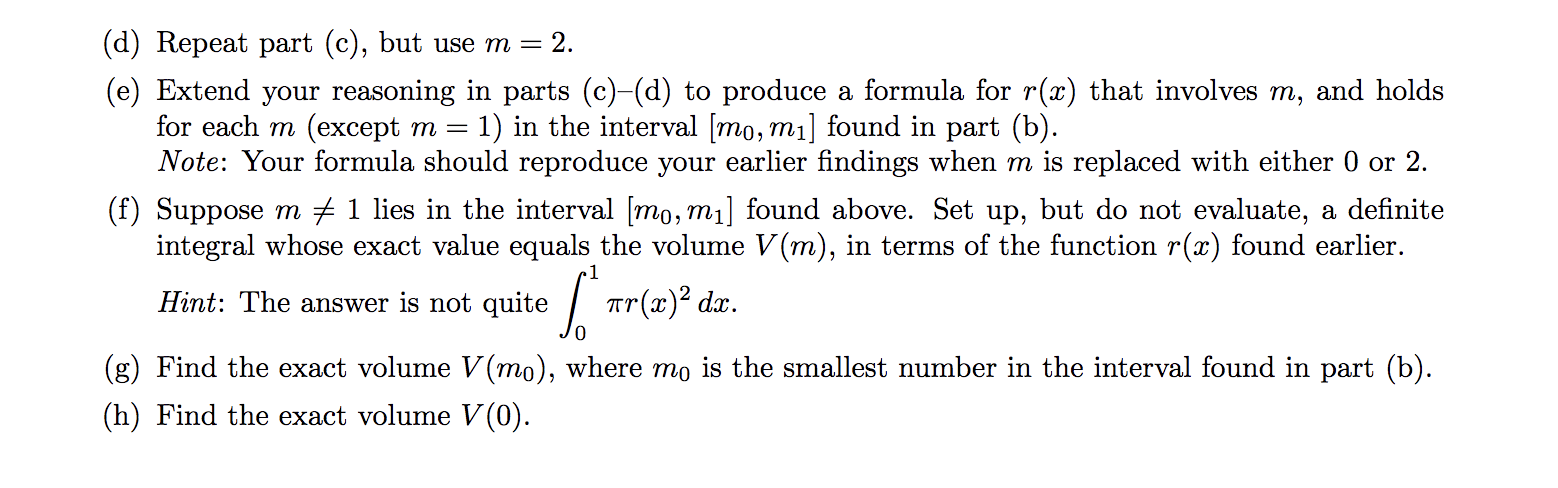
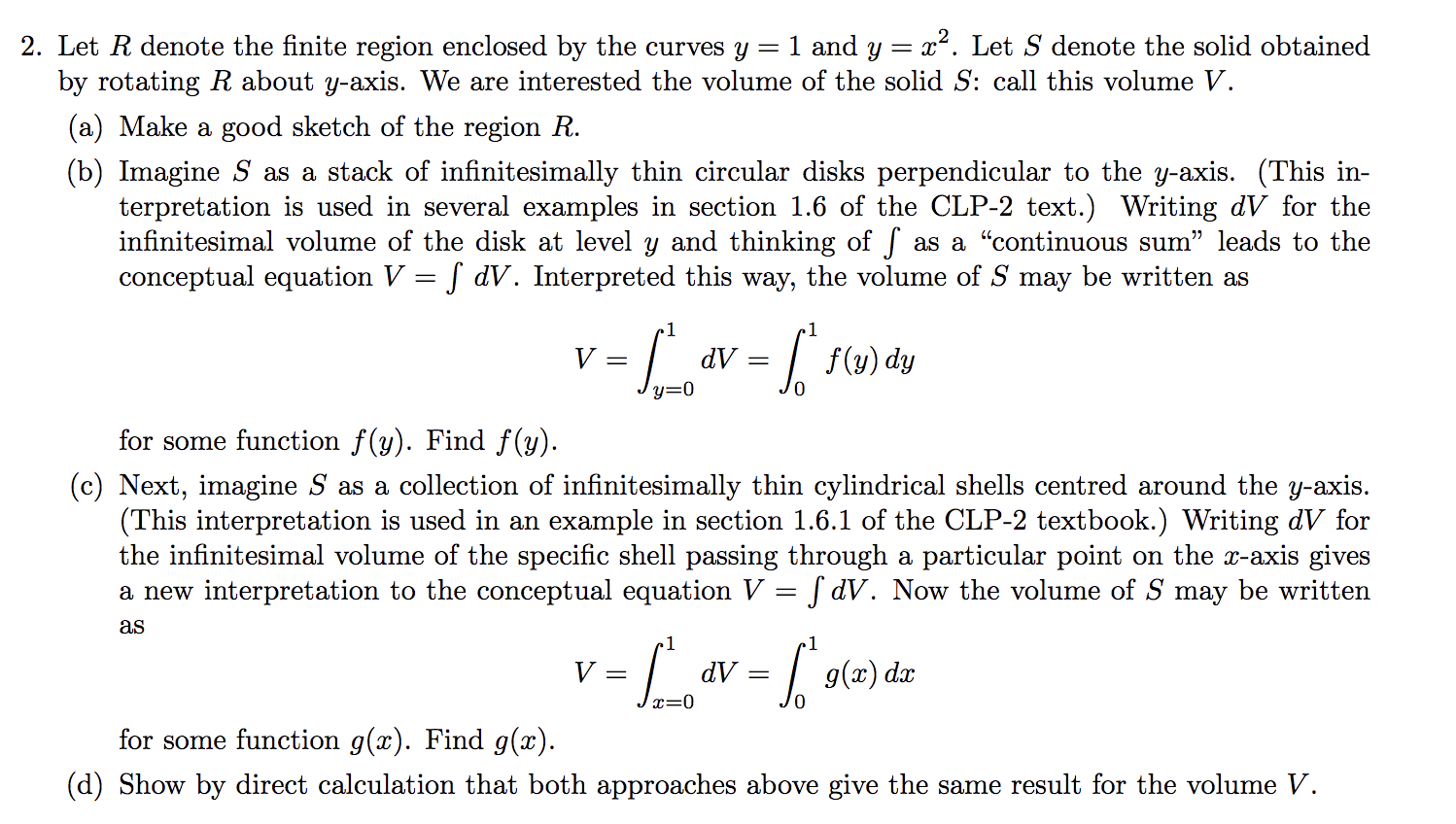
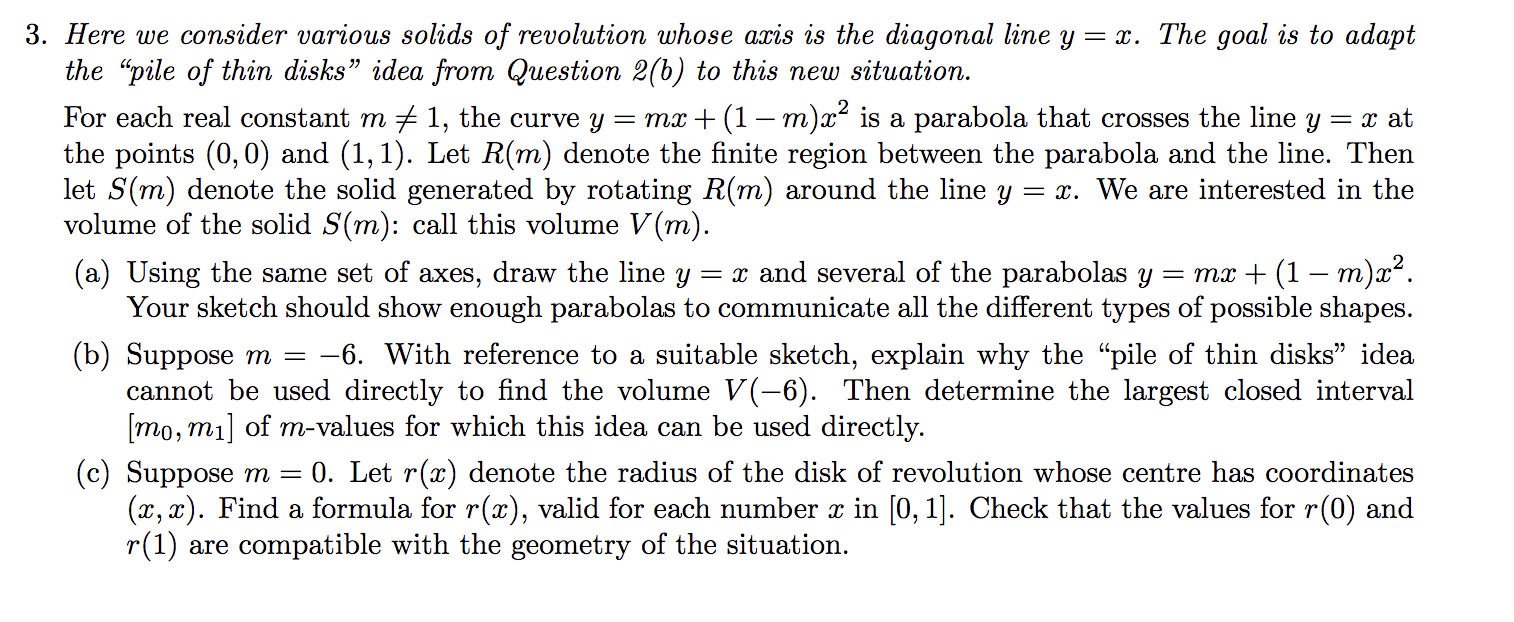
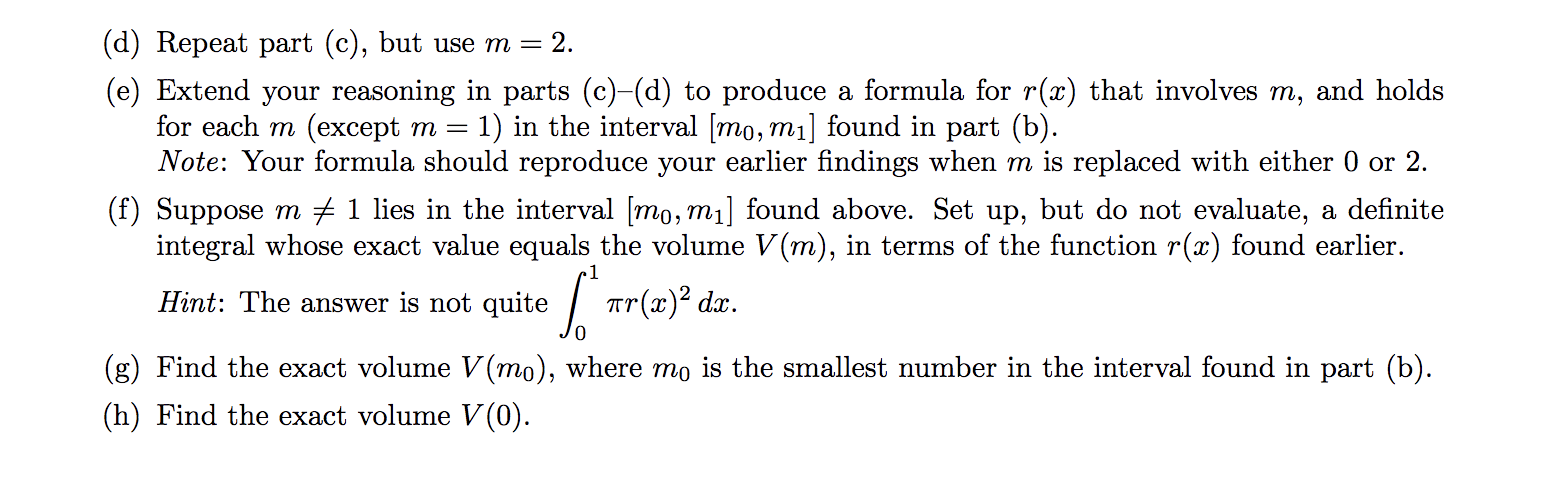
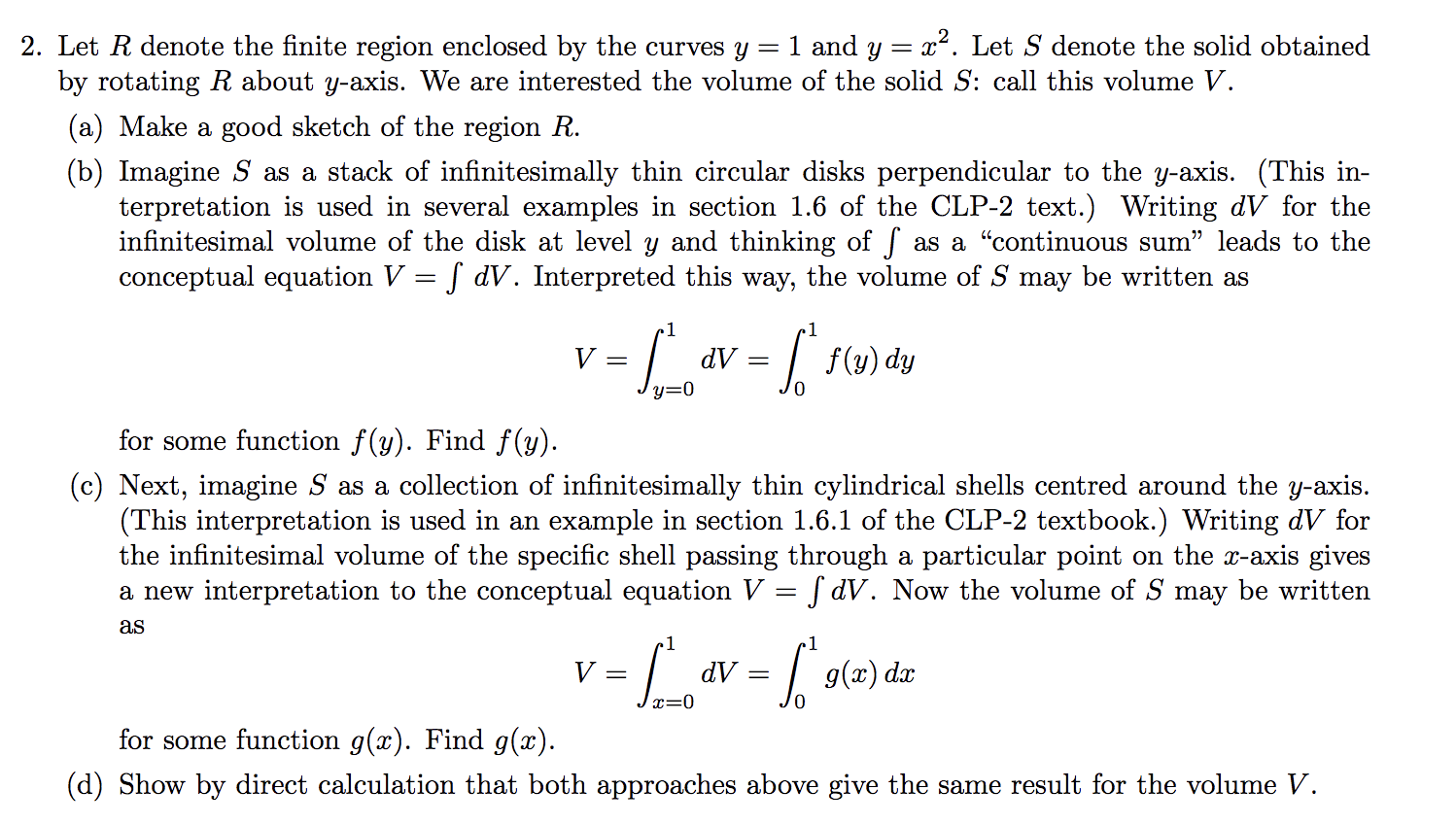
3. Here we consider uarious solids of revolution whose axis is the diagonal line y = :13. The goal is to adapt the \"pile of thin disks\" idea from Question 2(1)) to this new situation. For each real constant m 7g 1, the curve y : mm + (1 m):r:2 is a parabola that crosses the line 3; : a: at the points (0, 0) and (1, 1). Let R(m) denote the nite region between the parabola and the line. Then let S (m) denote the solid generated by rotating R(m) around the line 3; : 3:. We are interested in the volume of the solid 5(m): call this volume V(m). (a) Using the same set of axes, draw the line 3; : cc and several of the parabolas y : ms: + (1 m):1:2. Your sketch should show enough parabolas to communicate all the different types of possible shapes. (b) Suppose m : 43. With reference to a suitable sketch, explain why the \"pile of thin disks\" idea cannot be used directly to nd the volume V(e6). Then determine the largest closed interval [mmml] of m-values for which this idea can be used directly. (c) Suppose m = 0. Let r(:r;) denote the radius of the disk of revolution whose centre has coordinates (:23, 2:). Find a formula for at), valid for each number 33 in [0, 1]. Check that the values for r(0) and r( 1) are compatible with the geometry of the situation. (d) Repeat part (c), but use m = 2. (e) Extend your reasoning in parts (c)-(d) to produce a formula for r(x) that involves m, and holds for each m (except m = 1) in the interval [mo, mi] found in part (b). Note: Your formula should reproduce your earlier findings when m is replaced with either 0 or 2. (f) Suppose m + 1 lies in the interval [mo, mi] found above. Set up, but do not evaluate, a definite integral whose exact value equals the volume V(m), in terms of the function r(x) found earlier. Hint: The answer is not quite Fr(x) 2 dx. o (g) Find the exact volume V(mo), where mo is the smallest number in the interval found in part (b). (h) Find the exact volume V(0).2. Let R denote the nite region enclosed by the curves y = 1 and y = :52. Let 8 denote the solid obtained by rotating R about yaxis. We are interested the volume of the solid 3: call this volume V. (a) Make a good sketch of the region R. (b) Imagine S as a stack of innitesimally thin circular disks perpendicular to the y-axis. (This in terpretation is used in several examples in section 1.6 of the CLP-2 text.) Writing dV for the innitesimal volume of the disk at level :9 and thinking of f as a \"continuous sum\" leads to the conceptual equation V = f dV. Interpreted this way, the volume of 8 may be written as 1 1 V = dV = d jy=o f0 y) 3; for some function y). Find f (y) (c) Next, imagine S as a collection of innitesimally thin cylindrical shells centred around the yaxis. (This interpretation is used in an example in section 1.6.1 of the CLP2 textbook.) Writing dV for the innitesimal volume of the specic shell passing through a particular point on the maxis gives a new interpretation to the conceptual equation V : f dV. Now the volume of 5 may be written as 1 1 V = / dV 2 f 9(a) dm 56:0 0 (d) Show by direct calculation that both approaches above give the same result for the volume V. for some function 9(23). Find 9(33)
Step by Step Solution
There are 3 Steps involved in it

Get step-by-step solutions from verified subject matter experts
 Study Help