







Question: 3. Identify what else needs to be in place so that the strategic approach adopted remains effective. O CASE STUDY National Bank of Poland five
3. Identify what else needs to be in place so that the strategic approach adopted remains effective.
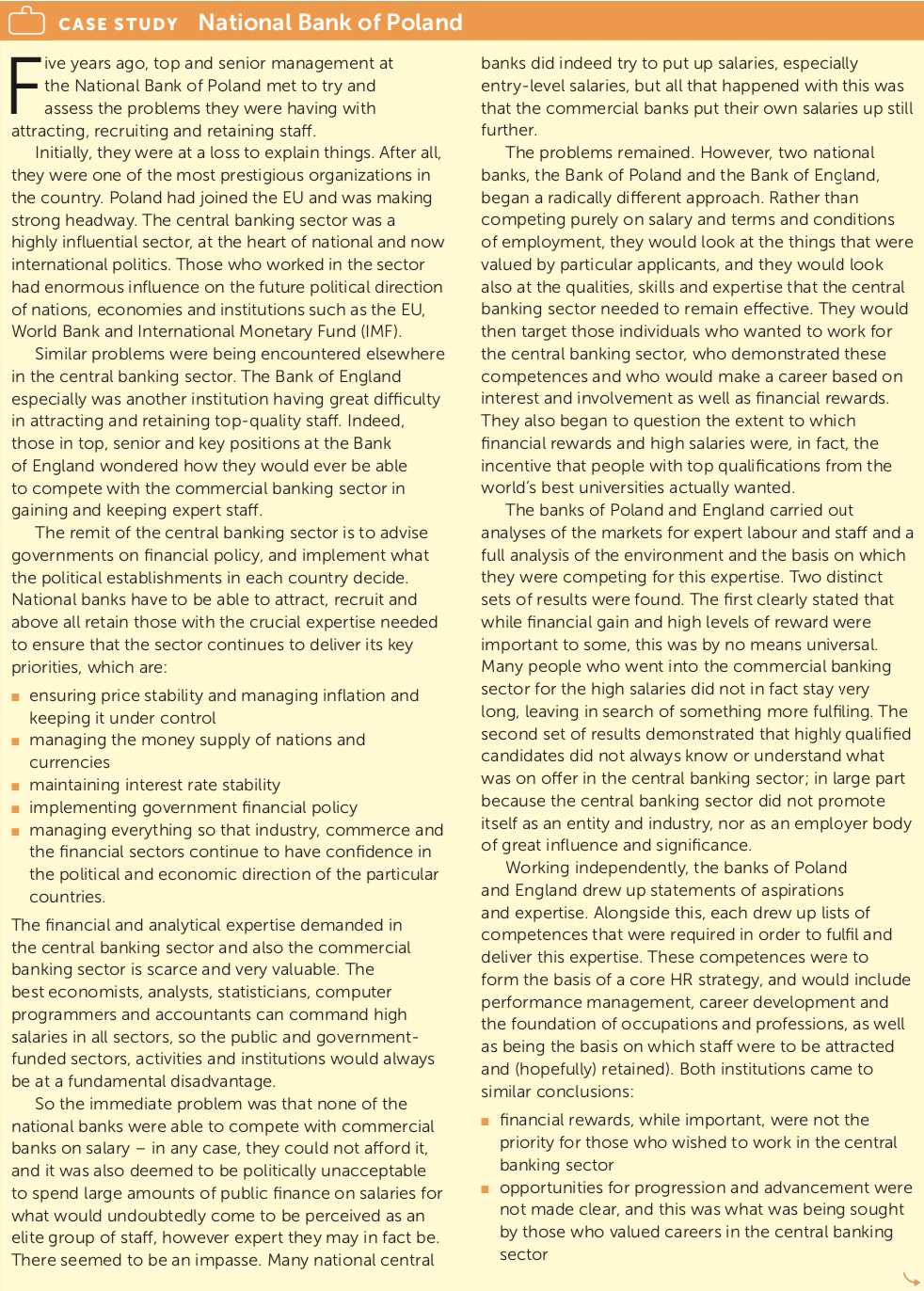
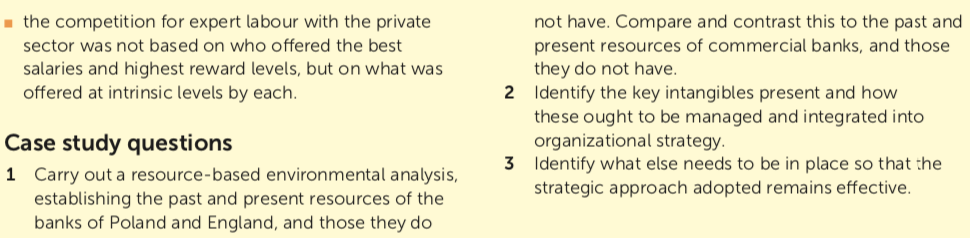
O CASE STUDY National Bank of Poland five years ago, top and senior management at the National Bank of Poland met to try and assess the problems they were having with attracting, recruiting and retaining staff. Initially, they were at a loss to explain things. After all, they were one of the most prestigious organizations in the country. Poland had joined the EU and was making strong headway. The central banking sector was a highly influential sector, at the heart of national and now international politics. Those who worked in the sector had enormous influence on the future political direction of nations, economies and institutions such as the EU, World Bank and International Monetary Fund (IMF). Similar problems were being encountered elsewhere in the central banking sector. The Bank of England especially was another institution having great difficulty in attracting and retaining top-quality staff. Indeed, those in top, senior and key positions at the Bank of England wondered how they would ever be able to compete with the commercial banking sector in gaining and keeping expert staff. The remit of the central banking sector is to advise governments on financial policy, and implement what the political establishments in each country decide. National banks have to be able to attract, recruit and above all retain those with the crucial expertise needed to ensure that the sector continues to deliver its key priorities, which are: ensuring price stability and managing inflation and keeping it under control managing the money supply of nations and currencies maintaining interest rate stability implementing government financial policy managing everything so that industry, commerce and the financial sectors continue to have confidence in the political and economic direction of the particular countries. The financial and analytical expertise demanded in the central banking sector and also the commercial banking sector is scarce and very valuable. The best economists, analysts, statisticians, computer programmers and accountants can command high salaries in all sectors, so the public and government- funded sectors, activities and institutions would always be at a fundamental disadvantage. So the immediate problem was that none of the national banks were able to compete with commercial banks on salary in any case, they could not afford it, and it was also deemed to be politically unacceptable to spend large amounts of public finance on salaries for what would undoubtedly come to be perceived as an elite group of staff, however expert they may in fact be. There seemed to be an impasse. Many national central banks did indeed try to put up salaries, especially entry-level salaries, but all that happened with this was that the commercial banks put their own salaries up still further. The problems remained. However, two national banks, the Bank of Poland and the Bank of England, began a radically different approach. Rather than competing purely on salary and terms and conditions of employment, they would look at the things that were valued by particular applicants, and they would look also at the qualities, skills and expertise that the central banking sector needed to remain effective. They would then target those individuals who wanted to work for the central banking sector, who demonstrated these competences and who would make a career based on interest and involvement as well as financial rewards. They also began to question the extent to which financial rewards and high salaries were, in fact, the incentive that people with top qualifications from the world's best universities actually wanted. The banks of Poland and England carried out analyses of the markets for expert labour and staff and a full analysis of the environment and the basis on which they were competing for this expertise. Two distinct sets of results were found. The first clearly stated that while financial gain and high levels of reward were important to some, this was by no means universal. Many people who went into the commercial banking sector for the high salaries did not in fact stay very long, leaving in search of something more fulfiling. The second set of results demonstrated that highly qualified candidates did not always know or understand what was on offer in the central banking sector; in large part because the central banking sector did not promote itself as an entity and industry, nor as an employer body of great influence and significance. Working independently, the banks of Poland and England drew up statements of aspirations and expertise. Alongside this, each drew up lists of competences that were required in order to fulfil and deliver this expertise. These competences were to form the basis of a core HR strategy, and would include performance management, career development and the foundation of occupations and professions, as well as being the basis on which staff were to be attracted and (hopefully) retained). Both institutions came to similar conclusions: financial rewards, while important, were not the priority for those who wished to work in the central banking sector opportunities for progression and advancement were not made clear, and this was what was being sought by those who valued careers in the central banking sector the competition for expert labour with the private sector was not based on who offered the best salaries and highest reward levels, but on what was offered at intrinsic levels by each. not have. Compare and contrast this to the past and present resources of commercial banks, and those they do not have. Identify the key intangibles present and how these ought to be managed and integrated into organizational strategy Identify what else needs to be in place so that the strategic approach adopted remains effective. Case study questions 1 Carry out a resource-based environmental analysis, establishing the past and present resources of the banks of Poland and England, and those they do
Step by Step Solution
There are 3 Steps involved in it
1 Expert Approved Answer
Step: 1 Unlock

Question Has Been Solved by an Expert!
Get step-by-step solutions from verified subject matter experts
Step: 2 Unlock
Step: 3 Unlock
 Study Help