







Question: 3. (Implications for asset prices) In this question we consider the special case of the asset- pricing model derived in Topic 4 where the stochastic
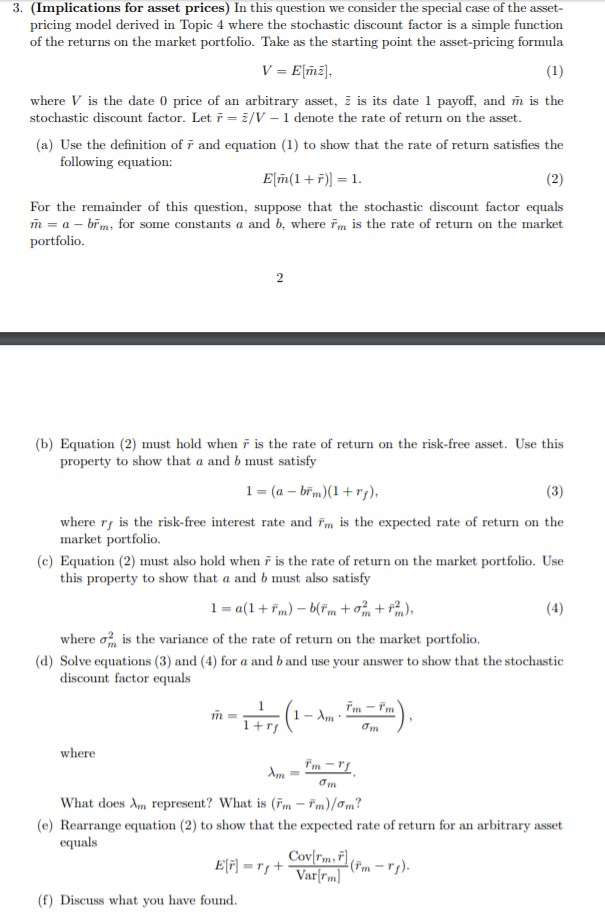
3. (Implications for asset prices) In this question we consider the special case of the asset- pricing model derived in Topic 4 where the stochastic discount factor is a simple function of the returns on the market portfolio. Take as the starting point the asset-pricing formula where V is the date 0 price of an arbitrary asset, is its date 1 payoff, and m is the stochastic discount factor. Let = z/V-1 denote the rate of return on the asset. (a) Use the definition of and equation (1) to show that the rate of return satisfies the following equation: For the remainder of this question, suppose that the stochastic discount factor equals ma brm, for some constants a and b, where Fm is the rate of return on the market portfolio b) Equation (2 must hold when is the rate of return on the risk-free asset. Use this property to show that a and b must satisfy 1-(a-b%)( 1 + rj) where r is the risk-free interest rate and m is the expected rate of return on the market portfolio. (c) Equation (2) must also hold when is the rate of return on the market portfolio. Use this property to show that a and b must also satisfy where ., is the variance of the rate of return on the market portfolio. d) Solve equations (3) and (4) for a and b and use your answer to show that the stochastic discount factor equals 1+ry where FYL what does rn represent? What is (rm-fm)/om? (e) Rearrange equation (2) to show that the expected rate of return for an arbitrary asset equals (f) Discuss what you have found. 3. (Implications for asset prices) In this question we consider the special case of the asset- pricing model derived in Topic 4 where the stochastic discount factor is a simple function of the returns on the market portfolio. Take as the starting point the asset-pricing formula where V is the date 0 price of an arbitrary asset, is its date 1 payoff, and m is the stochastic discount factor. Let = z/V-1 denote the rate of return on the asset. (a) Use the definition of and equation (1) to show that the rate of return satisfies the following equation: For the remainder of this question, suppose that the stochastic discount factor equals ma brm, for some constants a and b, where Fm is the rate of return on the market portfolio b) Equation (2 must hold when is the rate of return on the risk-free asset. Use this property to show that a and b must satisfy 1-(a-b%)( 1 + rj) where r is the risk-free interest rate and m is the expected rate of return on the market portfolio. (c) Equation (2) must also hold when is the rate of return on the market portfolio. Use this property to show that a and b must also satisfy where ., is the variance of the rate of return on the market portfolio. d) Solve equations (3) and (4) for a and b and use your answer to show that the stochastic discount factor equals 1+ry where FYL what does rn represent? What is (rm-fm)/om? (e) Rearrange equation (2) to show that the expected rate of return for an arbitrary asset equals (f) Discuss what you have found
Step by Step Solution
There are 3 Steps involved in it

Get step-by-step solutions from verified subject matter experts
 Study Help