







Question: 3 Inlet A 2 cm Inlet B E. = 77 Inlet C Consider the microfluidic chip given in the figure RHS below. The fluid moves
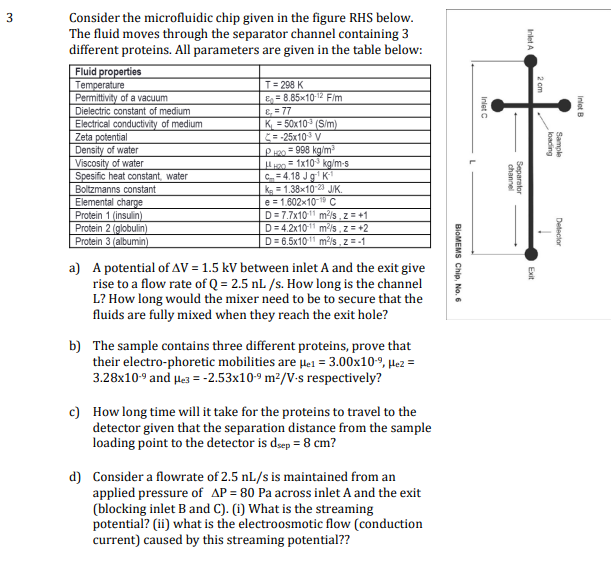
3 Inlet A 2 cm Inlet B E. = 77 Inlet C Consider the microfluidic chip given in the figure RHS below. The fluid moves through the separator channel containing 3 different proteins. All parameters are given in the table below: Fluid properties Temperature T= 298 K Permittivity of a vacuum E = 8.85x10⁻¹² F/m Dielectric constant of medium Electrical conductivity of medium K = 50x10(S/M) Zeta potential C = -25x10V Density of water Po = 998 kg/m2 Viscosity of water zo = 1x10 kg/m-s Spesific heat constant water C. = 4.18 Jg'K Boltzmanns constant ka = 1.38x10⁻²³ JK Elemental charge e = 1.602x10-C Protein 1 (insulin) D = 7.7x101 mils, z = +1 Protein 2 globulin) D = 4.2x10 mes. z = +2 Protein 3 (albumin) D = 6.5x10⁻¹¹ ms, 2.1 loading oues 7 channe Separator a) A potential of AV = 1.5 kV between inlet A and the exit give rise to a flow rate of Q = 2.5 nL /s. How long is the channel L? How long would the mixer need to be to secure that the fluids are fully mixed when they reach the exit hole? BioMEMS Chip, No. 6 Exit b) The sample contains three different proteins, prove that their electro-phoretic mobilities are bei = 3.00x10%, ez = 3.28x10⁻⁹ and He3 =-2.53x10⁻⁹ m2/V.s respectively? c) How long time will it take for the proteins to travel to the detector given that the separation distance from the sample loading point to the detector is deep = 8 cm? d) Consider a flowrate of 2.5 nL/s is maintained from an applied pressure of AP = 80 Pa across inlet A and the exit (blocking inlet B and C). (1) What is the streaming potential? (ii) what is the electroosmotic flow (conduction current) caused by this streaming potential?? 3 Inlet A 2 cm Inlet B E. = 77 Inlet C Consider the microfluidic chip given in the figure RHS below. The fluid moves through the separator channel containing 3 different proteins. All parameters are given in the table below: Fluid properties Temperature T= 298 K Permittivity of a vacuum E = 8.85x10⁻¹² F/m Dielectric constant of medium Electrical conductivity of medium K = 50x10(S/M) Zeta potential C = -25x10V Density of water Po = 998 kg/m2 Viscosity of water zo = 1x10 kg/m-s Spesific heat constant water C. = 4.18 Jg'K Boltzmanns constant ka = 1.38x10⁻²³ JK Elemental charge e = 1.602x10-C Protein 1 (insulin) D = 7.7x101 mils, z = +1 Protein 2 globulin) D = 4.2x10 mes. z = +2 Protein 3 (albumin) D = 6.5x10⁻¹¹ ms, 2.1 loading oues 7 channe Separator a) A potential of AV = 1.5 kV between inlet A and the exit give rise to a flow rate of Q = 2.5 nL /s. How long is the channel L? How long would the mixer need to be to secure that the fluids are fully mixed when they reach the exit hole? BioMEMS Chip, No. 6 Exit b) The sample contains three different proteins, prove that their electro-phoretic mobilities are bei = 3.00x10%, ez = 3.28x10⁻⁹ and He3 =-2.53x10⁻⁹ m2/V.s respectively? c) How long time will it take for the proteins to travel to the detector given that the separation distance from the sample loading point to the detector is deep = 8 cm? d) Consider a flowrate of 2.5 nL/s is maintained from an applied pressure of AP = 80 Pa across inlet A and the exit (blocking inlet B and C). (1) What is the streaming potential? (ii) what is the electroosmotic flow (conduction current) caused by this streaming potential
Step by Step Solution
There are 3 Steps involved in it

Get step-by-step solutions from verified subject matter experts
 Study Help