







Question: 3. Obtain the solution for y(t) as a deviation from its initial steady state value. Use the method of Laplace transforms and partial fraction expansion.
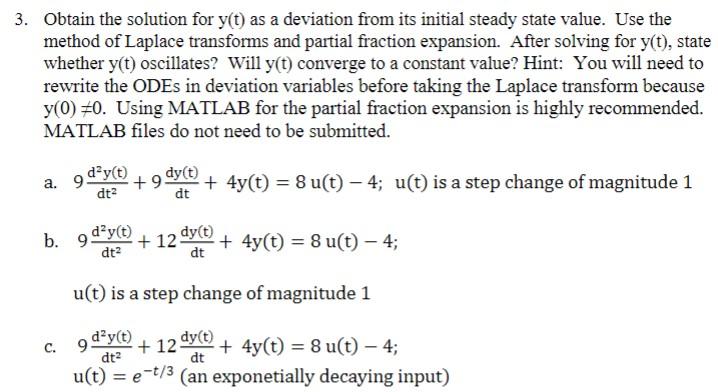
3. Obtain the solution for y(t) as a deviation from its initial steady state value. Use the method of Laplace transforms and partial fraction expansion. After solving for y(t), state whether y(t) oscillates? Will y(t) converge to a constant value? Hint: You will need to rewrite the ODEs in deviation variables before taking the Laplace transform because y(0)=0. Using MATLAB for the partial fraction expansion is highly recommended. MATLAB files do not need to be submitted. a. 9dt2d2y(t)+9dtdy(t)+4y(t)=8u(t)4;u(t) is a step change of magnitude 1 b. 9dt2d2y(t)+12dtdy(t)+4y(t)=8u(t)4 u(t) is a step change of magnitude 1 c. 9dt2d2y(t)+12dtdy(t)+4y(t)=8u(t)4; u(t)=et/3 (an exponetially decaying input)
Step by Step Solution
There are 3 Steps involved in it

Get step-by-step solutions from verified subject matter experts
 Study Help