



Question: 3. Review the Example - Antoine + Clapeyron Equations. The vaporization enthalpy for water is given below at two different temperatures. 50C42.911kJ/mol,54C42.738kJ/mol a) Assume the
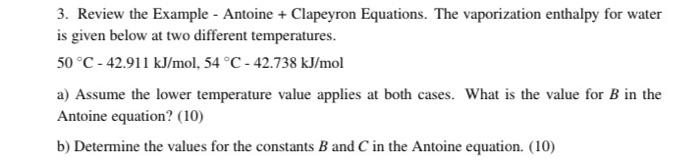
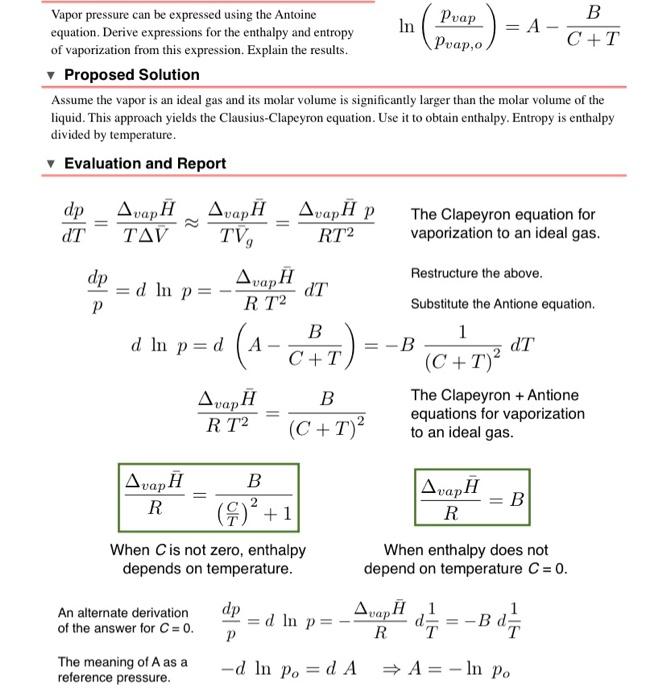
3. Review the Example - Antoine + Clapeyron Equations. The vaporization enthalpy for water is given below at two different temperatures. 50C42.911kJ/mol,54C42.738kJ/mol a) Assume the lower temperature value applies at both cases. What is the value for B in the Antoine equation? (10) b) Determine the values for the constants B and C in the Antoine equation. (10) VaporpressurecanbeexpressedusingtheAntoineequation.Deriveexpressionsfortheenthalpyandentropyofvaporizationfromthisexpression.Explaintheresults.ln(pvap,opvap)=AC+TB - Proposed Solution Assume the vapor is an ideal gas and its molar volume is significantly larger than the molar volume of the liquid. This approach yields the Clausius-Clapeyron equation. Use it to obtain enthalpy. Entropy is enthalpy divided by temperature. Evaluation and Report dTdp=TVvapHTVgvapH=RT2vapHpTheClapeyronequationforvaporizationtoanidealgas. pdp=dlnp=RT2vapHdTRestructuretheabove.SubstitutetheAntioneequation. dlnp=d(AC+TB)=B(C+T)21dT RT2vapH=(C+T)2BTheClapeyron+Antioneequationsforvaporizationtoanidealgas. RvapH=(TC)2+1B RvapH=B When C is not zero, enthalpy When enthalpy does not depends on temperature. depend on temperature C=0. The meaning of A as a dlnpo=dAA=lnpo reference pressure. 3. Review the Example - Antoine + Clapeyron Equations. The vaporization enthalpy for water is given below at two different temperatures. 50C42.911kJ/mol,54C42.738kJ/mol a) Assume the lower temperature value applies at both cases. What is the value for B in the Antoine equation? (10) b) Determine the values for the constants B and C in the Antoine equation. (10) VaporpressurecanbeexpressedusingtheAntoineequation.Deriveexpressionsfortheenthalpyandentropyofvaporizationfromthisexpression.Explaintheresults.ln(pvap,opvap)=AC+TB - Proposed Solution Assume the vapor is an ideal gas and its molar volume is significantly larger than the molar volume of the liquid. This approach yields the Clausius-Clapeyron equation. Use it to obtain enthalpy. Entropy is enthalpy divided by temperature. Evaluation and Report dTdp=TVvapHTVgvapH=RT2vapHpTheClapeyronequationforvaporizationtoanidealgas. pdp=dlnp=RT2vapHdTRestructuretheabove.SubstitutetheAntioneequation. dlnp=d(AC+TB)=B(C+T)21dT RT2vapH=(C+T)2BTheClapeyron+Antioneequationsforvaporizationtoanidealgas. RvapH=(TC)2+1B RvapH=B When C is not zero, enthalpy When enthalpy does not depends on temperature. depend on temperature C=0. The meaning of A as a dlnpo=dAA=lnpo reference pressure
Step by Step Solution
There are 3 Steps involved in it

Get step-by-step solutions from verified subject matter experts