







Question: 3- Solvent extraction is basically known as a. Gas-liquid extraction. b. Liquid-liquid extraction. c. Liquid-solid extraction. d. Solvent recovery. e. Kremser process. f. All of
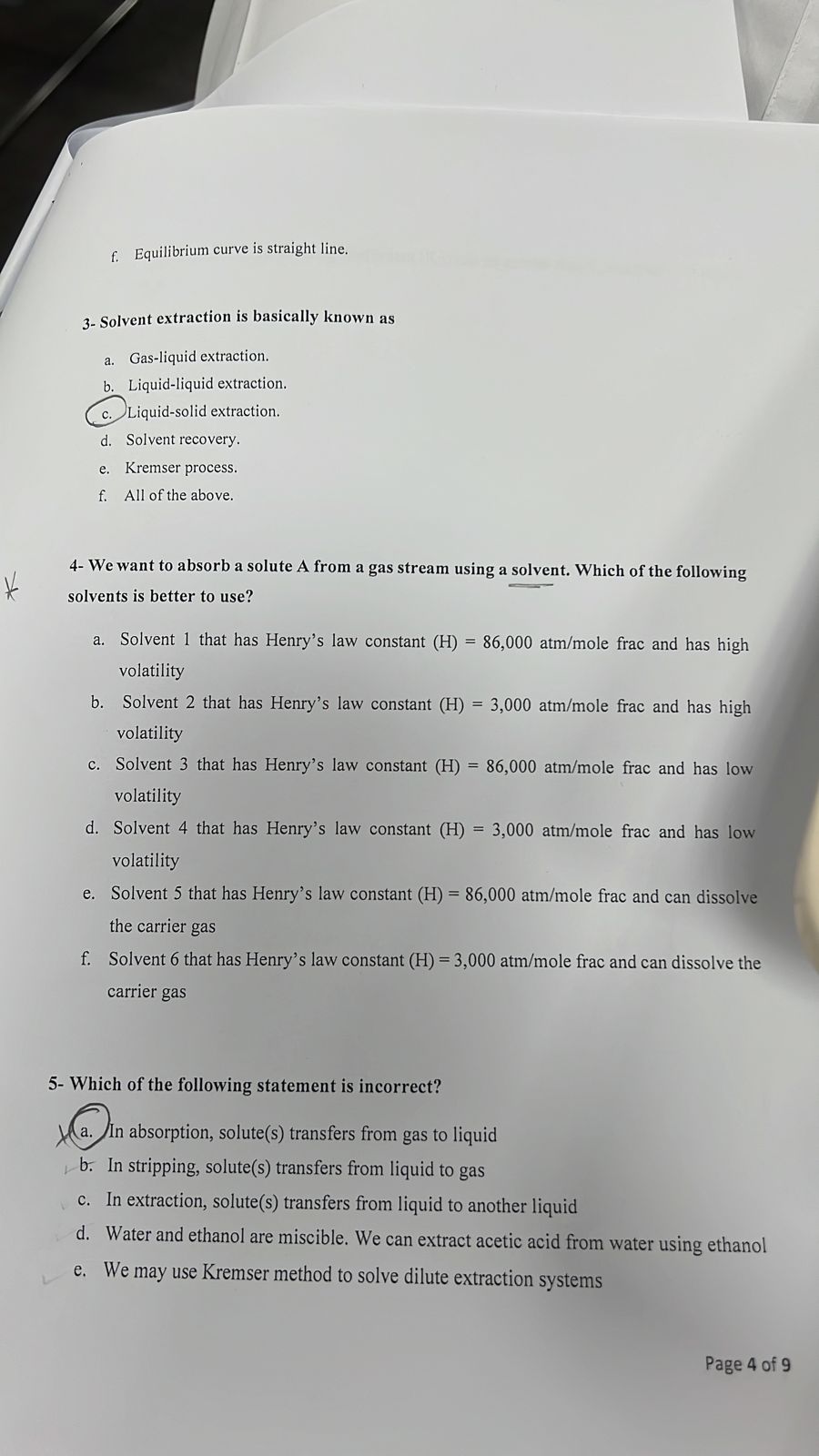
3- Solvent extraction is basically known as a. Gas-liquid extraction. b. Liquid-liquid extraction. c. Liquid-solid extraction. d. Solvent recovery. e. Kremser process. f. All of the above. 4- We want to absorb a solute A from a gas stream using a solvent. Which of the following solvents is better to use? a. Solvent 1 that has Henry's law constant (H)=86,000atm/mole frac and has high volatility b. Solvent 2 that has Henry's law constant (H)=3,000atm/mole frac and has high volatility c. Solvent 3 that has Henry's law constant (H)=86,000atm/mole frac and has low volatility d. Solvent 4 that has Henry's law constant (H)=3,000atm/mole frac and has low volatility e. Solvent 5 that has Henry's law constant (H)=86,000atm/mole frac and can dissolve the carrier gas f. Solvent 6 that has Henry's law constant (H)=3,000atm/mole frac and can dissolve the carrier gas 5- Which of the following statement is incorrect? (a. In absorption, solute(s) transfers from gas to liquid b. In stripping, solute(s) transfers from liquid to gas c. In extraction, solute(s) transfers from liquid to another liquid d. Water and ethanol are miscible. We can extract acetic acid from water using ethanol e. We may use Kremser method to solve dilute extraction systems
Step by Step Solution
There are 3 Steps involved in it

Get step-by-step solutions from verified subject matter experts
 Study Help