







Question: 3. Suppose two neighbors i = 1, 2 simultaneously must decide how many hours 3,- 2 0 to devote to the upkeep of their gardens.
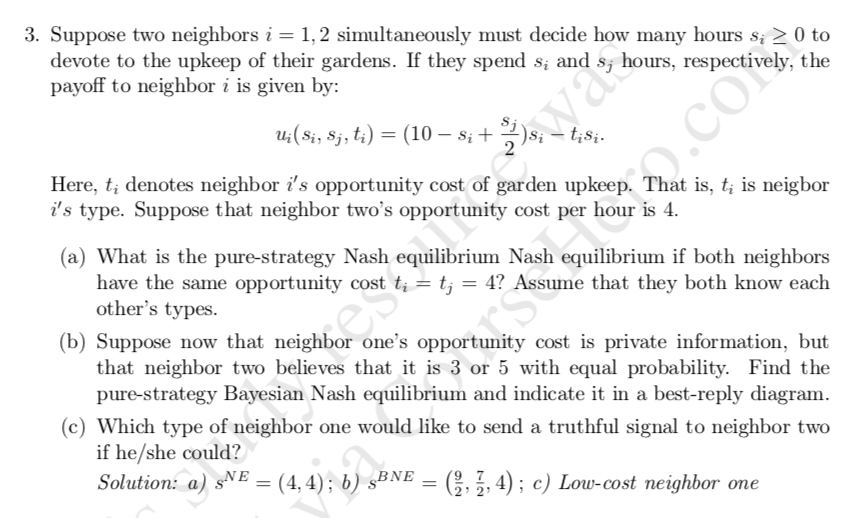
3. Suppose two neighbors i = 1, 2 simultaneously must decide how many hours 3,- 2 0 to devote to the upkeep of their gardens. If they spend 3,- and 3;; hours, rmpectively, the payo' to neighbor i is given by: 3. ur'(3i13jrti) = (10 _ 3i + 3])3i _ tisi- Here, t,- denotes neighbor 17's opportunity cost of garden upkeep. That is, t,- is neigbor 17's type. Suppose that neighbor two's opportunity cost per hour is 4. (a) What is the purestrategy Nash equilibrium Nash equilibrium if both neighbors have the same opportunity cost $.- = t,- = 4? Assume that they both know each other's types. (b) Suppose now that neighbor one's opportunity cost is private information, but that neighbor two believes that it is 3 or 5 with equal probability. Find the purestrategy Bayesian Nash equilibrium and indicate it in a bestreply diagram. (c) Which type of neighbor one would like to send a truthful signal to neighbor two if he/she muld? Solution: a.) 3\"\": = (4,4); b) 33"\": = (3, , 4); c) Lawcost neighbor one
Step by Step Solution
There are 3 Steps involved in it

Get step-by-step solutions from verified subject matter experts
 Study Help