Question: 3. Suppose we observe N i.i.d data points D = {11, 12,..., IN}, where each In {1, 2, ..., K} is a random variable with
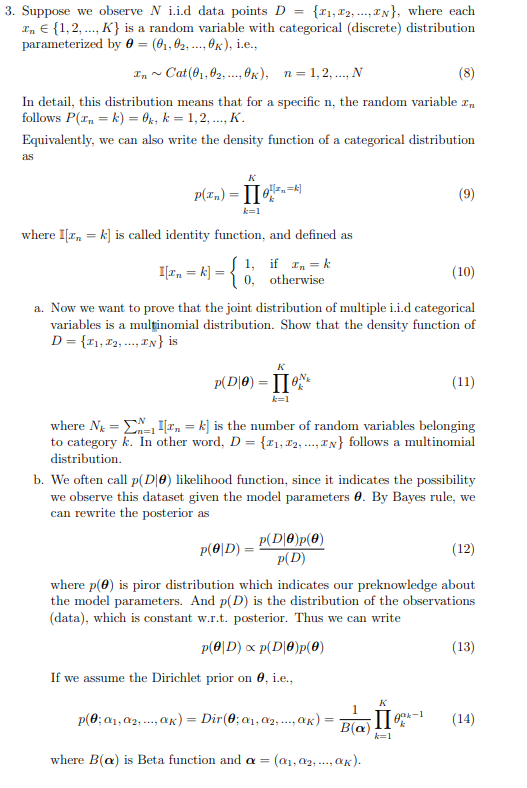
3. Suppose we observe N i.i.d data points D = {11, 12,..., IN}, where each In {1, 2, ..., K} is a random variable with categorical (discrete) distribution parameterized by = (0,0,...,0x), i.e., Cat(0,02, ...,Ox), n=1,2,..., N (8) In detail, this distribution means that for a specific n, the random variable en follows P(In = k) = fk, k=1,2,..., K. Equivalently, we can also write the density function of a categorical distribution as P(In) = II = (9) where IIr = k) is called identity function, and defined as [t. = k] = { z ha 0, otherwise (10) a. Now we want to prove that the joint distribution of multiple i.i.d categorical variables is a multinomial distribution. Show that the density function of D = {1, 22, ..., IN} is K p(D|8) TIX (11) k=1 where Ne = EN=, IP, = k) is the number of random variables belonging to category k. In other word, D = {21, 12,..., IN} follows a multinomial distribution. b. We often call p(DO) likelihood function, since it indicates the possibility we observe this dataset given the model parameters 6. By Bayes rule, we can rewrite the posterior as p(CD) p(D@p(0) (12) p(D) where p() is piror distribution which indicates our preknowledge about the model parameters. And p(D) is the distribution of the observations (data), which is constant w.r.t. posterior. Thus we can write P(0|D) x PGD|0)p(0) (13) If we assume the Dirichlet prior on 0, i.e., p(0:01, 02, ..., (K) = Dir(0:01, 02, ...,OK) R 1 Ba) k=1 II- (14) where Bla) is Beta function and a = =(Q1, 02, ..., x) 3. Suppose we observe N i.i.d data points D = {11, 12,..., IN}, where each In {1, 2, ..., K} is a random variable with categorical (discrete) distribution parameterized by = (0,0,...,0x), i.e., Cat(0,02, ...,Ox), n=1,2,..., N (8) In detail, this distribution means that for a specific n, the random variable en follows P(In = k) = fk, k=1,2,..., K. Equivalently, we can also write the density function of a categorical distribution as P(In) = II = (9) where IIr = k) is called identity function, and defined as [t. = k] = { z ha 0, otherwise (10) a. Now we want to prove that the joint distribution of multiple i.i.d categorical variables is a multinomial distribution. Show that the density function of D = {1, 22, ..., IN} is K p(D|8) TIX (11) k=1 where Ne = EN=, IP, = k) is the number of random variables belonging to category k. In other word, D = {21, 12,..., IN} follows a multinomial distribution. b. We often call p(DO) likelihood function, since it indicates the possibility we observe this dataset given the model parameters 6. By Bayes rule, we can rewrite the posterior as p(CD) p(D@p(0) (12) p(D) where p() is piror distribution which indicates our preknowledge about the model parameters. And p(D) is the distribution of the observations (data), which is constant w.r.t. posterior. Thus we can write P(0|D) x PGD|0)p(0) (13) If we assume the Dirichlet prior on 0, i.e., p(0:01, 02, ..., (K) = Dir(0:01, 02, ...,OK) R 1 Ba) k=1 II- (14) where Bla) is Beta function and a = =(Q1, 02, ..., x)









 Study Help