Question: 3. The case notes three main customer segments in the prepared foods business: a. Retailers (supermarket chains, etc.) b. Restaurants (Food Service Operators) c. Co-Pack
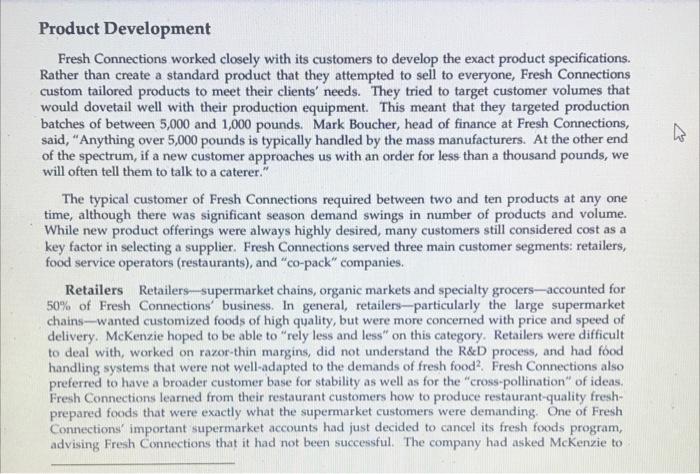
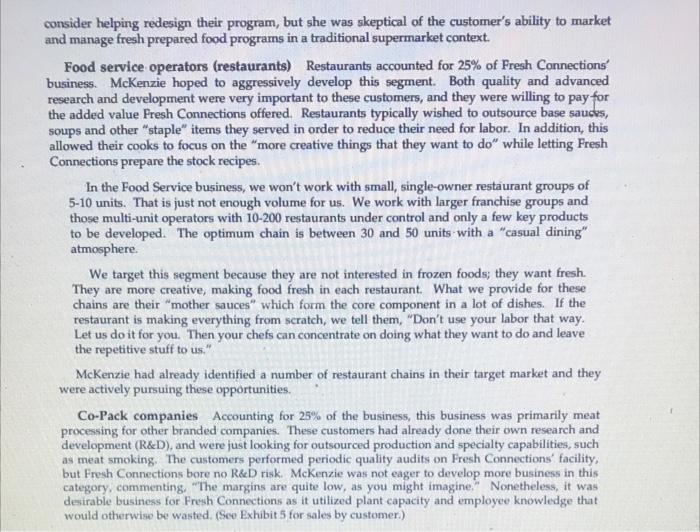
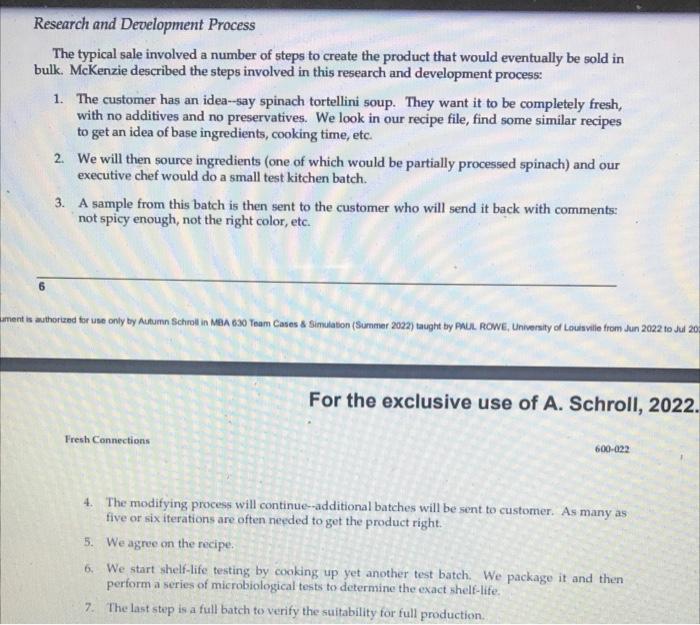
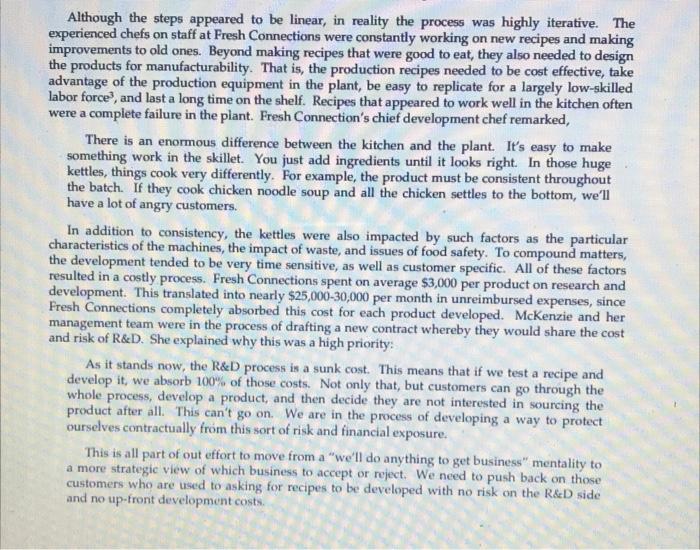
3. The case notes three main customer segments in the prepared foods business: a. Retailers (supermarket chains, etc.) b. Restaurants (Food Service Operators) c. Co-Pack companies I Which segment(s) do you recommend Fresh Connections focus on? Explain why. 4. Based on your answer to question 3, what capabilities and competitive priorities should Fresh Connections emphasize in its corporate strategy in order to best position themselves in the marketplace? will growth impact Fresh Connections' operations? 3. The case notes three main customer segments in the prepared foods business: a. Retailers (supermarket chains, etc.) b. Restaurants (Food Service Operators) c. Co-Pack companies Which segment(s) do you recommend Fresh Connections focus on? Explain why. 4. Based on your answer to question 3, what capabilities and competitive priorities should Fresh Connections emphasize in its corporate strategy in order to best position themselves in the marketplace? Product Development Fresh Connections worked closely with its customers to develop the exact product specifications. Rather than create a standard product that they attempted to sell to everyone, Fresh Connections custom tailored products to meet their clients' needs. They tried to target customer volumes that would dovetail well with their production equipment. This meant that they targeted production batches of between 5,000 and 1,000 pounds. Mark Boucher, head of finance at Fresh Connections, said, "Anything over 5,000 pounds is typically handled by the mass manufacturers. At the other end of the spectrum, if a new customer approaches us with an order for less than a thousand pounds, we will often tell them to talk to a caterer." The typical customer of Fresh Connections required between two and ten products at any one time, although there was significant season demand swings in number of products and volume. While new product offerings were always highly desired, many customers still considered cost as a key factor in selecting a supplier. Fresh Connections served three main customer segments: retailers, food service operators (restaurants), and "co-pack" companies. Retailers Retailers-supermarket chains, organic markets and specialty grocers-accounted for 50% of Fresh Connections business. In general, retailers-particularly the large supermarket chains-wanted customized foods of high quality, but were more concerned with price and speed of delivery. McKenzie hoped to be able to "rely less and less" on this category. Retailers were difficult to deal with, worked on razor-thin margins, did not understand the R&D process, and had food handling systems that were not well-adapted to the demands of fresh food2. Fresh Connections also preferred to have a broader customer base for stability as well as for the "cross-pollination" of ideas. Fresh Connections learned from their restaurant customers how to produce restaurant-quality fresh- prepared foods that were exactly what the supermarket customers were demanding. One of Fresh Connections important supermarket accounts had just decided to cancel its fresh foods program, advising Fresh Connections that it had not been successful. The company had asked McKenzie to 2 consider helping redesign their program, but she was skeptical of the customer's ability to market and manage fresh prepared food programs in a traditional supermarket context. Food service operators (restaurants) Restaurants accounted for 25% of Fresh Connections' business. McKenzie hoped to aggressively develop this segment. Both quality and advanced research and development were very important to these customers, and they were willing to pay for the added value Fresh Connections offered. Restaurants typically wished to outsource base sauces, soups and other "staple" items they served in order to reduce their need for labor. In addition, this allowed their cooks to focus on the "more creative things that they want to do" while letting Fresh Connections prepare the stock recipes. In the Food Service business, we won't work with small, single-owner restaurant groups of 5-10 units. That is just not enough volume for us. We work with larger franchise groups and those multi-unit operators with 10-200 restaurants under control and only a few key products to be developed. The optimum chain is between 30 and 50 units with a "casual dining" atmosphere. We target this segment because they are not interested in frozen foods; they want fresh. They are more creative, making food fresh in each restaurant. What we provide for these chains are their "mother sauces" which form the core component in a lot of dishes. If the restaurant is making everything from scratch, we tell them, "Don't use your labor that way. Let us do it for you. Then your chefs can concentrate on doing what they want to do and leave the repetitive stuff to us." McKenzie had already identified a number of restaurant chains in their target market and they were actively pursuing these opportunities. Co-Pack companies Accounting for 25% of the business, this business was primarily meat processing for other branded companies. These customers had already done their own research and development (R&D), and were just looking for outsourced production and specialty capabilities, such as meat smoking. The customers performed periodic quality audits on Fresh Connections' facility, but Fresh Connections bore no R&D risk. McKenzie was not eager to develop more business in this category, commenting, "The margins are quite low, as you might imagine." Nonetheless, it was desirable business for Fresh Connections as it utilized plant capacity and employee knowledge that would otherwise be wasted. (See Exhibit 5 for sales by customer.) Research and Development Process The typical sale involved a number of steps to create the product that would eventually be sold in bulk. McKenzie described the steps involved in this research and development process: 1. The customer has an idea-say spinach tortellini soup. They want it to be completely fresh, with no additives and no preservatives. We look in our recipe file, find some similar recipes to get an idea of base ingredients, cooking time, etc. 2. We will then source ingredients (one of which would be partially processed spinach) and our executive chef would do a small test kitchen batch. 3. A sample from this batch is then sent to the customer who will send it back with comments: not spicy enough, not the right color, etc. will ument is authorized for use only by Autumn Schroll in MBA 630 Team Cases & Simulation (Summer 2022) taught by PAUL ROWE, University of Louisville from Jun 2022 to Jul 20 For the exclusive use of A. Schroll, 2022. Fresh Connections 600-022 4. The modifying process will continue-additional batches will be sent to customer. As many as five or six iterations are often needed to get the product right. 5. We agree on the recipe. 6. We start shelf-life testing by cooking up yet another test batch. We package it and then perform a series of microbiological tests to determine the exact shelf-life. 7. The last step is a full batch to verify the suitability for full production. Although the steps appeared to be linear, in reality the process was highly iterative. The experienced chefs on staff at Fresh Connections were constantly working on new recipes and making improvements to old ones. Beyond making recipes that were good to eat, they also needed to design the products for manufacturability. That is, the production recipes needed to be cost effective, take advantage of the production equipment in the plant, be easy to replicate for a largely low-skilled labor force, and last a long time on the shelf. Recipes that appeared to work well in the kitchen often were a complete failure in the plant. Fresh Connection's chief development chef remarked, There is an enormous difference between the kitchen and the plant. It's easy to make something work in the skillet. You just add ingredients until it looks right. In those huge kettles, things cook very differently. For example, the product must be consistent throughout the batch. If they cook chicken noodle soup and all the chicken settles to the bottom, we'll have a lot of angry customers. In addition to consistency, the kettles were also impacted by such factors as the particular characteristics of the machines, the impact of waste, and issues of food safety. To compound matters, the development tended to be very time sensitive, as well as customer specific. All of these factors resulted in a costly process. Fresh Connections spent on average $3,000 per product on research and development. This translated into nearly $25,000-30,000 per month in unreimbursed expenses, since Fresh Connections completely absorbed this cost for each product developed. McKenzie and her management team were in the process of drafting a new contract whereby they would share the cost and risk of R&D. She explained why this was a high priority: As it stands now, the R&D process is a sunk cost. This means that if we test a recipe and develop it, we absorb 100% of those costs. Not only that, but customers can go through the whole process, develop a product, and then decide they are not interested in sourcing the product after all. This can't go on. We are in the process of developing a way to protect ourselves contractually from this sort of risk and financial exposure. This is all part of out effort to move from a "we'll do anything to get business" mentality to a more strategic view of which business to accept or reject. We need to push back on those customers who are used to asking for recipes to be developed with no risk on the R&D side and no up-front development costs









 Study Help