







Question: 3. This problem uses the cell phone and traffic data set described in Chapter 5 (page 174 ) to analyze the relationship between cell phone
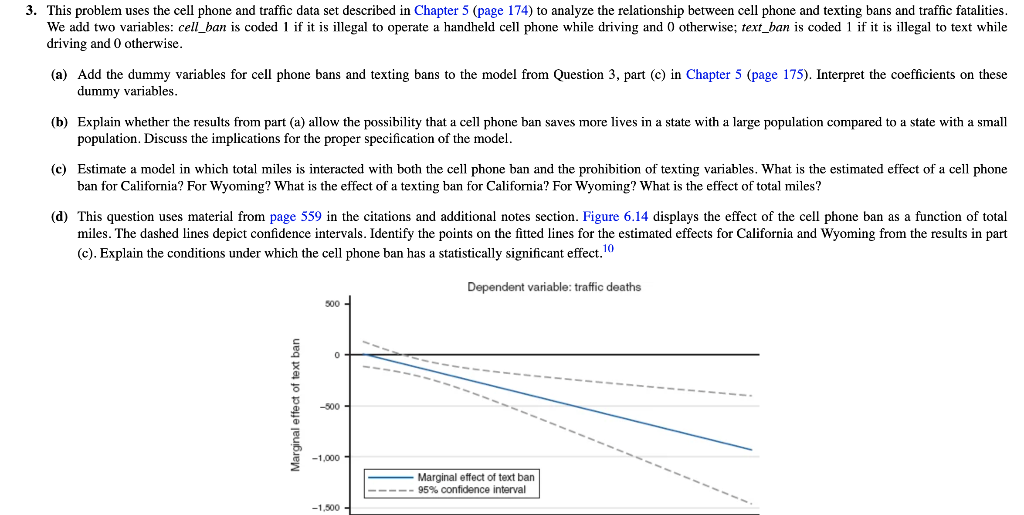
3. This problem uses the cell phone and traffic data set described in Chapter 5 (page 174 ) to analyze the relationship between cell phone and texting bans and traffic fatalities. We add two variables: cell_ban is coded 1 if it is illegal to operate a handheld cell phone while driving and 0 otherwise; text_ban is coded 1 if it is illegal to text while driving and 0 otherwise. (a) Add the dummy variables for cell phone bans and texting bans to the model from Question 3, part (c) in Chapter 5 (page 175). Interpret the coefficients on these dummy variables. (b) Explain whether the results from part (a) allow the possibility that a cell phone ban saves more lives in a state with a large population compared to a state with a small population. Discuss the implications for the proper specification of the model. (c) Estimate a model in which total miles is interacted with both the cell phone ban and the prohibition of texting variables. What is the estimated effect of a cell phone ban for California? For Wyoming? What is the effect of a texting ban for California? For Wyoming? What is the effect of total miles? (d) This question uses material from page 559 in the citations and additional notes section. Figure 6.14 displays the effect of the cell phone ban as a function of total miles. The dashed lines depict confidence intervals. Identify the points on the fitted lines for the estimated effects for California and Wyoming from the results in part (c). Explain the conditions under which the cell phone ban has a statistically significant effect. 10 3. This problem uses the cell phone and traffic data set described in Chapter 5 (page 174 ) to analyze the relationship between cell phone and texting bans and traffic fatalities. We add two variables: cell_ban is coded 1 if it is illegal to operate a handheld cell phone while driving and 0 otherwise; text_ban is coded 1 if it is illegal to text while driving and 0 otherwise. (a) Add the dummy variables for cell phone bans and texting bans to the model from Question 3, part (c) in Chapter 5 (page 175). Interpret the coefficients on these dummy variables. (b) Explain whether the results from part (a) allow the possibility that a cell phone ban saves more lives in a state with a large population compared to a state with a small population. Discuss the implications for the proper specification of the model. (c) Estimate a model in which total miles is interacted with both the cell phone ban and the prohibition of texting variables. What is the estimated effect of a cell phone ban for California? For Wyoming? What is the effect of a texting ban for California? For Wyoming? What is the effect of total miles? (d) This question uses material from page 559 in the citations and additional notes section. Figure 6.14 displays the effect of the cell phone ban as a function of total miles. The dashed lines depict confidence intervals. Identify the points on the fitted lines for the estimated effects for California and Wyoming from the results in part (c). Explain the conditions under which the cell phone ban has a statistically significant effect. 10
Step by Step Solution
There are 3 Steps involved in it

Get step-by-step solutions from verified subject matter experts
 Study Help