Question: Identify a technology change described in Chapter 11 (not including the discussion case) which had or could have had an adverse effect on a business.
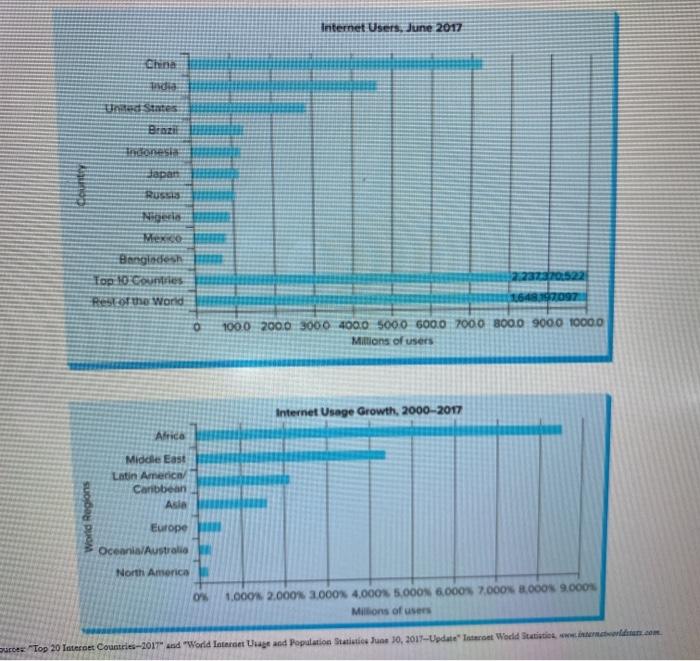
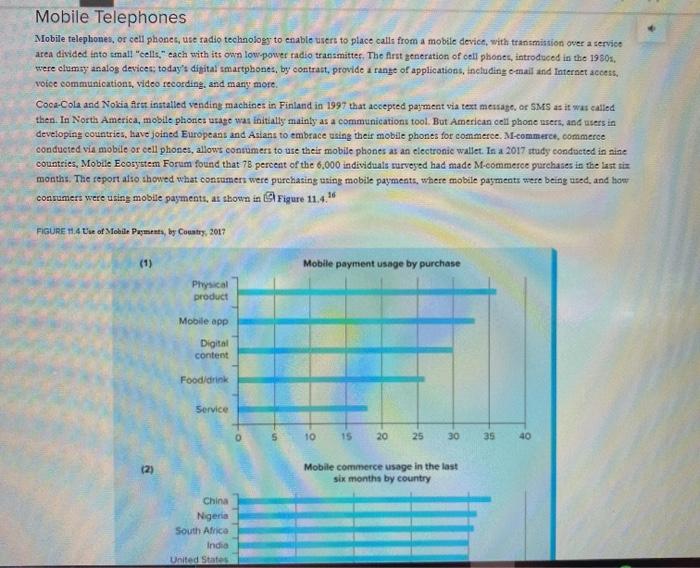
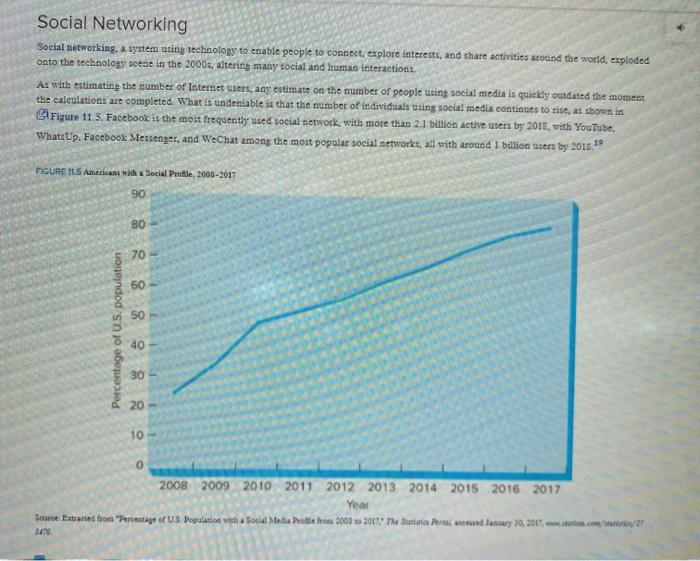
Identify a technology change described in Chapter 11 (not including the discussion case) which had or could have had an adverse effect on a business. Describe the adverse effect. The Role of Technology in Our Daily Lives Technology has been intertwined in our daily lives since the Industrial Revolution. The connection between the two became even stronger in the information, semantic, and biotechnology phases. Today, technology has the potential to influence every aspect of every individual's global activity-driving innovation, affecting collaborative partnerships, and changing businessstakeholder relationships. It has created great opportunities for people-but also terious ethical and social challenges. This section will explore some ways in which majos technologies have presented both opportunities and challenges for people in their daily lives. The Presence of the Internet More people have more access to technology than ever before. Residents of developing countries increasingly enjoy cer-powered appliances, entertainment devices, and communications equipment Individuals in developed countries in North America, Europe, portions of Asia, and the Middle East more than ever are dependent on electronic communication devices for access to information and for interactions with others and businesses. In today's environment, searly every individual in a developed country has a desktop or laptop computer, tablet, mobile phone, and a host of other electronic devices to connect them with others in their family neighborhood, country or world and this is becoming true for more and more people in developing countries as well. One of the most visible and widely used technological innovations over the past decade has been the Internet. Springing to life in Page 242 1994, this conduit of information revolutionized how business was conducted, students learned, and households operated. The Wall Street Journal reported that Generation Z, individuals born after 2000, access most of their video entertainment from Internet streaming services, such as YouTube (34 percent) and Netflix (27 percent), compared to traditional TV (27 percent).* Any estimate of the number of Internet users is quickly out of date but some important trends have emerged. In 2001, China murpassed the United States with the most internet users by country. By 2017, India surpassed the United States and Japan to become the country with the second largest number of Internet users. Indonesia, with 50.4 percent of its population using the Internet, moved up from cleveath place to Anth place based on number of Internet users by country by 2017. The top 10 countries by Internet usage in 2017 are shown in Figure 11.2. FIGURE 11.2 Top 10 erat ly Country, 2017, and Growth in World Internet rape by Region, 2006-2017 Internet Users, June 2017 China Internet Users, June 2017 China Daed States indonesia Japan downty RUSES Banglades Top 10 Counties Pethe World 2:237370522 1648197 097 0 1000 2000 3000 4000 5000 6000 7000 8000 9000 10000 Millions of users Internet Usage Growth, 2000-2017 Africa Middle East Latin America Caribbean Asie World Regions Europe Oceania Australia North America 1.0002.0003.000% 4.000 5.000 6.000 7.000 8.000 9.000 Millions of users Surce: "Top 20 Internet Countries-2017" and "World Intact Uuge and Population Statutice June 10, 2017-Update Tutarout Weld Statistics.com Thousands of new Internet users cach day demonstrate the power of this technology as a force in our lives. The Internet is increasingly being used as a place for interpersonal communication, social networking, and shopping, as described later. Yet, technology experts are warning of the potentially negative impacts on our lives of dependence on technology, Social paychologist Adam Alter warns that many children, teenagers, and adults are behaviorally addicted to modern digital products, indicated by the significant amount of time they are engaged in using their cellphones of other devices. Unlike a physical dependence on a habit forming chemical cubstance such as heroin or nicotine, behavioral addiction refers to a compulsion to engage in rewarding behaviors, ruch as checking one's Facebook feed, despite negative consequences. Alter says that some teenage boys spend weeks alone in their rooms paying video games, and Snapchat boasted that young users open their app more than 18 times a day Technology manufactures are accused of contributing to the increasing behavioral addiction to technology. Some of the games available on an individual's tmartphone require that users pay money as they play. Obviously, the game producers want users to keep playing, and they often pretest different versions of a game before release to see which vertion is the hardest to resist or will keep users' attention the longest South Korea and China are considering legislative proposals, called Cinderella laws, to protect children from playing certain games after midnight. In China, there are camps where parents commit their children for months so that therapists can treat them for their technology addiction When Facebook founder, Mark Zuckerberg was challenged with the accusation that Facebook users were spending far too much time on the social network platform, he responded that he wanted his company and its product "to encourage meaningful cocial interactions." He added. time spent is not a goal by itself Yes. A 2017 study conducted by the Royal Society for Public Health in the United Kingdom evaluated ive of the most frequently used social networkt, (Facebook, Twitter, Snapchat, Instagram, and YouTube), and concluded that all but one, YouTube, had a negative effect on the user'i mental health. In another study, Tel Aviv University teachers found that people using Facebook can begin to feel that their own lives do not measure up to those of others, causing depression, otpecially among young people. Page 243 Unwanted Technology Threats The presence of the Internet in our lives is a welcomed beneat, but it has also opened the door to various threats, such as spam and parking Spam refers to unsolicited commercial e-mails (also calledjunk e-mail) sent in bulk to valid e-mail and mobile accounts. These messages can vary from harmless advertisements for commercial products to offensive material and finance scams. Spam has created problems for users at it has caused extra network traffic and wasted time sorting through the irrelevant or unwanted e-mails to acceu desired messages. By the carly 2010, spam began to infiltrate e-mail accounts on mobile or cell phones. Page 44 As shown in Figure 11. 3. the volume of spam messages around the world, as a percentage of all e-mail traffic, began to fall somewhat from scarly 70 percent in July 2014 to around 55 percent in 2017. The main reason was the overall heightened level of antispam protection, according to a spokesperson at Kaspersky Labs, the world's largest antivirus and Internet security software company. Spamfiters are now in place on just about every e-mail system, reducing the amount of spam reaching both personal and corporate user accounts. Also, aggressive action taken by governments, especially in the United Kingdom and United States, have created strong penalties for spammert caught sending out malicious e-mail Page 243 Public Access to and Use of Technology Overall the public has more access to and uses more technology than ever before. Yet, inequalities remain in individuals' ability to access technology, whether within the United States or around the world. Certain technological devices, including mobile telephones, a new form of currency called bitcoin, and social media platforms are more readily available to come than others. These issues are discussed in greater depth in this section The Digital Divide in the United States and Worldwide The gap between those who have access to the Internet through technology and those who do not is called the digital divide. Some people have Internet access through computers, cell phones, and other devices, others do not. People in developing countries often have less Internet access than people in developed countries, and within developed countries, persons of color and the less affluentoften have less access. The presence of a digital divide is a problem because its advantaged individuals and societies may not enjoy the same benefits of technology as others In the United States, the government has acted to break down the digital divide. The U.S. government launched a 37 billion effort to expand access, chiefly thorough grants to build wired and wireless systemut in the most technologically deplected areas of the country. This government effort subsidized Internet upgrades for schools and libraries and provided digital textbooks in poor and rural areas." By 2013, reports claimed that nearly 95 percent of American homes were able to access the Internet on some sort of high-speed broadband network, either at home or work. Yet, in 2017, the MIT Technology Review pointed out that "the U.S. hat 'a persistent, embarcasting digital divide that needs to be addretted at the highest levels. Moreover, the report emphasized that, "mobile broadband access isn't the same as at-home connectivity, even though some people in the Federal Communication Committion and the executive branch of the federat government are making that case. Access to high speed Internet services remain: "neven" for many Americans. Microsoft announced plans in 2017 to address the digital divide in the United States by harnessing the unused channels between television broadcasts, known as white spaces, to help get more of rural America online. The initiative targeted twelve states, including Arizona, Kansas, New York, and Virginia, to provide two million rural Americans with access to high-speed Internet by 2022 Microsoft's president Brad Smith explained. " white tpaces are the best solution for teaching over 30 percent of people in rural America who lack broadband today." Microsoft also reached out to federal and state regulators to guarantee the use of unused televition channel and investments in promoting the technologs in these rutal areas." The digital divide also persists globally. According to a United Nations report, by 2017, more than 52 percent of people on the planet still did not have Internet access, despite efforts by some technology companies. Many businesses saw providing Internet access at the bottom of the pyramid as a lucrative business opportunity 12 Page 245 earch ORA f N Mobile Telephones Mobile telephones, or cell phones, use radio technology to enable users to place calls from a mobile device, with transmission over a service area divided into small "cells," each with its own low.power radio transmitter. The first generation of cell phones, introduced in the 1980s, were clumsy analog device today's digital smartphones, by contrast, provide a range of applications, including email and Internet access, voice communications, video recording, and many more. Coca-Cola and Nokia Arst installed vending machines in Finland in 1997 that accepted payment via text message or SMS as it was called then. In North America, mobile phones usage was initially mainty as a communication tool. But American cell phone users, and users in developing countries, have joined Europeans and Asians to embrace using their mobile phones for commerce. M-commerce, commerce conducted via mobile or cell phones, allows consumers to use their mobile phones as an electronic wallet. In a 2017 study conducted in nine countries, Mobile Ecosystem Forum found that 78 percent of the 6.000 individuals turveyed had made M-commerce purchases in the last six months. The report atso showed what consumers were purchasing using mobile payments, where mobile payments were being used, and how consumers were using mobile payments, as shown in Figure 11.4. FIGURE 11.41 Mobile Puments, by County, 2017 (1) Mobile payment usage by purchase Physical product Mobile app Digital content Food drink Service 0 5 10 15 20 25 30 35 40 (2) Mobile commerce usage in the last six months by country China Nigeria South Africa India United States Social Networking Social networking, a system using technology to enable people to connect, explore interests, and share activities around the world. exploded onto the technology scene in the 2000s, altering many social and human interactions. As with estimating the number of Internet users, any estimate on the number of people using social media is quickly outdated the moment the calculations are completed. What is undeniable is that the number of individuals using social media continues to tist, as shown in e Figure 11.5. Facebook is the most frequently used social network, with more than 2.1 billion active users by 2018, with YouTube, What:Up. Facebook Messenger, and WeChat among the most popular social networks, all with around 1 billion users by 2018, FIGURE 15 Americans with Social Prodile, 2006-2017 90 80 70 60 50 Percentage of U.S. population 40 30 20 10 0 2008 2009 2010 2011 2012 2013 2014 2015 2016 2017 Year Source Entred from "Percentage of US Dopulation with a fonal Media Prodle from 2003 2017 The Stara Pared lemary 10, 2017.com/21 3078 Ethical Challenges involving Technology With each new technological innovation comes the important ethical question: Should we develop and offer the new technological application? At present, many inventors, computer programmers, and business managers appear only to be asking: Can we develop and offer the new technological application? Both questions are paramount as technology continues to influence individuals, businesses, and society interactions in the world in which we live. Some of the most profound ethical issues involve privacy and free speech The Loss of Privacy The right to privacy, as introduced in Chapter 5 and also discussed in Chapters 14 and 15. refers to a person's entitlement to protection from invation of his or her private life by the government, business, or other persons. In many respects, the rise of the Internet and the Information Age have led to a loss of privacy. According to Richard Clarke, former senior White House cybersecurity adviser "Over time there will be few people who recall pre-Information Age privacy, more people who will have grown up with few expectations of privacy: While a backlath against the crotion of privacy is possible, it is more likely that people acting on their fear of big sovernment and big corporate data will be a minority: 21 Individuals are indeed under a technology microscope with vast amounts of data collected each minute and available to be analyzed in great detail, sometimes by people with the individuals interests in mind, such as marketers, job recruiters, and loan grantors, but also by others who have criminal motives. Facebook announced in 2018 a data partnership with four Chinese ciectronics toms, brings the number to 60 different data tharing partnerships since 2007.?? This dramatic increase in data thating has led to some users to ale Can what I post online or store on my electronic devices be used against me et accessed by povernment eaforcement agencies? Recently, this issue arote when the FBI sought to compel Apple to unlock the phone of a man involved in a terrorist attack the focus of the discussion case at the end of this chapter. But online activity can be used as evidence in everyday degal proceedings, too. Page 231 According to an online transparency report Facebook stseived 14,234 requests involving 21.731 accounts from U.S. law enforcement agencies in just six months That is far more than companies like Twitter, which received just 1,622 requests during the same period. Facebook provided information for nearly 10 percent of the request. Nevertheless, the practice remains controversial especially wbersaw enforcement casts a wide net. Invasion of individual privacy come from many different direction. Automobiles are becoming smarter, with global positioning system Internet connections, data recorders, and high-definition cameras. While automakets say they are only responding to consumer demands. these new technologies Increase the number of people with access to individuals' data. In 2014 a law was introduced in the United States that would enable car owners to control the data collected on the in-car device called the net dat recorder, commonly known at a black box The legislation was spurred by the clath over the use of personal data by law enforcement agencies and insurance companies, seeking to use the information against the car ownert Ethical challenges on how this information is collected and analyzed, and by whom are becoming increasingly talent Free Speech Issues Another important ethical issue posed by advances in technology involves free speech A: discussed in Chapter 5. Individuals have certain ethical rights, including the right to free speech. However, this right is not absolute and must be weighed against its consequences for the community. For example, an individual is not permitted to yell "fire" in a crowded movie theater, even though some might see this as an expression of free speech, since the potential harms caused by panicked moviegoers outweighs the right of free expression. The issue of free speech was at the core of Eioni United States in 2015 Anthony Elonis was accused of the eatening his estranged wift based on a series of Facebook ports. Elonis likened the posts to Eminem's Grammy winning songs "Kim" and "Kill You" which included threats of violence. He argued that he was only veating frustration after a run of personal setbacks, including the collapse of his marriage and lots of his job. He thought, like the artist Eminem, that he was just expressing his thoughts to a crowd, those accessing his Facebook pape, as the singer had to his concert audience. The Justice Department argued that Elonis's poste indicated a "clearly sinister meaning of a threat and were meant as expressions of his intent to harm his wife. The Supreme Court overturned Blonisearlier conviction arguing that criminal threats cannot be based solely on whether a reasonable person would regard communications pouted on social media or elsewhere at threatening 24 Other controversial issues involving free speech have appeared recently, such as when Facebook shutdown a popular anonymous discution board used by Facebook employees in 2016. FB Aron was a discussion forum that featured contervative political views that some claimed generated into racist or sexist comments, Facebook defended their actions by saying. A cornerstone of our culture is being open. The FB Aron internal Facebook group violated our terms of service, which require people who use Facebook, including our employees to use as authentic Identity on our platform." Facebook reminded their employees that there were other foruma where they could discuts confidential matters, but not anonymously. Some employees disagreed with Facebook's actions, saying that free speech was paramount and this forum provided lots of information that you would not have had otherwise.-25 Page 252 Undoubtedly, the debate over free speech versus censorship will continue and likely intensify as the frequency of using puble forums on Facebook and other social network mediums also increases. In many countries around the world, the government has stepped in to control the Internet or tocial media siten under the banner of national security. These actions directly pit government interests against individual rights. This conflict is ditcutsed next. The Impact of Scientific Breakthroughs Dramatic advances in the biological sciences have propelled the impact of technology on our lives. Recent unprecedented applications of biological science have made possible new, improved methods of agricultural food production as well as medical care, but they have also posed numerous ethical challenges regarding safety and the quality of life. Four of the most profound impacts of our lives come from the scientific breakthroughs in genetically modified (GM) or engineered foods, the sequencing of the human genome and the set gestio information: the adrest of biotechnology and the resulting stem cell research, and the development of radically sew medical procedures delivery and record keeping There topics are discussed in this section. As Bill Joy of Sun Microsystems warns, speaking of biotechnology as well as other innovative applications of science, cestory technologies are so powerful that they can spawa whole new classes of accidents and abuses. Most danger for the first time there accidents and abuses are widely within the reach of individuals or small group. Thessall not require Scilities or materials. Knowledge alone will enable the use of them.-50 Genetically Engineered Foods The biotechnological revolution resulted in applications for use by the agricultural industry and brought promises of larger than ever crop production through advances in genetic engineering of food. Genetic engineering involves altering the natural makeup of a living organism and allows scientists to intert virtually any sede into a plant and create a new crop or a new species Genetically modified foods, or GM foods, are foods that are processed from eactically modified crops. The explosion of GM foods into our food chain in just a few decades was remarkable. In 1982 the first tomato plant was estically engineered. Core was genetically modified to develop a retistance to insects, and soybeans were genetically modified to resist the weed-lider Roundup, enabling farmers to pray for weeds without harming the crop. At first, expectations were high that these changes would increase crop yields per acre. However, rebase been disappointing Page 254 A New York Times report using United Nations data, reported that there has been no discernable advantage in crop in de in the United States and Canada-measured by food per acro-when measured against Western Europe crop production, where that genetically modified food controls are in place. A tady by the National Academy of Sciences confirmed this finding when it stated that there was little evidence that the introduction of genetically modified crops in the United States has led to yield in besed 31 those seen in conventional crops Some critics charged that consuming genetically modified crops would harm humans. Despite a lack of scientite evidence that OM foods are harmful to humans, social advocates in Europe led the charge against genetically modified foods, calling Goods "Frankenstein foods." In the late 2000s, both France and Germany passed national bans on the use of various kinds of GM seeds. Despite French and German farmers protests that the ban would inflict set economie harm on them and their countries' cone, the German agriculture minister said, "The decision is not a political decision, it't a decision based on the fact." He amed the government's commitment to protect the safety of consumers and the eas content, Austria and Hungary al passed their own cabasco growing GM crops. While Europe continued to allow cach nation to decide whether to allow the planting or cale of GME food, the European Union passed a GM food labeling law to that all European comment can also make their own decisions to purchase this 32 type of food or not. By contrast with Europe, GM foods became quite common in grocery stores in the United States. Although mort OM corn grom is the Itatado de inimalidith nenantheatre minisric hinaan arch










 Study Help