



Question: 31.1 Use the IRAC Method to breifly identify the Issue, the Legal Rule (Legal Test), the Facts Applied to the Test (Analysis), and the Conclusion/
31.1 Use the IRAC Method to breifly identify the Issue, the Legal Rule (Legal Test), the Facts Applied to the Test (Analysis), and the Conclusion/ Holding of the case.
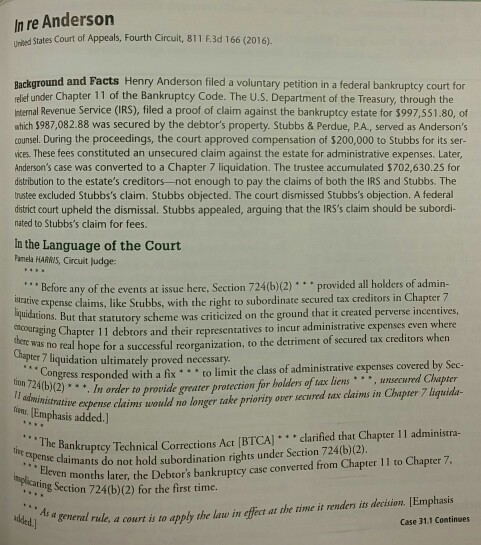
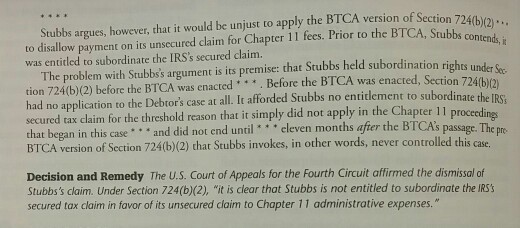
n re Anderson uried States Court of Appeals, Fourth Circuit, 811 F.3d 166 (2016) Background and Facts Henry Anderson filed a voluntary petition in a federal bankruptcy court for ielef under Chapter 11 of the Bankruptcy Code. The U.S. Department of the Treasury, through the nternal Revenue Service (IRS), filed a proof of claim against the bankruptcy estate for $997,551.80, of ahich $987,082.88 was secured by the debtor's property. Stubbs & Perdue, PA, served as Anderson's counsel. During the proceedings, the court approved compensation of $200,000 to Stubbs for its ser ices. These fees constituted an unsecured claim against the estate for administrative expenses. Later Anderson's case was converted to a Chapter 7 liquidation. The trustee accumulated $702,630.25 for dstribution to the estate's creditors-not enough to pay the claims of both the IRS and Stubbs. The tustee excluded Stubbs's claim. Stubbs objected. The court dismissed Stubbs's objection. A federal fstrict court upheld the dismissal. Stubbs appealed, arguing that the IRS's claim should be subordi nated to Stubbs's claim for fees in the Language of the Court Pamela HARRIS, Circuit Judge Before any of the events at issue here, Section 724(b)(2)provided all holders of admin- ative expense claims, like Stubbs, with the right to subordinate secured tax creditors in Chapter 7 uidtions. But that statutory scheme was criticized on the ground that it created perverse incentives ing Cha was no real h pter 11 debtors and their representatives to incur administrative expenses even where there ope for a successful reorganization, to the detriment of secured tax creditors when Congress responded with a fix . a to limit the class of administrative expenses covered by Sec In order to provide greater protection for holders of tax liens unsecured Chapter the expense claims would no longer take priority over secured tax claims in Chapter 7 liquida ter 7 liquidation ultimately proved necessary in l adminis istrative Emphasis added.] ie ce Bankruptcy Technical Corrections Act BTCAclarified that Chapter 11 administra- aimants do not hold subordination rights under Section 724(b)(2) nmonths later, the Debtor's bankruptcy case converted from Chapter 11 to Chapter 7 ng Section 724(b)(2) for the first time. ageneral rule, a court is to apply a court is to apply the law in effect at the time it renders its decision [Emphasis Case 31.1 Continues n re Anderson uried States Court of Appeals, Fourth Circuit, 811 F.3d 166 (2016) Background and Facts Henry Anderson filed a voluntary petition in a federal bankruptcy court for ielef under Chapter 11 of the Bankruptcy Code. The U.S. Department of the Treasury, through the nternal Revenue Service (IRS), filed a proof of claim against the bankruptcy estate for $997,551.80, of ahich $987,082.88 was secured by the debtor's property. Stubbs & Perdue, PA, served as Anderson's counsel. During the proceedings, the court approved compensation of $200,000 to Stubbs for its ser ices. These fees constituted an unsecured claim against the estate for administrative expenses. Later Anderson's case was converted to a Chapter 7 liquidation. The trustee accumulated $702,630.25 for dstribution to the estate's creditors-not enough to pay the claims of both the IRS and Stubbs. The tustee excluded Stubbs's claim. Stubbs objected. The court dismissed Stubbs's objection. A federal fstrict court upheld the dismissal. Stubbs appealed, arguing that the IRS's claim should be subordi nated to Stubbs's claim for fees in the Language of the Court Pamela HARRIS, Circuit Judge Before any of the events at issue here, Section 724(b)(2)provided all holders of admin- ative expense claims, like Stubbs, with the right to subordinate secured tax creditors in Chapter 7 uidtions. But that statutory scheme was criticized on the ground that it created perverse incentives ing Cha was no real h pter 11 debtors and their representatives to incur administrative expenses even where there ope for a successful reorganization, to the detriment of secured tax creditors when Congress responded with a fix . a to limit the class of administrative expenses covered by Sec In order to provide greater protection for holders of tax liens unsecured Chapter the expense claims would no longer take priority over secured tax claims in Chapter 7 liquida ter 7 liquidation ultimately proved necessary in l adminis istrative Emphasis added.] ie ce Bankruptcy Technical Corrections Act BTCAclarified that Chapter 11 administra- aimants do not hold subordination rights under Section 724(b)(2) nmonths later, the Debtor's bankruptcy case converted from Chapter 11 to Chapter 7 ng Section 724(b)(2) for the first time. ageneral rule, a court is to apply a court is to apply the law in effect at the time it renders its decision [Emphasis Case 31.1 Continues
Step by Step Solution
There are 3 Steps involved in it

Get step-by-step solutions from verified subject matter experts