Question: 32. Please identify what technique is being described in each of the following scenarios: (possible answers are: network diagram, interviewing, probability/impact matrix, workaround, top 10
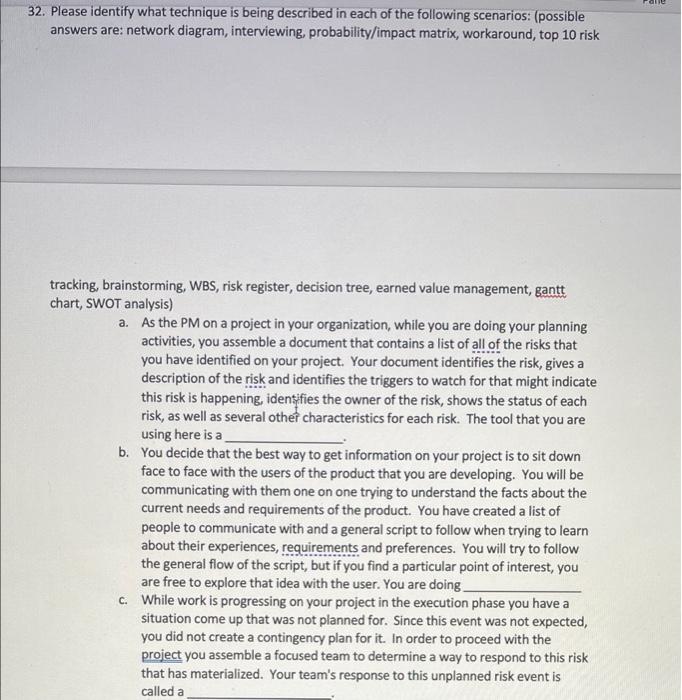
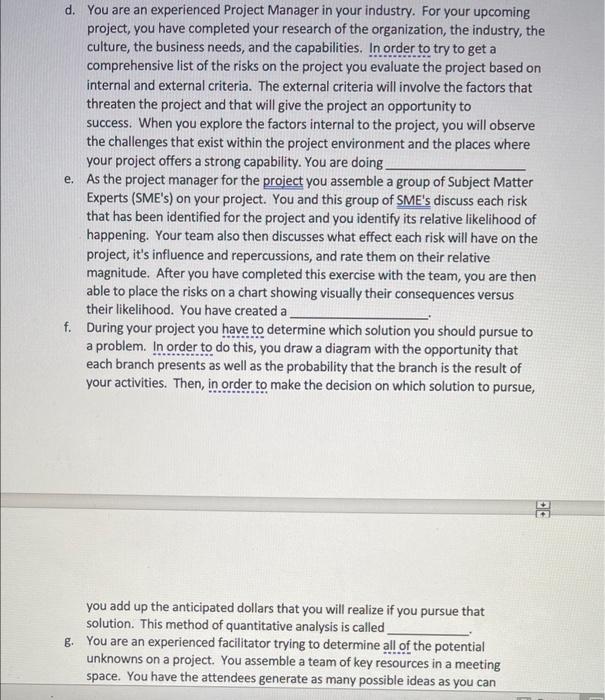
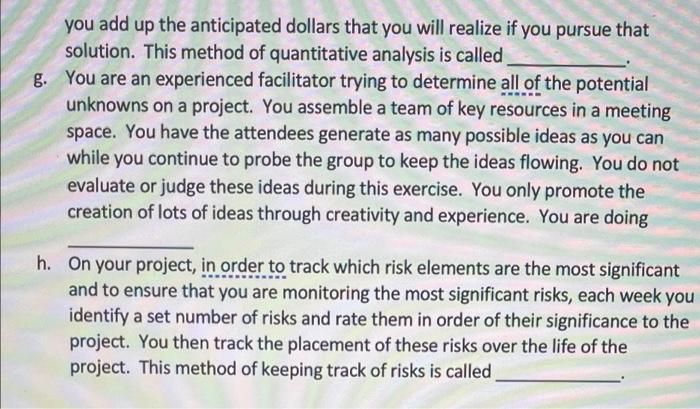
32. Please identify what technique is being described in each of the following scenarios: (possible answers are: network diagram, interviewing, probability/impact matrix, workaround, top 10 risk tracking, brainstorming, WBS, risk register, decision tree, earned value management, gantt chart, SWOT analysis) a. As the PM on a project in your organization, while you are doing your planning activities, you assemble a document that contains a list of all of the risks that you have identified on your project. Your document identifies the risk, gives a description of the risk and identifies the triggers to watch for that might indicate this risk is happening, identifies the owner of the risk, shows the status of each risk, as well as several other characteristics for each risk. The tool that you are using here is a b. You decide that the best way to get information on your project is to sit down face to face with the users of the product that you are developing. You will be communicating with them one on one trying to understand the facts about the current needs and requirements of the product. You have created a list of people to communicate with and a general script to follow when trying to learn about their experiences, requirements and preferences. You will try to follow the general flow of the script, but if you find a particular point of interest, you are free to explore that idea with the user. You are doing C. While work is progressing on your project in the execution phase you have a situation come up that was not planned for. Since this event was not expected, you did not create a contingency plan for it. In order to proceed with the project you assemble a focused team to determine a way to respond to this risk that has materialized. Your team's response to this unplanned risk event is called a d. You are an experienced Project Manager in your industry. For your upcoming project, you have completed your research of the organization, the industry, the culture, the business needs, and the capabilities. In order to try to get a comprehensive list of the risks on the project you evaluate the project based on internal and external criteria. The external criteria will involve the factors that threaten the project and that will give the project an opportunity to success. When you explore the factors internal to the project, you will observe the challenges that exist within the project environment and the places where your project offers a strong capability. You are doing e. As the project manager for the project you assemble a group of Subject Matter Experts (SME's) on your project. You and this group of SME's discuss each risk that has been identified for the project and you identify its relative likelihood of happening. Your team also then discusses what effect each risk will have on the project, it's influence and repercussions, and rate them on their relative magnitude. After you have completed this exercise with the team, you are then able to place the risks on a chart showing visually their consequences versus their likelihood. You have created a f. During your project you have to determine which solution you should pursue to a problem. In order to do this, you draw a diagram with the opportunity that each branch presents as well as the probability that the branch is the result of your activities. Then, in order to make the decision on which solution to pursue, C you add up the anticipated dollars that you will realize if you pursue that solution. This method of quantitative analysis is called &. You are an experienced facilitator trying to determine all of the potential unknowns on a project. You assemble a team of key resources in a meeting space. You have the attendees generate as many possible ideas as you can you add up the anticipated dollars that you will realize if you pursue that solution. This method of quantitative analysis is called g. You are an experienced facilitator trying to determine all of the potential unknowns on a project. You assemble a team of key resources in a meeting space. You have the attendees generate as many possible ideas as you can while you continue to probe the group to keep the ideas flowing. You do not evaluate or judge these ideas during this exercise. You only promote the creation of lots of ideas through creativity and experience. You are doing h. On your project, in order to track which risk elements are the most significant and to ensure that you are monitoring the most significant risks, each week you identify a set number of risks and rate them in order of their significance to the project. You then track the placement of these risks over the life of the project. This method of keeping track of risks is called









 Study Help