







Question: 32. This problem should be solved as a team exercise: Shaving is a process that most men perform each morning. Assume that the process begins
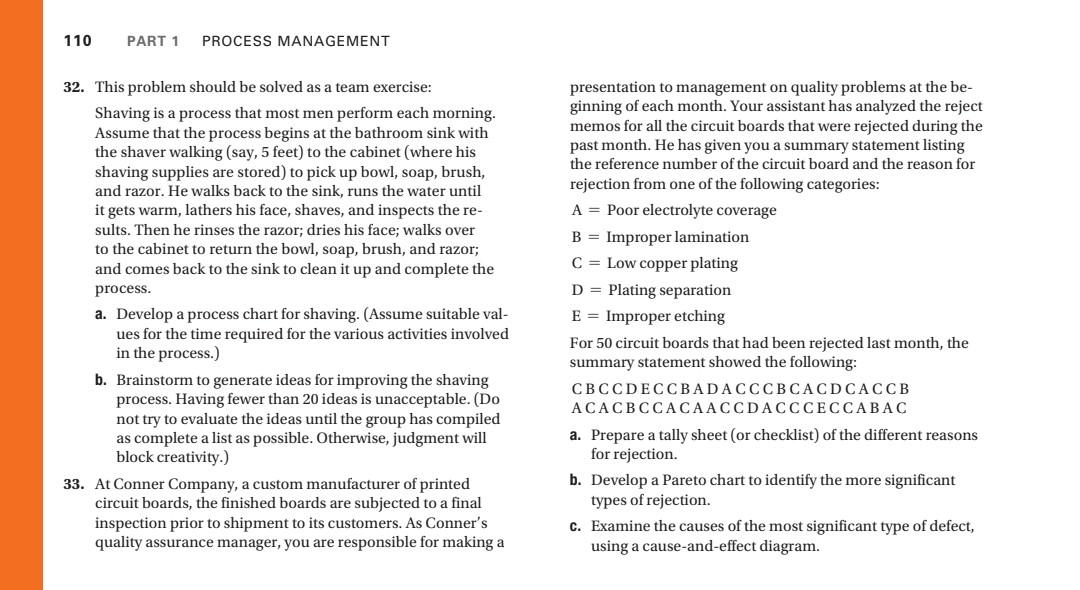
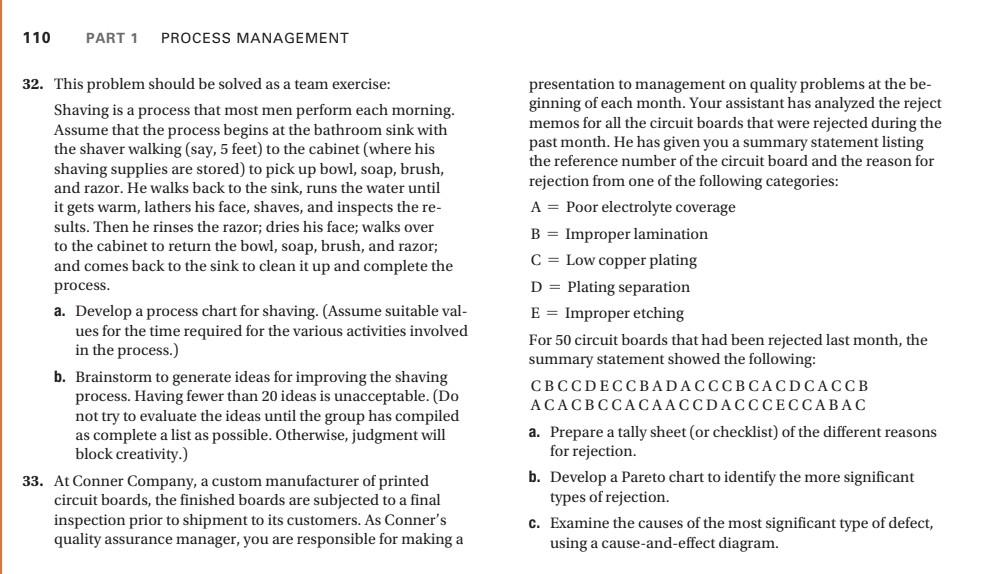
32. This problem should be solved as a team exercise: Shaving is a process that most men perform each morning. Assume that the process begins at the bathroom sink with the shaver walking (say, 5 feet) to the cabinet (where his shaving supplies are stored) to pick up bowl, soap, brush, and razor. He walks back to the sink, runs the water until it gets warm, lathers his face, shaves, and inspects the results. Then he rinses the razor; dries his face; walks over to the cabinet to return the bowl, soap, brush, and razor; and comes back to the sink to clean it up and complete the process. a. Develop a process chart for shaving. (Assume suitable values for the time required for the various activities involved in the process.) b. Brainstorm to generate ideas for improving the shaving process. Having fewer than 20 ideas is unacceptable. (Do not try to evaluate the ideas until the group has compiled as complete a list as possible. Otherwise, judgment will block creativity.) 33. At Conner Company, a custom manufacturer of printed circuit boards, the finished boards are subjected to a final inspection prior to shipment to its customers. As Conner's quality assurance manager, you are responsible for making a presentation to management on quality problems at the beginning of each month. Your assistant has analyzed the reject memos for all the circuit boards that were rejected during the past month. He has given you a summary statement listing the reference number of the circuit board and the reason for rejection from one of the following categories: A= Poor electrolyte coverage B= Improper lamination C= Low copper plating D= Plating separation E= Improper etching For 50 circuit boards that had been rejected last month, the summary statement showed the following: CB C CDEC CBADA C C B CACDCACCB ACACBCCACAACCDACCCECCABAC a. Prepare a tally sheet (or checklist) of the different reasons for rejection. b. Develop a Pareto chart to identify the more significant types of rejection. c. Examine the causes of the most significant type of defect, using a cause-and-effect diagram. 32. This problem should be solved as a team exercise: Shaving is a process that most men perform each morning. Assume that the process begins at the bathroom sink with the shaver walking (say, 5 feet) to the cabinet (where his shaving supplies are stored) to pick up bowl, soap, brush, and razor. He walks back to the sink, runs the water until it gets warm, lathers his face, shaves, and inspects the results. Then he rinses the razor; dries his face; walks over to the cabinet to return the bowl, soap, brush, and razor; and comes back to the sink to clean it up and complete the process. a. Develop a process chart for shaving. (Assume suitable values for the time required for the various activities involved in the process.) b. Brainstorm to generate ideas for improving the shaving process. Having fewer than 20 ideas is unacceptable. (Do not try to evaluate the ideas until the group has compiled as complete a list as possible. Otherwise, judgment will block creativity.) 33. At Conner Company, a custom manufacturer of printed circuit boards, the finished boards are subjected to a final inspection prior to shipment to its customers. As Conner's quality assurance manager, you are responsible for making a presentation to management on quality problems at the beginning of each month. Your assistant has analyzed the reject memos for all the circuit boards that were rejected during the past month. He has given you a summary statement listing the reference number of the circuit board and the reason for rejection from one of the following categories: A= Poor electrolyte coverage B= Improper lamination C= Low copper plating D= Plating separation E= Improper etching For 50 circuit boards that had been rejected last month, the summary statement showed the following: CBCCDEC B A D C C B CACDCACCB ACACBCCACAACCDACCCECCABAC a. Prepare a tally sheet (or checklist) of the different reasons for rejection. b. Develop a Pareto chart to identify the more significant types of rejection. c. Examine the causes of the most significant type of defect, using a cause-and-effect diagram
Step by Step Solution
There are 3 Steps involved in it

Get step-by-step solutions from verified subject matter experts
 Study Help