







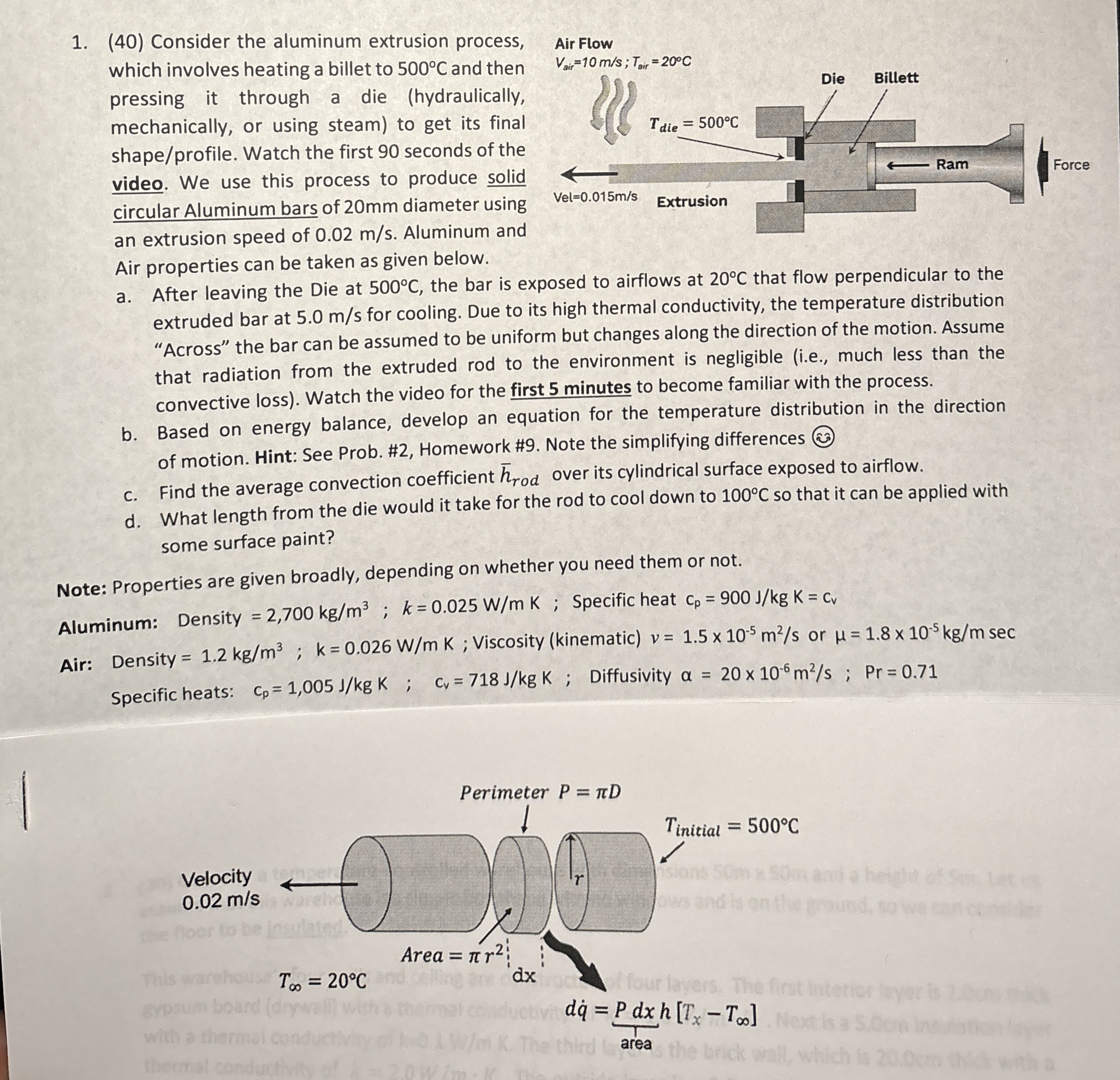
Question: ( 4 0 ) Consider the aluminum extrusion process, which involves heating a billet to 5 0 0 C and then pressing it through a
Consider the aluminum extrusion process,
which involves heating a billet to and then
pressing it through a die hydraulically
mechanically, or using steam to get its final
shapeprofile Watch the first seconds of the
video. We use this process to produce solid
circular Aluminum bars of mm diameter using
an extrusion speed of Aluminum and
Air properties can be taken as given below.
a After leaving the Die at the bar is exposed to airflows at that flow perpendicular to the
extruded bar at for cooling. Due to its high thermal conductivity, the temperature distribution
"Across" the bar can be assumed to be uniform but changes along the direction of the motion. Assume
that radiation from the extruded rod to the environment is negligible ie much less than the
convective loss Watch the video for the first minutes to become familiar with the process.
b Based on energy balance, develop an equation for the temperature distribution in the direction
of motion. Hint: See Prob. # Homework # Note the simplifying differences
c Find the average convection coefficient over its cylindrical surface exposed to airflow.
d What length from the die would it take for the rod to cool down to so that it can be applied with
some surface paint?
Note: Properties are given broadly, depending on whether you need them or not.
Aluminum: Density ;; Specific heat
Air: Density ;; Viscosity kinematic or
Specific heats: ;; Diffusivity ; Consider the aluminum extrusion process,
which involves heating a billet to and then
pressing it through a die hydraulically
mechanically, or using steam to get its final
shapeprofile Watch the first seconds of the
video. We use this process to produce solid
circular Aluminum bars of mm diameter using
an extrusion speed of Aluminum and
Air properties can be taken as given below.
a After leaving the Die at the bar is exposed to airflows at that flow perpendicular to the
extruded bar at for cooling. Due to its high thermal conductivity, the temperature distribution
"Across" the bar can be assumed to be uniform but changes along the direction of the motion. Assume
that radiation from the extruded rod to the environment is negligible ie much less than the
convective loss Watch the video for the first minutes to become familiar with the process.
b Based on energy balance, develop an equation for the temperature distribution in the direction
of motion. Hint: See Prob. # Homework # Note the simplifying differences
c Find the average convection coefficient over its cylindrical surface exposed to airflow.
d What length from the die would it take for the rod to cool down to so that it can be applied with
some surface paint?
Note: Properties are given broadly, depending on whether you need them or not.
Aluminum: Density ;; Specific heat
Air: Density ;; Viscosity kinematic or
Specific heats: ;; Diffusivity ;
Consider the aluminum extrusion process,
which involves heating a billet to and then
pressing it through a die hydraulically
mechanically, or using steam to get its final
shapeprofile Watch the first seconds of the
video. We use this process to produce solid
circular Aluminum bars of mm diameter using
an extrusion speed of Aluminum and
Air properties can be taken as given below.
a After leaving the Die at the bar is exposed to airflows at
Step by Step Solution
There are 3 Steps involved in it
1 Expert Approved Answer
Step: 1 Unlock

Question Has Been Solved by an Expert!
Get step-by-step solutions from verified subject matter experts
Step: 2 Unlock
Step: 3 Unlock
 Study Help