







Question: 4. [-/1 Points] DETAILS SERPSE10 33.3.OP.006. PRACTICE ANOTHER MY NOTES ASK YOUR TEACHER An electromagnetic wave in vacuum has an electric field amplitude of
![4. [-/1 Points] DETAILS SERPSE10 33.3.OP.006. PRACTICE ANOTHER MY NOTES ASK YOUR](https://s3.amazonaws.com/si.experts.images/answers/2024/05/664358b10092a_648664358b0ca4cc.jpg)
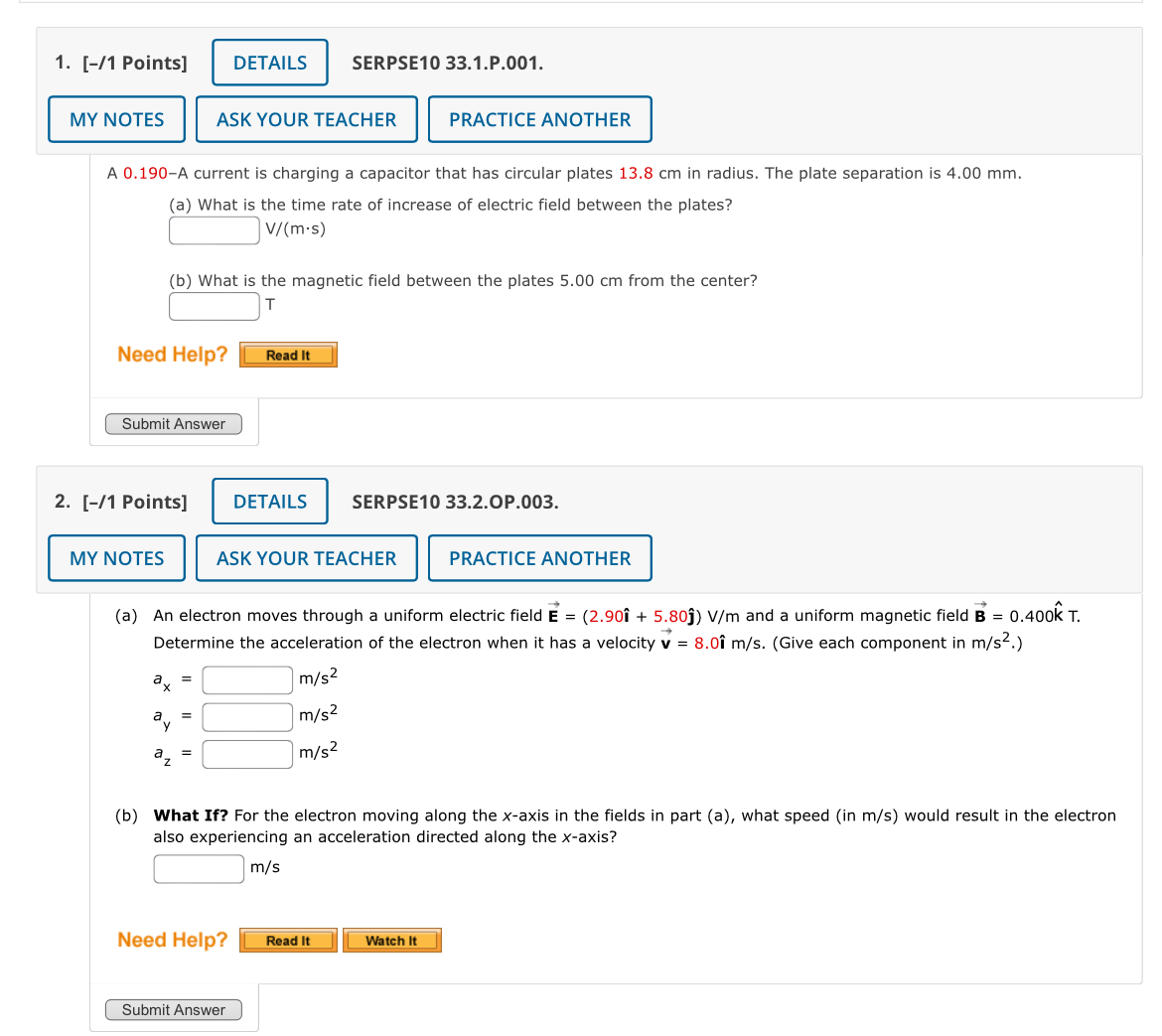
4. [-/1 Points] DETAILS SERPSE10 33.3.OP.006. PRACTICE ANOTHER MY NOTES ASK YOUR TEACHER An electromagnetic wave in vacuum has an electric field amplitude of 348 V/m. Calculate the amplitude of the corresponding magnetic field. nT Need Help? Read It Watch It Submit Answer 5. [-/1 Points] DETAILS MY NOTES ASK YOUR TEACHER SERPSE10 33.3.OP.007.MI. PRACTICE ANOTHER The figure below shows a plane electromagnetic sinusoidal wave propagating in the x direction. Suppose the wavelength is 48.0 m and the electric field vibrates in the xy plane with an amplitude of 20.0 V/m. (a) Calculate the frequency of the wave. MHz (b) Calculate the magnetic field Bwhen the electric field has its maximum value in the negative y direction. magnitude direction ---Select-- nT (c) Write an expression for Bwith the correct unit vector, with numerical values for B max, k, and w, and with its magnitude in the form B = B max cos (kx - wt). (Assume B is measured in nT, x is measured in m and t in s.) B = COS Need Help? Read It Master It Submit Answer x 107) t] knT SERPSE10 33.1.P.001. PRACTICE ANOTHER 1. [-/1 Points] DETAILS MY NOTES ASK YOUR TEACHER A 0.190-A current is charging a capacitor that has circular plates 13.8 cm in radius. The plate separation is 4.00 mm. (a) What is the time rate of increase of electric field between the plates? V/(m-s) (b) What is the magnetic field between the plates 5.00 cm from the center? T Need Help? Read It Submit Answer SERPSE10 33.2.OP.003. 2. [-/1 Points] DETAILS MY NOTES ASK YOUR TEACHER PRACTICE ANOTHER (a) An electron moves through a uniform electric field E = (2.901 + 5.80) V/m and a uniform magnetic field B = 0.400K T. Determine the acceleration of the electron when it has a velocity v = 8.01 m/s. (Give each component in m/s.) ax ay = = = m/s m/s m/s (b) What If? For the electron moving along the x-axis in the fields in part (a), what speed (in m/s) would result in the electron also experiencing an acceleration directed along the x-axis? m/s Need Help? Read It Watch It Submit Answer
Step by Step Solution
There are 3 Steps involved in it

Get step-by-step solutions from verified subject matter experts
 Study Help