







Question: 4 . 3 Bass Diffusion Model: Predict New Product Sales and Product Rollover You are the brand manager of Q - Phone, a new product
Bass Diffusion Model: Predict New Product Sales and Product Rollover
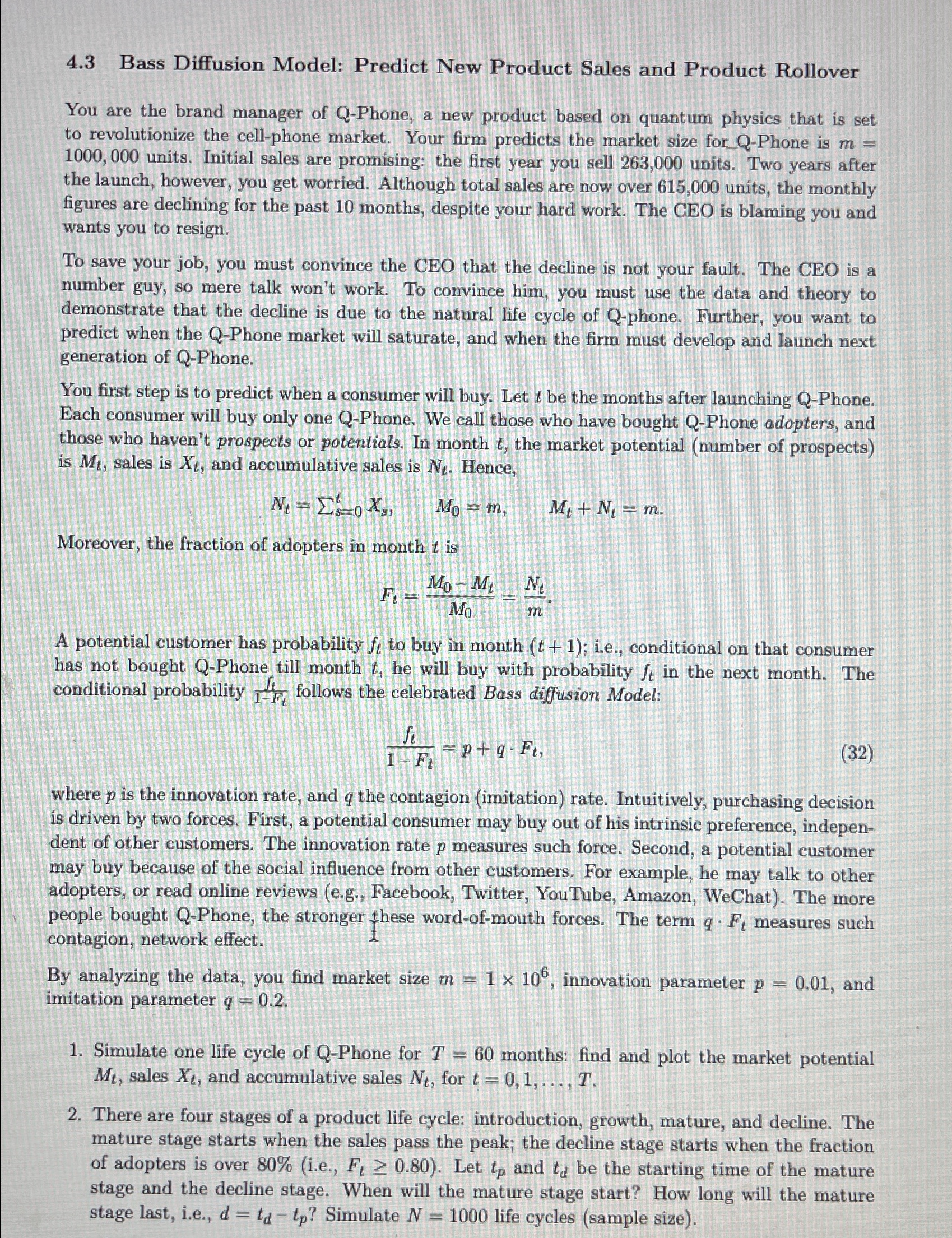
You are the brand manager of QPhone, a new product based on quantum physics that is set to revolutionize the cellphone market. Your firm predicts the market size for QPhone is units. Initial sales are promising: the first year you sell units. Two years after the launch, however, you get worried. Although total sales are now over units, the monthly figures are declining for the past months, despite your hard work. The CEO is blaming you and wants you to resign.
To save your job, you must convince the CEO that the decline is not your fault. The CEO is a number guy, so mere talk won't work. To convince him, you must use the data and theory to demonstrate that the decline is due to the natural life cycle of Qphone. Further, you want to predict when the QPhone market will saturate, and when the firm must develop and launch next generation of QPhone.
You first step is to predict when a consumer will buy. Let be the months after launching QPhone. Each consumer will buy only one QPhone. We call those who have bought QPhone adopters, and those who haven't prospects or potentials. In month the market potential number of prospects is sales is and accumulative sales is Hence,
Moreover, the fraction of adopters in month is
A potential customer has probability to buy in month ; ie conditional on that consumer has not bought QPhone till month he will buy with probability in the next month. The conditional probability follows the celebrated Bass diffusion Model:
where is the innovation rate, and the contagion imitation rate. Intuitively, purchasing decision is driven by two forces. First, a potential consumer may buy out of his intrinsic preference, independent of other customers. The innovation rate measures such force. Second, a potential customer may buy because of the social influence from other customers. For example, he may talk to other adopters, or read online reviews eg Facebook, Twitter, YouTube, Amazon, WeChat The more people bought QPhone, the stronger these wordofmouth forces. The term measures such contagion, network effect.
By analyzing the data, you find market size innovation parameter and imitation parameter
Simulate one life cycle of QPhone for months: find and plot the market potential sales and accumulative sales for dots,
There are four stages of a product life cycle: introduction, growth, mature, and decline. The mature stage starts when the sales pass the peak; the decline stage starts when the fraction of adopters is over ie Let and be the starting time of the mature stage and the decline stage. When will the mature stage start? How long will the mature stage last, ie Simulate life cycles sample size
Step by Step Solution
There are 3 Steps involved in it
1 Expert Approved Answer
Step: 1 Unlock

Question Has Been Solved by an Expert!
Get step-by-step solutions from verified subject matter experts
Step: 2 Unlock
Step: 3 Unlock
 Study Help