







Question: 4. (30 points) In a small community with a population of 4,000, an incident released E. coli into the water supply, resulting in the
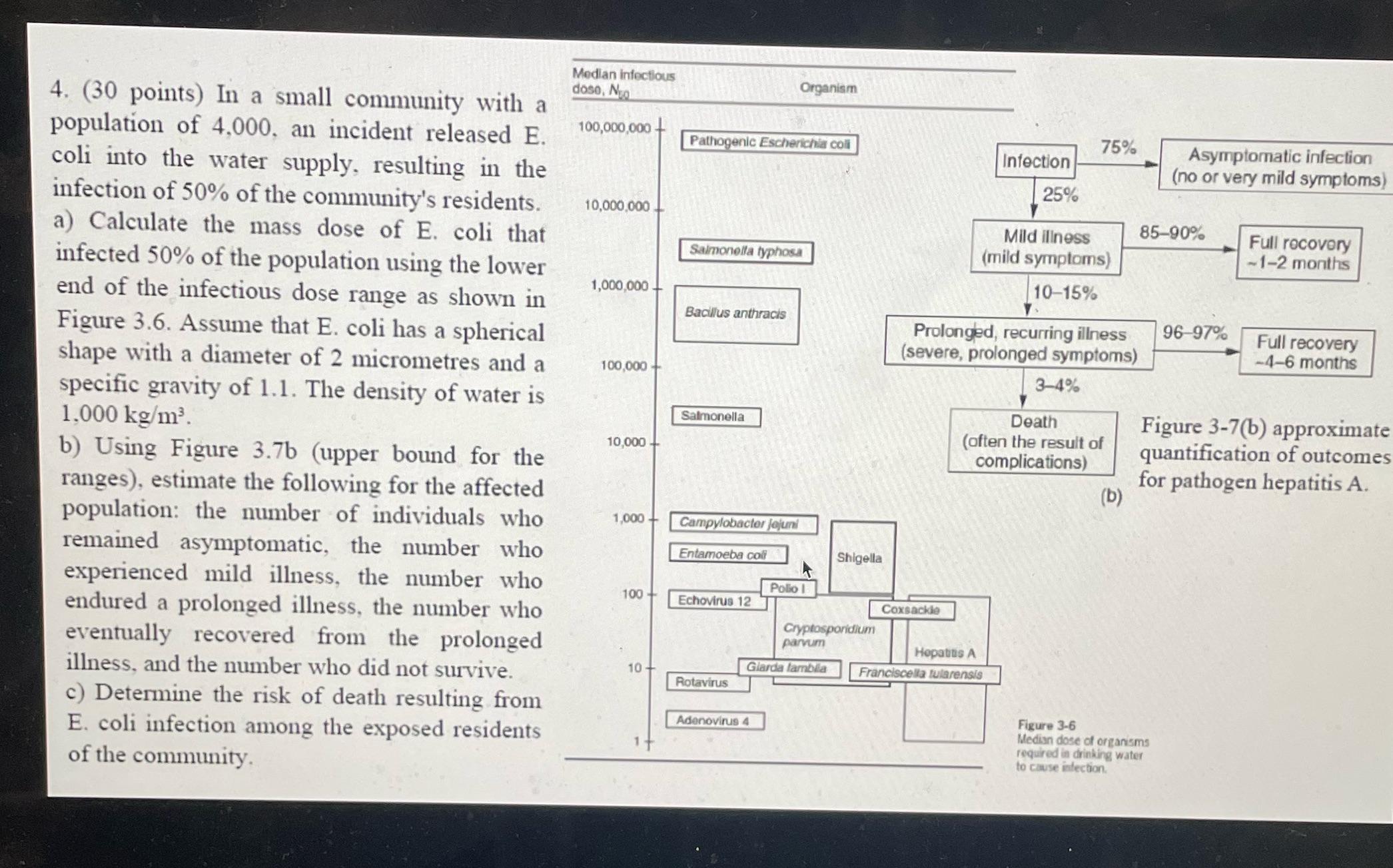
4. (30 points) In a small community with a population of 4,000, an incident released E. coli into the water supply, resulting in the infection of 50% of the community's residents. a) Calculate the mass dose of E. coli that infected 50% of the population using the lower end of the infectious dose range as shown in Figure 3.6. Assume that E. coli has a spherical shape with a diameter of 2 micrometres and a specific gravity of 1.1. The density of water is 1,000 kg/m. b) Using Figure 3.7b (upper bound for the ranges), estimate the following for the affected population: the number of individuals who remained asymptomatic, the number who experienced mild illness, the number who endured a prolonged illness, the number who eventually recovered from the prolonged illness, and the number who did not survive. c) Determine the risk of death resulting from E. coli infection among the exposed residents of the community. Median infectious dose, No 100,000,000- Organism Pathogenic Escherichia coll 75% Infection Asymptomatic infection (no or very mild symptoms) 25% 10,000,000 85-90% Salmonella typhosa Mild illness (mild symptoms) Full recovery -1-2 months 1,000,000 10-15% Bacillus anthracis Prolonged, recurring illness (severe, prolonged symptoms) 96-97% Full recovery -4-6 months 3-4% Death 100,000 Salmonella 10,000 (often the result of complications) Figure 3-7(b) approximate quantification of outcomes for pathogen hepatitis A. (b) 1,000+ Campylobacter jejuni Entamoeba coll Shigella Polio I 100+ Echovirus 12 Coxsackie Cryptosporidium 10 parvum Glarda lamblia Hepatitis A Franciscella tularensis Rotavirus Adenovirus 4 Figure 3-6 Median dose of organisms required in drinking water to cause infection.
Step by Step Solution
There are 3 Steps involved in it

Get step-by-step solutions from verified subject matter experts
 Study Help