







Question: 4, 8, 4, 6 2. Sample Statistics: For the following sample data, find the mean, median, mode, range, sample variance, and sample standard deviation. You
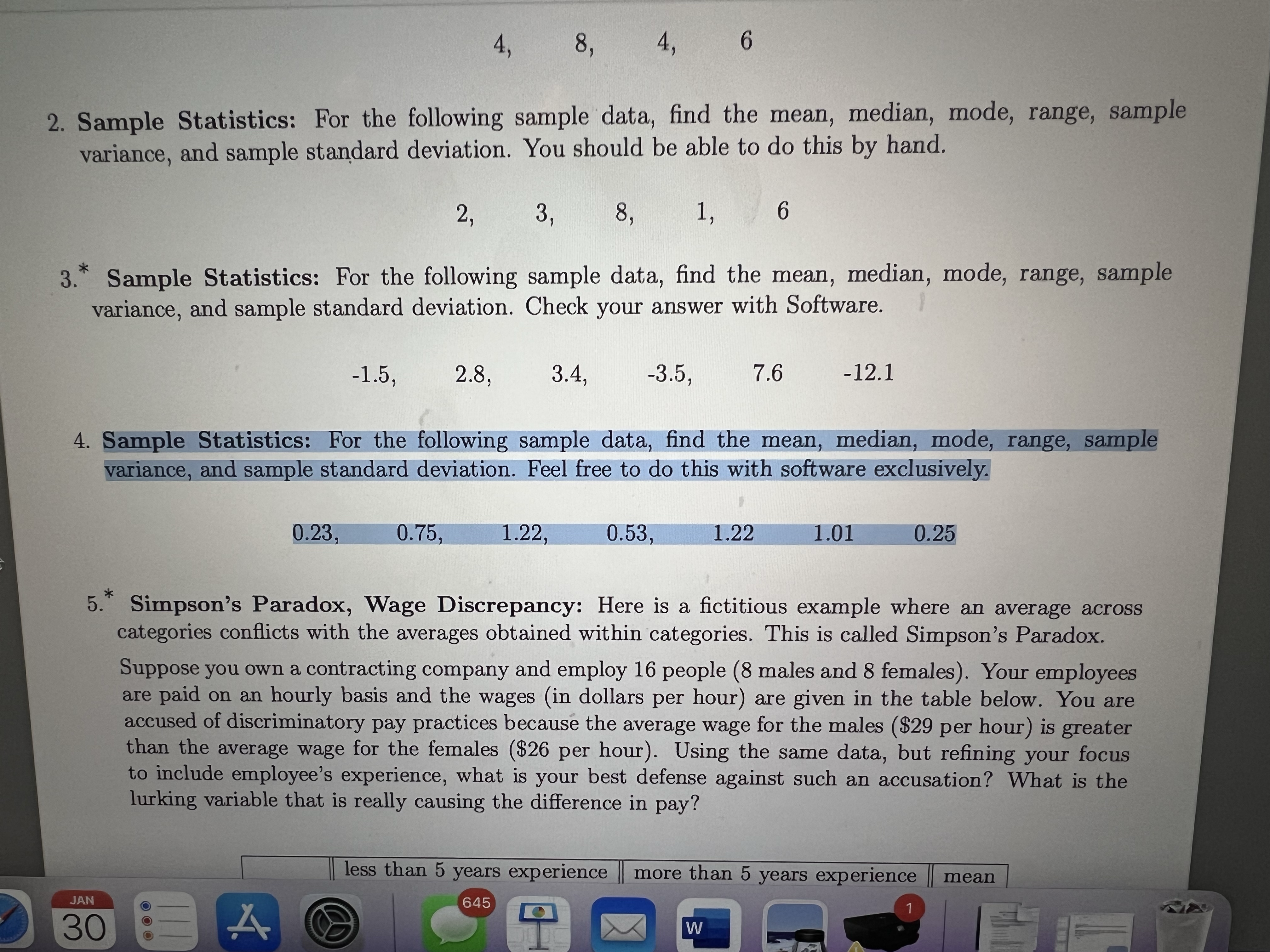
4, 8, 4, 6 2. Sample Statistics: For the following sample data, find the mean, median, mode, range, sample variance, and sample standard deviation. You should be able to do this by hand. 2 , 3, 8, 1 , 6 3. Sample Statistics: For the following sample data, find the mean, median, mode, range, sample variance, and sample standard deviation. Check your answer with Software. -1.5, 2.8, 3.4, -3.5, 7.6 -12.1 4. Sample Statistics: For the following sample data, find the mean, median, mode, range, sample variance, and sample standard deviation. Feel free to do this with software exclusively. 0.23, 0.75, 1.22, 0.53, 1.22 1.01 0.25 5. Simpson's Paradox, Wage Discrepancy: Here is a fictitious example where an average across categories conflicts with the averages obtained within categories. This is called Simpson's Paradox. Suppose you own a contracting company and employ 16 people (8 males and 8 females). Your employees are paid on an hourly basis and the wages (in dollars per hour) are given in the table below. You are accused of discriminatory pay practices because the average wage for the males ($29 per hour) is greater than the average wage for the females ($26 per hour). Using the same data, but refining your focus to include employee's experience, what is your best defense against such an accusation? What is the lurking variable that is really causing the difference in pay? less than 5 years experience | more than 5 years experience mean JAN 645 30 W
Step by Step Solution
There are 3 Steps involved in it

Get step-by-step solutions from verified subject matter experts
 Study Help