



Question: 4. Brianne is a mean-variance utility maximizer. When allocating her wealth at the prevailing returns for the risk-free and risky asset, she chooses a portfolio
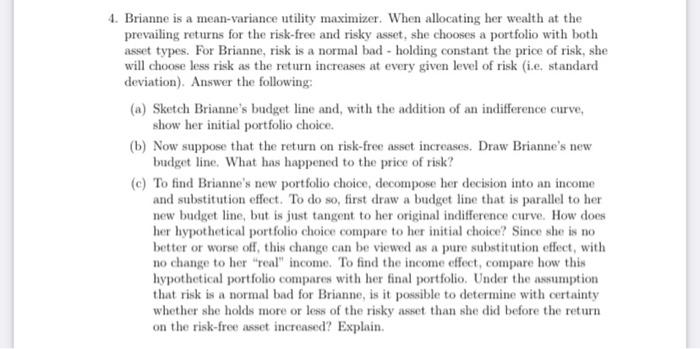
4. Brianne is a mean-variance utility maximizer. When allocating her wealth at the prevailing returns for the risk-free and risky asset, she chooses a portfolio with both asset types. For Brianne, risk is a normal bad - holding constant the price of risk, she will choose less risk as the return increases at every given level of risk (i.e, standard deviation). Answer the following: (a) Sketch Brianne's budget line and with the addition of an indifference curve, show her initial portfolio choice. (b) Now suppose that the return on risk-free asset increases. Draw Brianne's new budget line. What has happened to the price of risk? (e) To find Brianne's new portfolio choice, decompose her decision into an income and substitution effect. To do so, first draw a budget line that is parallel to her new budget line, but is just tangent to her original indifference curve. How does her hypothetical portfolio choice compare to her initial choice? Since she is no better or worse off, this change can be viewed as a pure substitution effect, with no change to her "real" income. To find the income effect, compare how this hypothetical portfolio compares with her final portfolio. Under the assumption that risk is a normal bad for Brianne, is it possible to determine with certainty whether she holds more or less of the risky asset than she did before the return on the risk-free asset increased? Explain
Step by Step Solution
There are 3 Steps involved in it

Get step-by-step solutions from verified subject matter experts