







Question: 4. Consider the binary encoding of 4 MIPS instructions in the table below. Further consider each instruction individually; in other words, these four instructions do
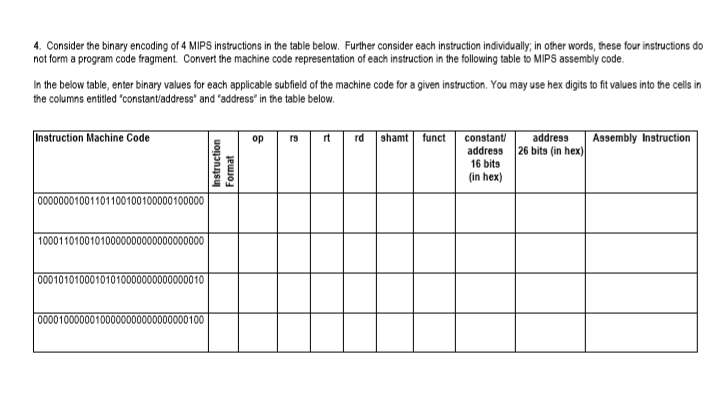
4. Consider the binary encoding of 4 MIPS instructions in the table below. Further consider each instruction individually; in other words, these four instructions do not form a program code fragment. Convert the machine code representation of each instruction in the following table to MIPS assembly code. In the below table, enter binary values for each applicable subfield of the machine code for a given instruction. You may use hex digits to fit values into the cells in the columns entitled "constant/address' and 'address' in the table below Instruction Machine Code op rd shamtfunctconstant address Assembly Instruction address 26 bits (in hex) 16 bits (in hex) 00000001001101100100100000100000 10001101001010000000000000000000 00010101000101010000000000000010 00001000000100000000000000000100 4. Consider the binary encoding of 4 MIPS instructions in the table below. Further consider each instruction individually; in other words, these four instructions do not form a program code fragment. Convert the machine code representation of each instruction in the following table to MIPS assembly code. In the below table, enter binary values for each applicable subfield of the machine code for a given instruction. You may use hex digits to fit values into the cells in the columns entitled "constant/address' and 'address' in the table below Instruction Machine Code op rd shamtfunctconstant address Assembly Instruction address 26 bits (in hex) 16 bits (in hex) 00000001001101100100100000100000 10001101001010000000000000000000 00010101000101010000000000000010 00001000000100000000000000000100
Step by Step Solution
There are 3 Steps involved in it

Get step-by-step solutions from verified subject matter experts
 Study Help