







Question: 4. Fluids and Error in Measurement: In your fluids lab, you saw how the pressure in a fluid is linear in respect to the
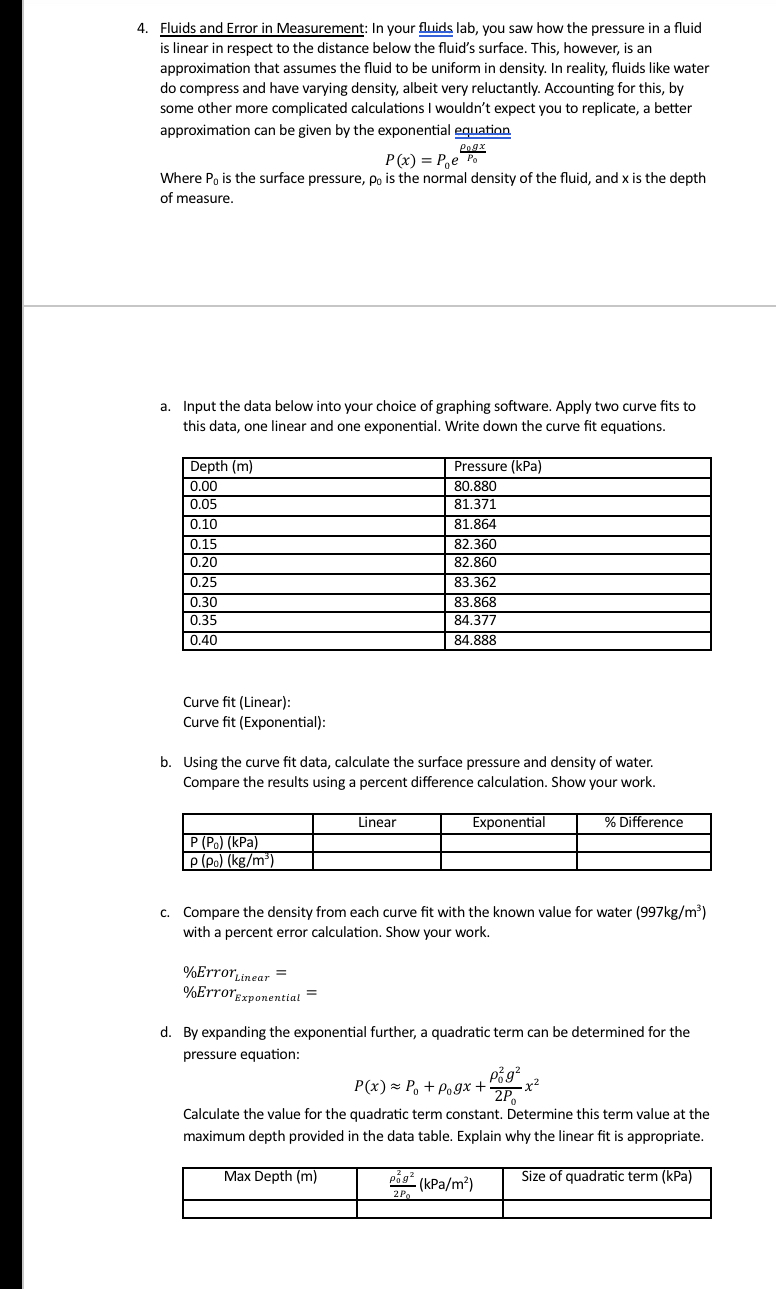
4. Fluids and Error in Measurement: In your fluids lab, you saw how the pressure in a fluid is linear in respect to the distance below the fluid's surface. This, however, is an approximation that assumes the fluid to be uniform in density. In reality, fluids like water do compress and have varying density, albeit very reluctantly. Accounting for this, by some other more complicated calculations I wouldn't expect you to replicate, a better approximation can be given by the exponential equation Pogx P(x) = Poe Po Where Po is the surface pressure, po is the normal density of the fluid, and x is the depth of measure. a. Input the data below into your choice of graphing software. Apply two curve fits to this data, one linear and one exponential. Write down the curve fit equations. Pressure (kPa) Depth (m) 0.00 80.880 0.05 81.371 0.10 81.864 0.15 82.360 0.20 82.860 0.25 83.362 0.30 83.868 0.35 84.377 0.40 84.888 Curve fit (Linear): Curve fit (Exponential): b. Using the curve fit data, calculate the surface pressure and density of water. Compare the results using a percent difference calculation. Show your work. P (Po) (kPa) Linear Exponential % Difference P (po) (kg/m) c. Compare the density from each curve fit with the known value for water (997kg/m) with a percent error calculation. Show your work. %Error Linear = %Error Exponential d. By expanding the exponential further, a quadratic term can be determined for the pressure equation: P(x) = Po + Pogx + 2P Calculate the value for the quadratic term constant. Determine this term value at the maximum depth provided in the data table. Explain why the linear fit is appropriate. Max Depth (m) Pog (kPa/m) Size of quadratic term (kPa) 2Po
Step by Step Solution
There are 3 Steps involved in it

Get step-by-step solutions from verified subject matter experts
 Study Help