







Question: 4. For a continuous-review inventory system that uses a base-stock policy (that is a policy used when there are no significant fixed ordering costs), the
4. For a continuous-review inventory system that uses a base-stock policy (that is a policy used when there are no significant fixed ordering costs), the system orders every time a demand occurs. The system maintains some safety stock to protect against demand during the replenishment lead time (i.e., time between placing an order and receiving it). Every time there is a demand, the system orders enough to bring inventory position (which is equal to inventory on-hand plus inventory on-order (that is, all previously placed orders that have not arrived yet)) back to a base-stock level S. That translates to ordering the exact amount of the demand. The value of Scan be computed as [ Pr{LT _Demand
a. If demand (per week) is normally distributed, then S can be computed as S = mu*L + z*SQRT[L*sigd^2 + mu^2*sigl^2], where mu = average weekly demand, sigd = standard deviation of weekly demand, L = average lead time (measured in weeks), and sigl = std deviation of lead time (measured in weeks). The values of z for a 95% desired service level is 1.65. Assume weekly demand for engine DR1428-RX is normally distributed with mean 5, and standard deviation 2. The lead-time data for this engine is shown in Exhibit 9. One week = 7 days.
S=_______
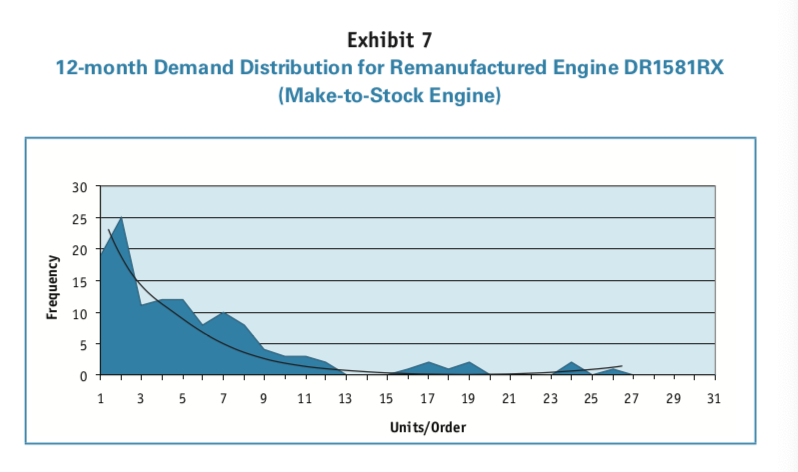
b. Suppose demand during the replenishment lead time for engine DR1581RX (Exhibit 7) is exponentially distributed with mean mul = 5.653. You also know that for exponentially distributed lead time demand, Prob{LT _Demand
S=_______
c. Now, consider the following facts: Weekly demand for DR1581RX has a mean of mu = 3.325 and standard deviation of sigd = 3.325. In addition, replenishment lead time has a mean of L = 1.7 weeks and a standard deviation of sigl = 0.5 weeks. Notice that this results in a mean demand during the lead time of mul = 1.7*3.325 = 5.653. Suppose the analyst computed the base stock level S for this engine using the assumption of normally distributed demand (and hence, used the formula stated in (a) to compute S). However, demand during the lead time is really exponentially distributed. Compute S under the normal distribution assumption (default in VPEX).
S=
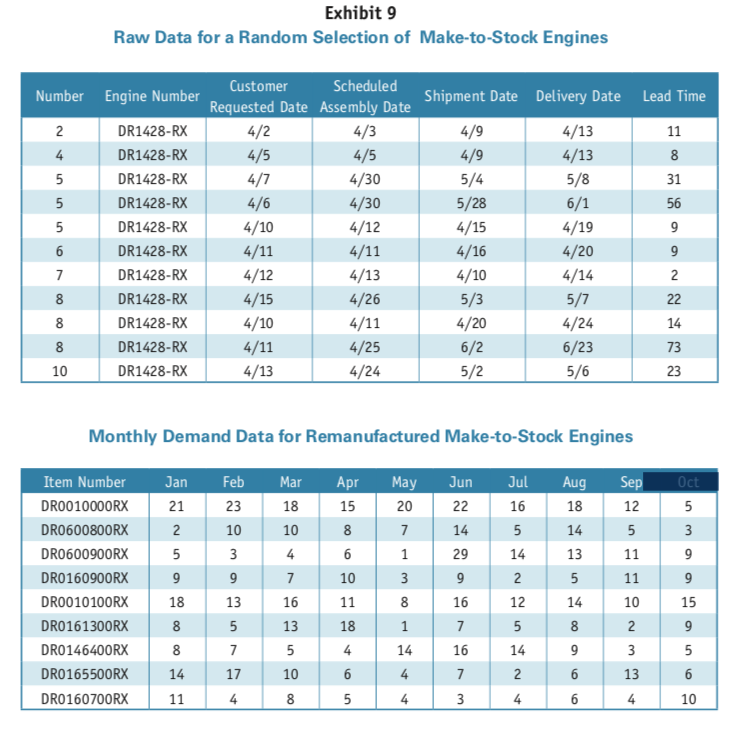
\fExhibit 9 Raw Data for a Random Selection of Manda-Stuck Engines L' _ Dlx Dx URDEDDBUDRX Dlx unun1u1nnax D1613x nau1454unax Dlx l?x
Step by Step Solution
There are 3 Steps involved in it

Get step-by-step solutions from verified subject matter experts
 Study Help