







Question: 4 . Individual Problems 1 7 - 6 The HR department is trying to fill a vacant position for a job with a small talent
Individual Problems The HR department is trying to fill a vacant position for a job with a small talent pool. Valid applications arrive every week or so and the applicants all seem to bring different levels of expertise. For each applicant, the HR manager gathers information by trying to verify various claims on the candidate's rsum but some doubt about fit always lingers when a decision to hire or not is to be made. Suppose that hiringYou're a contestant on a TV game show. In the final round of the game, if contestants answer a question correctly, they will increase their current
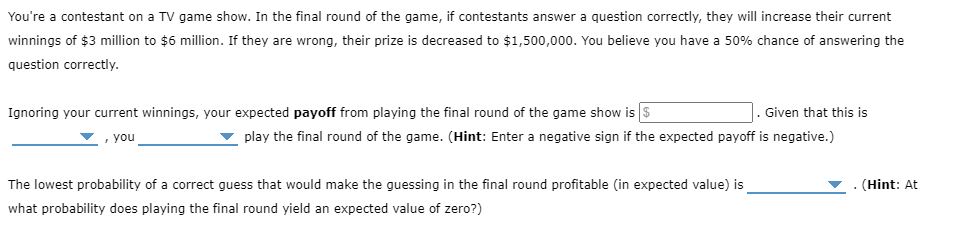
winnings of $ million to $ million. If they are wrong, their prize is decreased to $ You believe you have a chance of answering the
question correctly.
Ignoring your current winnings, your expected payoff from playing the final round of the game show is
Given that this is
you
play the final round of the game. Hint: Enter a negative sign if the expected payoff is negative.
The lowest probability of a correct guess that would make the guessing in the final round profitable in expected value is
Hint: At
what probability does playing the final round yield an expected value of zero? Individual Problems
The HR department is trying to fill a vacant position for a job with a small talent pool. Valid applications arrive every week or so and the applicants all
seem to bring different levels of expertise. For each applicant, the HR manager gathers information by trying to verify various claims on the
candidate's rsum but some doubt about "fit" always lingers when a decision to hire or not is to be made.
Suppose that hiring an employee who is a bad fit for the company results in an error cost of $ but failing to hire a good employee results in an
error cost of $ to the company. Although it is impossible to tell in advance whether an employee is a good fit, assume that the probability that an
applicant is a "good fit" is while the probability that an applicant is a "bad fit" is Hiring an applicant who is a good fit, as well as not
hiring an applicant who is a bad fit, results in no error cost to the company.
For each decision in the following table, calculate and enter the expected error cost of that decision.
Suppose an otherwise qualified applicant applies for a job.
In order to minimize expected error costs, the HR department should
the applicant.
Step by Step Solution
There are 3 Steps involved in it
1 Expert Approved Answer
Step: 1 Unlock

Question Has Been Solved by an Expert!
Get step-by-step solutions from verified subject matter experts
Step: 2 Unlock
Step: 3 Unlock
 Study Help