







Question: 4. Let be an arbitrary alphabet. For every w *, if w = E, {x |cx if w = xc for some x *
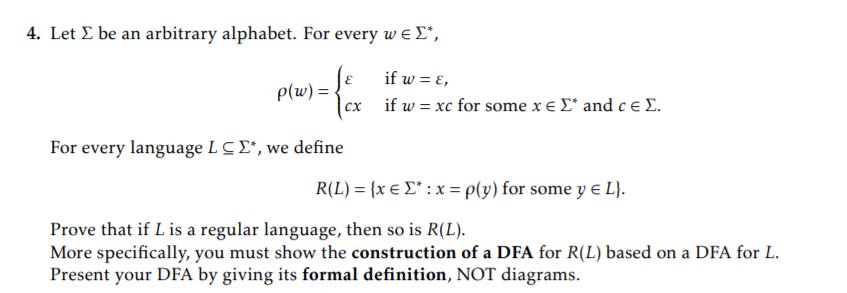
4. Let be an arbitrary alphabet. For every w *, if w = E, {x |cx if w = xc for some x * and c e . For every language L CE*, we define p(w) =. R(L)= {xe E*: x = p(y) for some y = L}. Prove that if L is a regular language, then so is R(L). More specifically, you must show the construction of a DFA for R(L) based on a DFA for L. Present your DFA by giving its formal definition, NOT diagrams. 4. Let be an arbitrary alphabet. For every w E E*, if w = E, {x |cx if w = xc for some x * and c e . p(w) =. For every language L CE*, we define R(L) = (x e E*: x = p(y) for some y L}. Prove that if L is a regular language, then so is R(L). More specifically, you must show the construction of a DFA for R(L) based on a DFA for L. Present your DFA by giving its formal definition, NOT diagrams.
Step by Step Solution
3.28 Rating (145 Votes )
There are 3 Steps involved in it

Get step-by-step solutions from verified subject matter experts
 Study Help